Showing posts with label Indian Nationalist. Show all posts

Saturday, 15 August 2020

Arya Bhashyam, who hoisted Indian Flag at Fort. St. George in 1932

Saluting the forgotten hero Arya Bhashyam, who hoisted Indian Flag at Fort. St. George in 1932


Shri Arya Bhashyam, who hoisted the Indian Tricolour, after removing the Union Jack in 1932 – a rare photo


On 15th August 2016, India celebrated her 70th Independence Day. During the freedom struggle, many patriots had come out and fought against the British Raj, spending the prime of their youth in prisons. These patriots had also contributed to the independence and freedom we now enjoy. Their families suffered. Many of these patriots’ grandchildren lead very simple lives. Sadly, but for a few top national leaders, several thousands of great men and women are not even known to the present generation. 

The media, especially the television channels rarely talk about the freedom struggle and the sufferings of these great men and women who struggled for this freedom. During the Independence Day and Republic Day celebrations, the mainstream freedom fighters are lauded, with no mention about the true UnSung Heroes. Our school text books too recognise only a couple of the leaders of the Independence period. Many citizens across the country prefer to spend these national holidays entertaining themselves. 

Many Indians are under the impression that our National Flag has been flying atop only since 15th August 1947. Very few are aware that on 26th January 1932 at 2 am, someone had dared to bring down the Union Jack and hoist the Indian Tricolour at the prestigious flag post of Fort St. George at Madras. This was by a 25-year-old vibrant youth named Arya K Bhashyam. 

In 1919, as a young 12-year-old student, K Bhashyam (Arya was his pen name) was disturbed to hear about the massacre of hundreds of innocent people at Jallianwala Bagh by General Dyre. He was also inspired by Vanchinathan, who shot and killed Collector Ashe in 1911 and later killed himself at Maniyachi Railway station. Bhashyam purchased four pistols secretly to kill the then Governor of Madras Province and later shoot himself. However, when he stood before the Governor face to face, ready to shoot him, a spark crossed his mind and he resolved not to resort to violence, but follow Mahatma Gandhi. 

Spurred by Lokmanya Bal Gangadhar Tilak's vision of Swaraj, Bhashyam became a firebrand revolutionary and dared several feats protesting against the British colonial rule. He was imprisoned several times and tortured by the police.

The Fort St. George, Madras was built in 1644 by the British rulers as their first fortress in India. In 1687, they erected a 148-foot high flag post made of teakwood to stand as the tallest in the country. The Union Jack used to be hoisted on that flag post everyday. The British considered these two among the most prestigious emotional accomplishments by them.  


Fort St George and the Teakwood Flag Staff (100 years ago)


26th January was considered the Swarajya Day by the Congress leaders then. Bhashyam wanted to hoist the Indian Tricolour on the Flag Post on Swarajya Day in 1932. Two days in advance, he personally made a large tricolour flag, using his dhoti and wrote in Tamil “இன்றிலிருந்து இந்தியா சுதந்திரம் அடைந்தத்து” (“From today India has attained independence”). He tied the tricolour dhoti on his waist to skip the notice of the security personnel. In the early hours of 26th January 1932 at 2 am, he arrived at the flag post. Arya Bhashyam shinned up the 148-foot flag post, removed the Union Jack from the ropes and hoisted the Indian tricolour. The Union Jack was torn into pieces. 

No doubt, seeing the Indian tricolour flying atop the flag post infuriated the British and two days later, they arrested Arya Bhashyam and sentenced him to rigorous imprisonment in the Central Jail. He was treated as a ‘dangerous prisoner’ and kept in quarantine. Netaji Subash Chandra Bose was also brought to the Madras prison during that time. Both Arya Bhasyam and Netaji became close associates.

In an exclusive interview to the All India Radio during 1970s, Arya Bhashyam described the torture he faced with the police in the jail. He said he was given 30 lashes for questioning their atrocities. He continued to shout ‘Vandemataram’ while he was being given the lashes by the police. 

Bhashyam was an artist and sculptor. After independence, he returned to a quiet and simple life. He refused the pension given to freedom fighters. He died in 1999 at the age of 93. It is also reported that he studied at National College, Tiruchi. 

The Indian tricolour was hoisted in all the states, including Delhi on 15th August 1947. But Bhashyam accomplished this, way back in 1932. 

Today, only a few records have registerd his achievements. With great effort, PreSense traced his only available photograph. The teakwood flag post was replaced in 1994 with a steel replica by the State Government. 

In every district of the country, there were thousands of such Arya Bhashyams, who are not known to the present generation. Both the Central and the State Governments should initiate efforts to identify these UnSung warriors and inform about their contributions, for the knowledge of the present generation. PreSense salutes these great men and women, who had contributed to India’s freedom. 

Jai Hind

By Prime Point Srinivasan
Source-http://www.primepointfoundation.in/2018/01/saluting-forgotten-hero-arya-bhashyam.html
(This article was published as cover story in the eMagazine PreSense in August 2016 issue)

Thursday, 10 November 2016

Karnataka government's plan to celebrate 'Tipu Jayanti' equivalent to that of celebrating the anniversary of Aurangzeb

Karnataka govt should not give legitimacy to ‘tyrant’ Tipu Sultan: Mohandas Pai to Firstpost
by Nov 10, 2016
http://www.firstpost.com/india/karnataka-govt-should-not-give-legitimacy-to-tyrant-tipu-sultan-mohandas-pai-to-firstpost-3098080.html


] 

File image of Mohandas Pai. Reuters

The Congress government thinks he's a patriot and is preparing itself to celebrate his Jayanti on 10 November. The department of Kannada and Culture and the state budget has earmarked Rs 60 lakh towards the celebration of Tipu's anniversary. 

Ranged on the other side are the BJP, RSS, minority groups like the Kodavas, Konkanis and Mangalore Christians and some prominent citizens who say that Tipu was a tyrant.

What is interesting to note is that the Karnataka government is going ahead with the celebrations despite stiff opposition and violent protests last year. The Karnataka High Court questioned the state government's logic of celebrating the Tipu Jayanti while hearing a PIL last week. It also observed, "Tipu was not a freedom fighter, but a monarch who fought the opponents to safeguard his interests."

The most vocal person against the celebration of the Tipu Sultan Jayanti has been TV Mohandas Pai. A technology investor, Padma Shri awardee, and the Chairman of the Board of Manipal Global education services, Pai had even likened the celebrations to that of celebrating Aurangzeb's anniversary.

Talking to Firstpost, Pai explained why he is against the celebrations and also why a constitutional government should not play "divisive politics".

Last week, you likened Karnataka government's plan to celebrate 'Tipu Jayanti' to that of celebrating the anniversary of Aurangzeb. Why do you think the state government is so adamant on celebrating Tipu Jayanti despite the protests and the violence last year?

The Congress government in Karnataka is playing communal politics. I have no objection to political parties playing communal politics because that's what all parties do. Everybody plays communal and caste politics. It's become the sign of the day.

However, I have an objection to my legitimately elected government, which has sworn to rule in the name of the Constitution, indulging in communal politics.  


They are honouring a tyrant, a religious bigot, and a killer - his killings, his destruction of temples, his conversion of people to Islam, and his fundamentalist thinking are well known. His call to the Afghans to come and invade India and his desire to establish a Caliphate is documented history.

Some malcontents are spreading rumours that he was secular and a freedom fighter. It's a big joke. There was no India or even the concept of India at that point that we know of today. Tipu was fighting for his kingdom and not for anyone else. And as for him being secular is concerned, he was pushing Islam on people. He was an Islam fundamentalist. Where is secularism? These are all ridiculous statements by people that he fought against the British or that he was a freedom fighter. He only fought for his kingdom and even the High Court has said the same thing. So, what is the difference between Aurangzeb and Tipu - none.

Can you elaborate on your reasons for speaking against Tipu?
There were three minorities who suffered under Tipu and were deeply offended by him. The first were the Kodavas. Tipu invaded Coorg, killed many Kodavas, converted people and spread terror.
Then there were the Mangalore Catholics. Tipu marched against them, took 20,000 of them as prisoners to Srirangapatna and put them in dungeons. Only about 10,000 returned. He also destroyed many churches.

The third are the Konkanis in Manjeswar, Kasargod, and North Karnataka. In the Malabar area, the temples were all destroyed by Tipu and his troops. In the Sultan Battery area as well, he destroyed temples and he killed people.

Now, a government sworn to rule under the Constitution cannot honour a person who killed its state's citizens. This is unconstitutional, unethical and immoral. That's why all of us should oppose this.

The government should not spread lies that he's a freedom fighter or a secular person. The government should not do this. I don't know whether it has already been done or not - but some people are spreading lies and the government should not fall in that trap.

Would you say that Tipu Sultan is best forgotten by history?

No, Tipu Sultan is a part of history just like Aurangzeb. All of us are entitled to know the good things that he did and the bad things as well in a very dispassionate manner. We cannot have hatred for anybody in history because that is all over. But, we should learn lessons from history so that such bad things don't happen again.

You had also said that Kaarnataka should be celebrating other legends from history like Wodeyars, Mysore Dewan Mirza Ismail and Sir Visveswaraya. Is this a flaw in our political system that leaders only pick controversial rulers to celebrate?

If the government wants to celebrate the jayantis of great figures in Karnataka, they should celebrate Sir Mirza Ismail. He was the Dewan of Mysore, a modern person and did many good things for our state.

Let's celebrate the Wodeyars, who were benevolent rulers. The Mysore kingdom was one of the top three kingdoms in India.

We can also celebrate the life of Sir Visveswaraya, who is now forgotten. Visveswaraya is India's greatest engineer. Bharat Ratna - we must celebrate his life, he's a role model for all of us, Tipu is not a role model, but Visveswaraya is.

Would you say this is pure vote bank politics with an eye on the upcoming elections next year?

The government should not indulge in divisive or vote bank politics. Let the political parties party do that. Let Congress do it. Let the BJP do it. These politics are not for constitutional governments. They are sworn to uphold the Constitution, which is sacred for us.

However, opinion is divided over Tipu's role in Indian history. He is also known as a brave warrior. He built the first missile, faced the British rulers and fought for Indian freedom. He laid down his life for India.

Let me explain. It is a fact that Tipu is a brave warrior. But, it is also true that he fought for himself. He did use technology for rockets for the first time in warfare.

Let's also consider the other known facts. Tipu had diplomatic relations with Napoleon. He gave some gold coins to Sringeri temple. But, that was after he lost two wars and wanted the support of the people. These do not take away the fact that he was brutal and a killer. He was also a religious bigot. He did all the wrong things.

It's like Adolf Hitler - he built Germany, gave full employment to people, built the autobahns, invested in technology, but people still don't like him because of the Holocaust, the killings, the mass murders. It's the same thing.

But, Tipu is also known for his work on our famous lung space Lalbagh? We all go to Lalbagh

Look Tipu was known for Lalbagh, but Lalbagh was a royal garden. It was not for you or me. He was a feudal lord and Lalbagh was only for himself.

The British built the residencies and the vice-regal lodges. We took over after India became independent. By this logic, should we also give them credit and say “oh, they did so much for us.”

Do you think, from a larger perspective, the government should be celebrating any jayantis at all?

I don't think the government should celebrate any jayanti and give legitimacy to anybody, specially a historical figure. The government definitely shouldn't do it.

Instead of spending Rs 60 lakhs for the Jayanti, shouldn't the government be spending on education?

The Karnataka state budget is Rs 170,000 crore and of that Rs 60 lakhs doesn't really matter. It's not the money, it's the attitude that matters. They can spend on education or roads, that's not a valid point. My point is a legitimately elected government, sworn under the Constitution, should not do divisive politics in the name of a tyrant and a killer.

So, your message is very simple and clear - no divisive politics, right?

Yes, very simple and clear, it's got nothing else. It's got nothing to do with Muslims or Hindus or anything else for that matter. It's a limited point. It's the constitutional principle.

Living in a liberal democracy, we must insist that the government follows the Constitution. And not play divisive politics. Under the Constitution, every citizen is equal, they must not do anything that divides people. The three minorities of Karnataka are upset, angry and hurt - they're also minorities as much as Muslims are. They also voted the government to power, please understand the context. 

http://www.firstpost.com/india/karnataka-govt-should-not-give-legitimacy-to-tyrant-tipu-sultan-mohandas-pai-to-firstpost-3098080.html 

http://www.coorg.com/kodavas-mysore-sultan-ignorance-ko-channabasappa/

In the early 1730s, after the death of Krishna Raja Wodeyar I, Chama Raja Wodeyar VI came to the throne of Mysore. A few years later Krishna Raja Wodeyar II, a little boy at that time, succeeded him as the Raja of Mysore. Under such circumstances, the one who held the position of the Dalavoy (army general) became the regent and the real power of Mysore in the 1740s. The Wodeyar Raja could not really consolidate his power thereafter. (Wilks 1869: 141-147)

Hyder and Tipu’s recent ancestry was in Persia, only a couple of generations prior to them. Hyder, Tipu’s father, was an ambitious man who like his father, Fateh Muhammed, was a mercenary soldier employed in Mysore. (Bowring 2009: 11,12) Hyder rose through the ranks to become the Dalavoy (General) of Mysore. At that time there was a struggle for power between different regents and ministers. In 1761, Hyder usurped power, declared himself Nawab of Mysore and took control of the Raja’s palace and affairs. He was however not recognised as the ruler of Mysore by the Mughal Emperor at Delhi or by the neighbours of Mysore. The Wodeyar Raja died in 1766 and his successors were kept out of power. Tipu Sultan succeeded Hyder in 1782.

Under the Wodeyar Rajas the state language of Mysore (Karnataka) was Kannada. But under the two Mysore Sultans Persian was made the official language in Mysore. Tipu gave all places Persian names. Mysore was renamed Nazarabad while Madikeri was renamed as Jafarabad and Bhagamandala was called Abjalabad. The two Sultans had an alliance with the French against the British East India Company. It is strange that some writers claim that Tipu Sultan patronised Kannada. (Bowring 2009: 15-92)

Tipu Sultan was known to have persecuted the people to the west of Mysore, the Kodavas of Kodagu, the Roman Catholics of Mangalore, the Nairs and the Moplahs of Malabar and the Brahmins of Malenad and Malabar. He was known to have destroyed temples in Kodagu and in Malabar in the 1780s (before the third Anglo-Mysore War, 1789-1792). On the other hand, he however patronised the temples of Srirangapatna and Sringeri and retained some Hindu ministers in the 1790s (after the third Anglo-Mysore War, in which he was defeated by the British) (Mill and Wilson 1858: 307). Hence to Tipu Sultan, people and temples, seemed to be more of a political value than of any religious value. He must have been a shrewd leader who knew how to gain politically during his times. It is again strange that some writers claim that Tipu was tolerant. Hyder Ali, on the other hand, was known to be more tolerant with the Kodavas, the Mangalore Christians and the others. The Roman Catholics who were imprisoned in Srirangapatna later escaped their confinement and some of them were settled in the town of Virajpet. During the telecast of the Doordarshan TV serial ‘The sword of Tipu Sultan’, there were protests in Kerala where Tipu is still popularly viewed as a tormentor. (Kutty 1993: 56-66).

All known sources, whether Indian (Hindu or Muslim) or English, written during his lifetime and around that period, acknowledge that Tipu did convert Coorgs(Kodavas) into Muslims. The reasons and the statistics given are however various. The number of Kodavas who were converted by Tipu Sultan is disputed, some say it was ‘only’ 500 Kodavas, others (especially according to accounts of the British East India Company) say it was 80,000. The number is not the real issue, even 500 is a large number. There are a number of Kodava Muslims still existing in Kodagu. They still bear the family names that they share with their Hindu ancestors and Kodava Hindu families who were related to them generations ago. (Krishnaiah 1974: 230)


http://www.news18.com/blogs/india/d-p-satish/tipu-sultan-making-a-tiger-out-of-a-tyrant-11027-1162986.html

D P Satish's Blog : Tipu Sultan – Making a 'Tiger' out of a tyrant


I don't believe in any political ideology. I believe in real secularism, not in the pseudo version of it. I have always been criticising the right wing politics being practised by the "Sangh" and their opponents on the other side. Therefore I call myself just "straight". I am neither right, nor left. I am sure both sides attack me if my views are opposed to their views. I am also a student of history, again not a left wing or right wing student. It is my firm belief that Tipu Sultan does not deserve the title "Tiger" of Mysore. Tipu was a religious fanatic. He was a tyrant. During his reign of terror, people of present day South Karnataka, parts of Tamil Nadu, parts of Kerala had to suffer unspeakable misery. The historical documents of those years prove that he was anything but a freedom fighter.

It is true that he fought the British for over 20 years and was finally killed by them in the fourth Anglo-Mysore war of 1799 at his capital Srirangapatna near Mysore. But, he fought the British to save his kingdom like all other big and small kings across the World. It was the norm during those medieval days. The so-called "patriot" Tipu took the help of another foreign coloniser, the French, to oust the British! He had even invited Napoleon to invade India. If the British were foreign invaders, the French were also foreign invaders. Both the British and French wanted to colonise India and rule the natives. Tipu did everything to please the French and was even ready to accept their rule. Just because the French were opposed to the British, he took their help. He was okay with French ruling India. If the French had attacked his kingdom, I am sure, he would have taken the help of the British to save himself.

Even the French who initially helped him to fight the British were horrified by his crimes, mass murders, forced conversion and the methods he adopted to torture the people. Many French Army officers sent to help Tipu refused to fight for him and returned home in disgust.

The Congress government in Karnataka led by Chief Minister Siddaramaiah is doing exactly the same the right wing "Sangh" elements are accused of doing – Polarising the people on religious lines. Tipu was killed 216 years ago. After 216 years, Karnataka government has suddenly woken up and decided to spend government money to celebrate Tipu's Jayanthi. It does mean that Siddaramaiah knows nothing about Tipu. Being a Mysorean himself, the Chief Minister is aware of Tipu's tyranny. But, he wants to make some political gains by dividing the state on communal lines. In a way both Congress and "Sangh" are feeding each other by flaring up the communal tension in the name of Tipu. By organising a state sponsored Tipu Jayanthi, Congress government in the state has insulted the warrior Kodava or Coorg community. Tipu had plundered the small kingdom Kodagu, killed thousands in the most brutal manner and converted several thousand Kodavas to Islam. Even the Christians don't find Tipu a patriot or a good ruler. He had killed tens of thousands of local and foreign Christians destroyed their Churches etc. He did not spare even Christian nuns and priests.

As a senior journalist and himself a Kodava, Gautham Machaiah says Kodavas are not opposing Tipu Jayanthi, because he is a Muslim ruler. They are opposing it because he was a tyrant. The Kodavas would have done the same thing, even if Tipu was a Hindu ruler. Writers like Girish Karnad, who have assumed the role of courtiers of Siddaramaiah are deliberately defending Tipu. After all it suits their brand of secularism. He has also written a play on Tipu and hopes that he can sell a few hundred copies more. Karnad should know that he is not a historian and he should not distort historical facts. The stories of Tipu giving shelter to Shankaracharya of Sringeri, retaining a Hindu Poornaiah as his Diwan etc have been highly exaggerated to make Tipu a 'secular' ruler. People like Karnad are repeating it hundred times.

According to an article appeared in "Outlook" in 2013 titled "The Tyrant Diaries" Tipu was a butcher of the people of Mysore. According to its author Francos Gauitier in December 8, 1988, an old trunk was discovered in the attic of the house of Elaine de la Taille Tretinville, who died at 91 in her 14th arrondissement flat in Paris. She was a descendant of the family of Les Ripaud Montaudeverts. Among the contents was a manuscript in the hand of the most famous of the Montaudeverts—Francois Fidele Ripaud de Montaudevert. It starts with these words (in old French): "I, Francois Ripaud, am old today, but I want to tell you the true story of Tipu Sultan."

Born in Saffre, northwestern France, in a middle-class family, Ripaud enrolled as a sailor, aged 11, on the Le Palmier. After many adventures, he settled in Mauritius, where he married and had two children. In 1797, hearing of Le Grand Tipu Sultan, he sailed from Mauritius (then called Ile de France) to Mangalore and sought a meeting with the sultan, promising "to raise a large force in Mau­ritius and put it at Tipu's disposal". Tipu, who had an early connection with the French, having been instructed in warfare by French officers in the employ of his father, jumped at the idea and gave Ripaud letters of credential. On August 19, 1798, Ripaud came back to Mauritius and made a proclamation seeking volunteers for an "expedition to travel to Mysore to assist Tipu in his resistance to British encroachment in south India". It must be noted that, two months earlier, Napoleon had invaded Egypt and dreamt of establishing a junction with India against the British, so the governor of Mauritius received instructions to collaborate and Ripaud was able to sail to Mangalore with a shipload of French soldiers who were welcomed there like heroes.

Life at Tipu's court was a dream for our hardy adventurer, but he began to have some misgivings. In his diary entry of January 14, 1799, he writes: "I'm disturbed by Tipu Sultan's treatment of these most gentle souls, the Hindus. During the siege of Mangalore, Tipu's soldiers daily exposed the heads of many innocent Brahmins within sight from the fort for the Zamorin and his Hindu followers to see." Even so, he cast his doubts aside and put up for Tipu's benefit a dem­onstration of the egalitarian political ideas of France: in 1799, a French paper entitled 'Proceedings of a Jacobin Club formed at Seringapatnam by the French Soldiers in the Corps Commanded by Francois Ripaud' was found in Tipu's palace. It listed 59 Frenchmen in the pay of "citizen Tipu" and described a "primary assembly" of May 5, 1797, to elect a president (Ripaud) and other office-bearers. The 'Rights of Man' were proclaimed and the sultan formally received a small delegation from the club.

After this interval, we find another diary entry in which Ripaud is appalled at what he witnessed in Calicut (Kozhikode): "Most of the Hindu men and women were hanged...first mothers were hanged with their children tied to their necks. That barbarian Tipu Sultan tied the naked Christians and Hindus to the legs of elephants and made the elephants move around till the bodies of the helpless victims were torn to pieces. Temples and churches were ordered to be burned down, desecrated and des­troyed. Christian and Hindu women were forced to marry Mohammedans, and similarly, their men (after conversion to Islam) were forced to marry Moha­mm­edan women. Christians who refused to be honoured with Islam were ordered to be killed by hanging immediately." These events were corroborated by Father Bartholomew, a famous Portu­guese traveller, in his memoir, Voyage to East Indies.

Another diary entry of Ripaud says: "To show his ardent devotion and steadfast faith in the Mohammedan religion, Tipu Sultan found Kozhikode to be the most suitable place. Kozhikode was then a centre of Brahmins and had over 7,000 Brahmin families living there. Over 2,000 Brahmin families perished as a result of Tipu Sultan's Islamic cruelties. He did not spare even women and children."

A disgusted Ripaud left Seringapatnam and went back to France, where he obtained captainship of a fine fighting ship, the Shapho. On February 23, 1814, fighting an English frigate, Ripaud had his arm ripped off by a cannon ball, claims "Outlook" article.

According to Sandeep Balakrishna, who has written a book "The Tyrant of Mysore" the Siddaramaiah-led Congress government in Karnataka appears to think that the solution to what is being remarked as the party's "existential crisis", is a sharper version of the same, six-plus decades of secularism. He writes that one of the latest manifestations of this sharper secularism is chief minister Siddaramaiah announcing the launch of the Tipu Jayanti celebrations from this year, funded by the taxpayer. Indeed, the chief minister was open about why he was doing this:

"There has been a lot of pressure from various quarters to celebrate Tipu Jayanti. We have decided to take this into consideration and will announce the date shortly," Siddaramaiah had said at the release of a book Tipu Sultan: A Crusader for Change, authored by historian professor B Sheik Ali.

Siddaramaiah had earlier claimed that "Tipu Sultan was a secular ruler. He was a model king in the entire country. A section of people criticise him out of prejudice."

That history writing in India has been the subject of fierce controversy is now an article of faith, especially following Arun Shourie's seminal expose of the Indian history establishment in his Eminent Historians, a classic in its own right. Shourie, among other things, exposed in detail how in both official and dominant history textbooks and narratives at all levels — from school to university to general/popular history — do several things simultaneously as we shall see argues Sandeep Balakrishna.

He says that Tipu Sultan is in many ways the "Aurangzeb of the South". As the author of a book on Tipu Sultan (Tipu Sultan: The Tyrant of Mysore, Rare Publications, Chennai), I am both amused and amazed at the continuing efforts to paint him as a hero, patriot, and freedom fighter.

To be sure, the Tipu myth gained currency after Bhagvan S Gidwani's distorted novel named The Sword of Tipu Sultan, where Tipu is hailed as the "tiger of Mysore" among other things.

It is instructive to examine the assessment of Gidwani's novel by the historian and scholar IM Muthanna in his comprehensive Tipu Sultan X-Rayed published in 1980:

Gidwani's Tipu has a political value today, especially after the Congress government in 1974, perhaps to oblige the Muslim voters, released a commemoration stamp on Tipu, and described him as a "freedom fighter". Releasing a 50-paisa postage stamp commemorating Tipu in July 1974, a minister of Karnataka said that Tipu was "a hero" of Karnataka, "the defender of freedom," and so on. The chariman of the stamp releasing committee wanted the writers to present a true and faithful account of Tipu. Well… Gidwani has obliged him, rather sneakily, and in the form of a novel.

Muthanna was both perceptive and prophetic given how the Tipu myth was since used in the service of vote bank politics. But there was another review of Gidwani's novel predating Muthanna's book by four years. The December 19, 1976 edition of Hindustan Times carried a scathing review of the Sword of Tipu Sultan by MC Gabriel:

The author's effort throughout is to rebuild the past closer to his heart's desire. But anyone will grant that such consideration is extra-historical… it is a pity that… he could not put his material to better purpose than giving us just his private views… To say that Tipu was "the first nationalist", "a believer in communal harmony" and an "apostle of non-violence"… is quite uncalled for.

This detailed look at the Sword of Tipu Sultan was essential because much of the material for Tipu myth-making is derived from this book. In our own times, Girish Karnad's Kannada play, Tipuvina Kanasugalu (The Dreams of Tipu Sultan) borrows approvingly from Gidwani's book.

But what is astonishing is the manner in which this myth has persisted despite the availability of copious amounts of primary sources regarding Tipu Sultan which prove the exact opposite of what Tipu myth-makers claim. These include and are not limited to letters he wrote to various officials in his administration and military, letters he wrote to himself (in the form of a journal/diary) [iii][iii], eyewitness accounts by his contemporaries (Indian, French and British), land and other records. Indeed, we can construct an accurate picture of the life, times, character and legacy of Tipu Sultan using these primary sources even if we don't want to rely on any history textbook about him — both that glorify him or otherwise. And that accurate picture is not pretty laments Sandeep Balakrishna in one of his articles.

According to his book the most charitable description of Tipu Sultan after a survey of these sources is to call him the tyrant of Mysore. His 17-year-long regime was primarily a tenure of military and economic terror as far as Hindus were concerned. He razed entire cities literally to the ground and depopulated them. As representative samples, we can examine his raids in Coorg and the Malabar for the extent and scale of sheer barbarism and large scale destruction.

In 1788, Tipu marched into Coorg and burnt down entire towns and villages. Mir Hussein Kirmani, Tipu's courtier-cum-biographer describes how the raid resulted in the burning down of villages in Kushalapura (today's Kushalnagar), Talakaveri, Madikeri, and other places. Additionally, Tipu in a letter to the Nawab of Kurnool, Runmust Khan describes how he took 40,000 Coorgis as prisoners and forcibly converted them to Islam and "incorporated them with our Ahmadi corps." Already a thinly-populated country, Tipu's brutal raid followed by large-scale prisoner-taking depopulated Coorg of its original inhabitants to a severe extent. To Islamise Coorg, he transported about 7,000 Muslim families belonging to the Shaikh and Sayyid sects to Coorg from elsewhere.

The intensity of Tipu's raid was so terrifying that hundreds of temple priests fled to Mangalore along with their families. Worship came to a permanent halt in several temples. Some temples were covered with leaves in order to conceal their presence. The Maletirike Bhagavati temple at Virajpet is a good example of this. Equally, the renowned Omkareshwara temple in Madikeri was about to meet the same fate — the then ruler at Madikeri panicked at the approach of Tipu, removed its tower and replaced it with a dome so that it looked like a mosque from afar. The temple continues to retain this appearance till date. In his raid of Napoklu near Madikeri, Tipu destroyed the temples in the surrounding villages of Betu and Kolakeri.

Remnants of Tipu Sultan's savage raid of Coorg survive even today — the forcibly converted Coorgis are today known as Kodava Mapilas (Coorg Muslims) whose last/family names are still Hindu — representative examples are surnames like Kuvalera, Italtanda, Mitaltanda, Kuppodanda, Kappanjeera, Kalera, Chekkera, Charmakaranda, Maniyanda, Balasojikaranda, and Mandeyanda.

To the Kodavas, Tipu's fanatical dance of death in their homeland remains a wound that will never heal.

When we turn to the Malabar, the record is equally, if not gorier. Indeed, Tipu's incursions into the Malabar can form the subject of an independent book. Like in Coorg, remnants of Tipu's disastrous campaigns in the Malabar can be seen even today in the region. The city that bore the brunt of his excesses in the Malabar is Kozhikode (Calicut). William Logan's Malabar Manual, the Malabar Gazetter, the Portuguese missionary Fr Bartholomew's Voyage to East Indies, the German missionary Guntest and accounts by various contemporary British military officers contain first-hand accounts of how Tipu razed the city to the ground. An excerpt from Bartholomew provides us a representative glimpse:

First a corps of 30,000 barbarians who butchered everybody on the way… followed by the field-gun unit… Tipu was riding on an elephant behind which another army of 30,000 soldiers followed. Most of the men and women were hanged in Calicut, first mothers were hanged with their children tied to their necks. That barbarian Tipu Sultan tied the naked Christians and Hindus to the legs of elephants and made the elephants move around till the bodies of the helpless victims were torn to pieces. Temples and churches were ordered to be burned down, desecrated and destroyed. Christian and Hindu women were forced to marry Mohammadans and similarly their men were forced to marry Mohammadan women. Those Christians who refused to be honoured with Islam, were ordered to be killed by hanging immediately. These atrocities were told to me by the victims of Tipu Sultan who escaped from the clutches of his army and reached Varappuzha, which is the centre of Carmichael Christian Mission. I myself helped many victims to cross the Varappuzha River by boats.

The devastation in Calicut was so comprehensive that it changed the character of the place forever. Calicut was home to more than 7,000 Brahmin families. Thanks to Tipu, more than 2,000 of these were wiped out, and the remaining fled to the forests. In the words of the German missionary Guntest, "Accompanied by an army of 60,000, Tipu Sultan came to Kozhikode [Calicut] in 1788 and razed it to the ground. It is not possible even to describe the brutalities committed by that Islamic barbarian from Mysore."

He claims that indeed, Tipu made no secret of his hatred for infidels — both Hindu and Christian. After his death in 1799 in the Fourth Anglo-Mysore War and the fall of his capital Srirangapattana to the British, Colonel William Kirkpatrick discovered more than 2000 letters in his palace written in Farsi in Tipu's own handwriting. In these letters, Tipu refers to Hindus as "kaffirs and infidels" and to the British as "Christians" who needed to be "cleansed (or converted) if the rule of Islam is to be firmly established in India."

Just concluded Bihar election has proved that communal politics won't work much. But, I doubt Siddaramaiah type realise that. As I have earlier said Siddaramaiah type and the "Sangh" type feed other. If you have nothing constructive to offer, then be a destructive element. Sadly, the hard realities of our times.

Wednesday, 9 November 2016

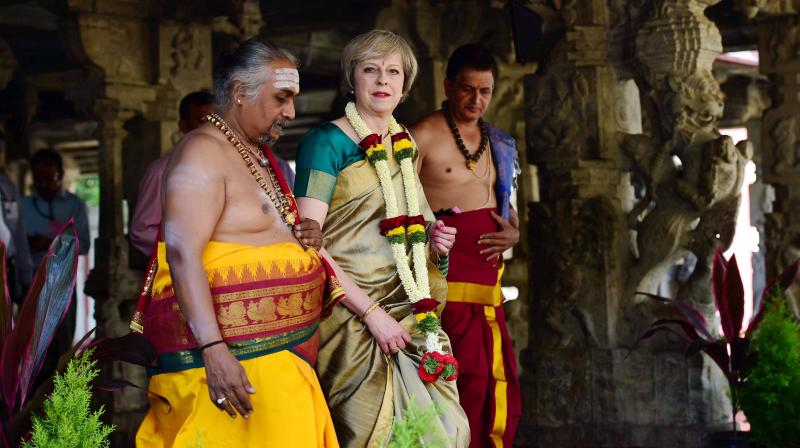
Theresa May, PM of the UK at the Chola era Someshwara Temple at Ulsoor, in Bengaluru

Someshwara Temple, Halasuru, Bangalore
On Tuesday, 8th November 2016, a saree-clad Theresa May, Prime Minister of the United Kingdom visited the Someshwara Temple at Ulsoor, in BengaluruBritish Prime Minister Theresa May, donning a saari, visits the Someshwara temple in Bengaluru on Tuesday. (Photo: PTI)
The Someshwara Temple is one the oldest temples of Bangalore in Karnataka. Built during the Chola period, the Someshwara Temple, Bangalore is one of the most striking examples of ancient Indian architecture.


The village of Halasuru is said to have been gifted to Kempe Gowda I (1513–1569), the founder of Bangalore, by the Vijayanagar emperors. 


The Ulsoor Lake was built by his successor, Kempe Gowda II, and is the only surviving tank built by the Gowda kings in Bangalore. The first British military station was set up in Halasuru in 1807. During the British rule, the name was anglicised to 'Ulsoor'.

The Someshwara Temple, Bangalore is located in Ulsoor and was built by Kempa Gowda. This temple is symbol of the greatness of the Chola kings. The shrine is particularly known for its magnificent architecture. There are a large number of elaborately carved pillars inside the temple premise. The pillars are said to produce the sounds of musical instruments when tapped. You can also take a look at the ancient scriptures inscribed on the walls. Some of the most striking features of the temple include the Rajgopuram or the temple tower and the Dhwajastambha, which is huge pillar placed right in front of the temple.

Someshwara Temple in Bangalore is dedicated to Lord Shiva. The most amazing fact about this temple is that Lord Vishnu and Lord Brahma are also worshipped over here. This huge temple also houses the deities of Kamakshamma, Arunachaleswara, Bhimeswara, Nanjundeswara and Panchalingeswara. Numerous religious festivals are held inn this temple throughout the year. 


Shivaratri Festival is one of the main festivals that is held over here. Large number of devotees come here to pour water on the 'Pancha Lingeswaras' and offer prayers to Lord Shiva. Other festivals that are held in the Someshwara Temple, Bangalore includes the Brahmostsav and the Kamakshamma Pallaki Utsav. During the Kamakshamma Pallaki Utsav, the idol of Goddess Kamakshamma is taken out in procession in a palanquin around the temple. Special rituals and ceremonies are also held over here during Ugadi and Karthik Poornima. Other attractions of the temple include the Ashwattha Katte, a huge banyan tree.

The Someshwara Temple, Bangalore is one of the most beautiful temples of the city. You can come over here and take a look at the amazing sculptures and carvings that beautify this Shiva temple.

Address:
Sri Someshwara Swamy Temple,
Sri Sameshwara Swamy Temple Road,
Ulsoor, Bangalore 560 008.
Landmark: Near Ulsoor Police Station
Phone: 080-25911860
Temple Timings: 6 am to 12 noon and 4 pm to 9 pm.

Article on Sri Someshwara Swamy Temple from
http://www.bangalorebest.com/WondersOfBangalore/Someshwara-Temple-Wonders-of-bangalore.php

Video of UK Prime Minster visiting the
Someshwara Swamy Temple
 https://youtu.be/d0dSKoT_3iE


Monday, 7 November 2016

Hindus Are the Best Educated Religious Group in the U.S.

The most and least educated U.S. religious groups
By Caryle Murphy
http://www.pewresearch.org/fact-tank/2016/11/04/the-most-and-least-educated-u-s-religious-groups/

Attainment of a four-year college degree in the United States, often regarded as a key asset for economic success, varies by race and gender. But the share of people completing a college education also differs by religion, with members of some faith groups much more educated, on average, than others.

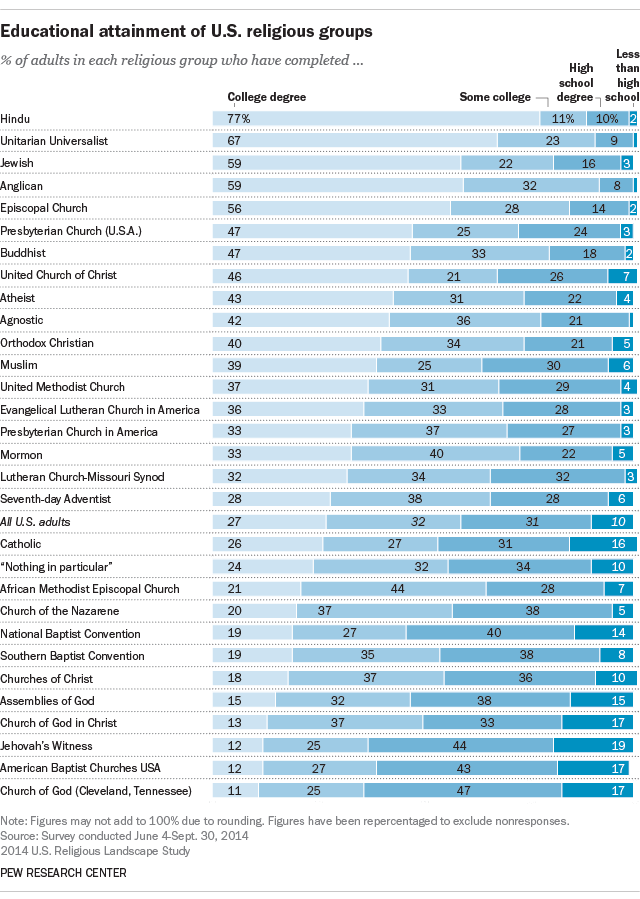
By far, Hindus and Unitarian Universalists have among the largest share of those with a college degree – 77% and 67% respectively. Roughly six-in-ten Jews (59%) have college degrees, as do similar shares in both the Anglican church (59%) and the Episcopal Church (56%).

These groups are among the top of a list of 30 U.S. religious groups ranked by educational attainment based on data from our 2014 Religious Landscape Study.

Given the strong correlation between educational attainment and economic success, it is not surprising that Jews and Hindus, on average, have high household incomes, with four-in-ten Jews (44%) and roughly a third of Hindus (36%) living in households with annual incomes of at least $100,000, according to the 2014 study.

Other religious groups also have a higher percentage of college graduates than the full sample of more than 35,000 U.S. adults surveyed in the 2014 Religious Landscape Study, among whom 27% completed university. They include Buddhists and members of the Presbyterian Church (U.S.A.) – both at 47% – as well as Orthodox Christians (40%), Muslims (39%) and Mormons (33%).

Since Catholics make up one-in-five adults, it is not surprising that their share of members with a college degree (26%) roughly mirrors that of the general public.

One-in-five members of historically black Protestant denominations – the National Baptist Convention (19%) and the African Methodist Episcopal Church (21%) – have a college degree, as do members of the Southern Baptist Convention (19%).

Our study also looked at educational attainment in three categories of religiously unaffiliated people. About four-in-ten atheists (43%) and agnostics (42%) have earned college degrees, as have nearly a quarter (24%) of those who say their religion is “nothing in particular.”

Tuesday, 25 October 2016

Ten Things about BR Ambedkar That You Probably Didn't Know

Ten Things about BR Ambedkar That You Probably Didn't Know 
http://kiranasis.blogspot.in/2015/04/ten-things-about-br-ambedkar-that-you.html


While every political organization lays claim to Dr.Ambedkar, without knowing anything about what he stood for, it is ironical that the BJP under Narendra Modi is not doing enough to align themselves with Dr.Ambedkar. The Modi government is naturally in line with most of what Dr.Ambedkar wanted to do. It is also the only government so far that has real pride in being an Indian and if you read the below article, it will be clear that Dr.Ambedkar would have been proud of India having finally got such a government at the center.Image result for dr.ambedkar
Dr. Bhimrao Ramji Ambedkar is a tall figure of 20th century Indian history. Popularly known as Babasaheb, the details about his careers as a lawyer, politician, constitution framer, social reformer and an economist are well known. He's an inspiration to crores of young Indians today of various classes and ideologies.

But there are ten snippets about this famous man, that are not quite highlighted. Time to take a look at them. I will provide references for each as to where I learned about them, and if any of them need correction or contention, please post comments with authentic references.

1: Dr. Ambedkar stood for Sanskrit as the official language of India.

This is not a well known fact, but it is a fact. In 2005, this was revealed by Chamu Krishna Shastry, a well known Sanskrit proponent in India.

"Dr Ambedkar himself wanted to sponsor Sanskrit as the official language of the Indian union along with his supporters Dr BV Keskar, deputy minister for external affairs, and Naziruddin Ahmed. He moved an amendment draft on September 10, 1949. The resolution had to be withdrawn due to political pressure." Reference: Ambedkar wanted Sanskrit as official language

It is anyone's guess as to who might have exerted " political pressure" on Ambedkar in 1949 to withdraw that historic resolution, which could have changed India in an different direction. Ambedkar's strong support to Sanskrit is something to ponder upon, for those who consider Sanskrit as an "Aryan" language of upper castes, that should not be supported.

2: Ambedkar is actually a Hindu Brahmin surname.


Image from Wiki

Bhimrao's original surname was Ambavadekar. It comes from his family's native village name in Ratnagiri district of Maharashtra, even though he was born in today's Madhya Pradesh region. In Marathi, it is a common practice to add "kar" to the village name as the surname.

In this writeup in the Outlook, Smruti Koppikar describes how his favourite Hindu Brahmin teacher, Mahadev Ambedkar, changed his surname from 'Ambavadekar' to his own surname 'Ambedkar' in the school records. The respect Bhimrao had for his teacher Mahadev, ensured that his borrowed surname continued for rest of his life! It tells us that Bhimrao respected all castes - his fight was against caste discrimination, and not Hinduism or any particular caste.

Reference: Bhimrao Sakpal Ambavadekar became Bhimrao Ambedkar

3. Ambedkar's father was a Vegetarian.

This one really surprised me. In the recent days, whenever there's a protest against ban on cow slaughter, you will invariably see an Ambedkar picture and beef eating "ceremonies".

But after reading Vikram Doctor's blog on the Economic Times, I stumbled upon two surprising details.

"Nor is it correct to equate all upper-castes with vegetarianism and all Dalits with eating meat – Dr.Ambedkar’s father, for example, was vegetarian."
"I’m not sure if Dr.Ambedkar became vegetarian when he converted to Buddhism – Keer’s book doesn’t seem to make this clear and there is a surprising lack of other biographical material." It looks like being a Kabir Panthi, Ambedkar's father Ramji was certainly a vegetarian and teetotaler. It also kind of implies that Babasaheb might have become a vegetarian coming from that family and also a vegetarian during the later part of his life. Something that needs a bit more research. And those who follow Ambedkar's path, this is something critical to ask - why was his father and (likely) himself vegetarian?

Reference: The Dalit Meanings of Food

4. Nehru prevented Ambedkar from entering Lok Sabha. Jan Sangh got him to Rajya Sabha.

Ambedkar contested Lok Sabha election twice. Both times Nehru's Congress made sure that he was defeated. Babasaheb Ambedkar contested from Bombay North in the first Indian General Election in 1952 but lost to the Congress candidates Narayan Kajrolkar, who had been his assistant once. He tried to enter Lok Sabha again in 1954 when he contested the by-election from Bhandara but he was placed third in the ballot won by Congress.

"In 1952, the Congress defeated Ambedkar in the parliamentary seat of Dadar in Bombay. It is strange that Jawaharlal Nehru did the sin of campaigning against Ambedkar during the elections.” 


"The reason behind this was the Congress mentality of devaluing him. Later, the role played by Jan Sangh in getting him elected for Rajya Sabha from West Bengal is not hidden from anybody,” - Arvind Menon, BJP. So much for "love" of Ambedkar by Congress party.

Reference: Babasaheb was close to Jan Sangh, says BJP

Edit on 17th August 2016 - The reported claim by BJP above (see reference) was challenged by many people. Some are giving credit to Muslim League and JN Mandal of Bengal too. But the common theme is still that Congress did not help Dr. Ambedkar, but others did.

5. Bhimrao's second wife was a Hindu Brahmin.

Ambedkar met Dr. Sharada Kabir, a Saraswat Brahmin, when he needed medical treatment in the late 1940s. He married her on 15 April 1948, at his home in New Delhi. His first wife had passed away a decade ago. Doctors recommended that he needed a companion who was both a good cook and a possessor of medical knowledge and could thus take care of him. She adopted the name Savita Ambedkar and took care of him for the rest of his life.


Pic: photobucket
It is unfortunate that any political or NGO conversations regarding Ambedkar quickly turn into anti-Brahmin mode, when his borrowed surname is that of a Brahmin and his wife who served him during most needy years, was a Brahmin woman.

6. Ambedkar was not against Hindutva or RSS.

Ambedkar actually claimed Hindutva for the Dalits (untouchables or depressed classes) in 1927.

"Hindutva belongs as much to untouchable Hindus as to the touchable Hindus. The temples must be open for all. Efforts were made for the growth of Hindutva by Brahmins like Vasishta, Kshatriyas like Krishna, Vaishyas like Harsha and Shudras like Tukaram. The same amount of efforts for Hindutva were pitched in by untouchables (Dalits) like Valmiki (of Ramayana), Drishthara of Vyadha Gita, Chhokamela and Rohidasa. We have brave Sidnak Mahar kind of untouchable who fought for protection of Hindutva. Both touchable and untouchable Hindus have served the Hindu temples built in the names of Hindutva. So everyone has the right to enter them."


He also also praised Hindutva ideologue Veer Savarkar's efforts to eradicate caste discrimination in his Janata paper in 1933.

"Savarkar's efforts to uplift Dalits are as noble and effective as Gautama Buddha's" Ambedkar even visited RSS camp and praised them.

"Ever conscious of Hindu movements supporting Sanghatan – social solidarity, Dr.Ambedkar visited RSS camp in Pune in May 1939. He expressed his satisfaction: “I am surprised to find Swayamsevaks here moving about in absolute equality and brotherhood without even caring to know the castes of others." References:

Essays on Dalits book by Raj Kumar, page 72.
Kannada Prabha 14-Apr-2015 page 7, by Tejasvi Surya. Need to save Ambedkar from pseudos
Bodhi Sattva’s Hindutva: Part 4 by Aravindan Neelakandan. 7. Ambedkar's strong views on Muslim society's evils, Christianity and Partition of India.

When some Dalit youth were supporting the anti-India Razakars of Hyderabad after independence, Ambedkar told them not to take that path:


"Hyderabad state's scheduled castes must not support the Nizam or Ittehad-ul-Muslimeen under any circumstance. No scheduled caste member should join hands with anti India forces, bringing disrepute to their castes"

If you read Ambedkar's book, chapter 10, you would start seeing his absolutely rational arguments condemning the evils of Muslim society in pre-partitioned India.


Read chapter 10 for instance which has a sub title ;- Muslim Society is even more full of social evils than Hindu Society is.

"the Muslim woman is the most helpless person in the world."
"No words can adequately express the great and many evils of polygamy and concubinage, and especially as a source of misery to a Muslim woman. It is true that because polygamy and concubinage are sanctioned, one must not suppose they are indulged in by the generality of Muslims; still the fact remains that they are privileges which are easy for a Muslim to abuse to the misery and unhappiness of his wife."
"Take the caste system. Islam speaks of brotherhood. Everybody infers that Islam must be free from slavery and caste. Regarding slavery nothing needs to be said. It stands abolished now by law. But while it existed, much of its support was derived from Islam and Islamic countries.While the prescriptions by the Prophet regarding the just and humane treatment of slaves contained in the Koran are praiseworthy, there is nothing whatever in Islam that lends support to the abolition of this curse..... But if slavery has gone, caste among Musalmans has remained. As an illustration one may take the conditions prevalent among the Bengal Muslims."
"There can thus be no manner of doubt that the Muslim Society in India is afflicted by the same social evils as afflict the Hindu Society. Indeed, the Muslims have all the social evils of the Hindus and something more. That something more is the compulsory system of purdah for Muslim women." Regarding Pakistan, if you read the Chapter 14 of the same book, you can clearly see that he wanted transfer of Muslims to Pakistan (east and West) with non Muslims back to India from there.

What about its workability? The scheme is not new. It has been tried and found workable. It was put into effect after the last European War, to bring about a transfer of population between Greece and Bulgaria and Turkey and Greece. Nobody can deny that it has worked, has been tried and found workable. The scheme I have outlined is a copy of the same scheme. It had the effect of bringing about a transfer of population between Greece and Bulgaria and Turkey and Greece. Nobody can deny that it was [=has] worked with signal success. What succeeded elsewhere may well be expected to succeed in India. The most recent Organiser special edition on Ambedkar notes his view about Christianity and Islam, and conversion in general:

Ambedkar was against Dalits converting to Christianity or Islam because he believed that “if the numbers of Muslims and Christians rise and it will cause danger to India.” References:

Kannada Prabha 14-Apr-2015 page 7, by Tejasvi Surya. Need to save Ambedkar from pseudos
Book: Pakistan or the Partition of India by BR Ambedkar - Chapter 10 and Chapter 14.
Ambedkar a pioneer like Savarkar, Malviya: RSS. 8. Ambedkar's openly opposed Article 370 of Nehru's Congress, for Jammu and Kashmir.

Ambedkar opposed Article 370 in the Constitution, which gives a special status to the State of Jammu and Kashmir, and it was put against his wishes. Balraj Madhok reportedly said, Ambedkar had clearly told Sheikh Abdullah:-

"You wish India should protect your borders, she should build roads in your area, she should supply you food grains, and Kashmir should get equal status as India. But Government of India should have only limited powers and Indian people should have no rights in Kashmir. To give consent to this proposal, would be a treacherous thing against the interests of India and I, as the Law Minister of India, will never do it." Reference: Kashmir problem from Ambedkarite Perspective, by K Jamanadas.

9. Ambedkar was a confirmed enemy of Communists, in his own words!

Read this excerpt from a book on India.

In another context, presiding over a District conference of the Depressed Classes at Masur in September 1937, Ambedkar declared that he was a confirmed enemy of the Communists who exploited the labourers for their political ends, and there was no possibility of joining them. Reference: Book Perfidies of Power: India in the New Millennium, by P Radhakrishnan, page 54.

10. Ambedkar warned India against China's aggression on Tibet and beyond.

The Time issue dated October 22, 1951, noted:

“Ambedkar is the first important Indian official who has openly attacked Nehru for being too friendly to China and not friendly enough to the US”. On China he disagreed with the Tibet policy and the enunciation of Panchsheel. He said:-

“If Mao had any faith in the Panchsheel, he certainly would treat the Buddhist in his own country in a very different way. There is no room for Panchsheel in politics”.
Reference: Ambedkar’s views on foreign policy, by Harish Parvathaneni

Hope you gained some insight after reading these today. Anything else you want to share in comments?

Thursday, 21 July 2016

Gen. Malik, Please tell the nation what Barkha did at Kargil

Gen. Malik, Please tell the nation what Barkha did at Kargil 


Jay Bhattacharjee writes an open letter to former Army chief General Malik who led the army in 1999 during the Kargil war. Read on…

General V.P. Malik (Retd.)PVSM, AVSM, ADCFormer Chief of Army StaffPanchkula (Haryana)
Dear General Malik : 23 February 2016

Sir, please allow me to state upfront, that I have been (and will continue to be) one of your admirers for a number of reasons. 

The first one, of course, is that, from Sept.1997 to Sept.2000, you commanded a 1.4 million strong Army that has protected and guarded our young Republic (which is, at the same time, an ancient and venerable civilisation) with the utmost commitment, valour and loyalty. 

For almost the entire Indian population (barring a minuscule minority), the nation’s armed forces are the most admired and venerated institution by a thousand miles (please pardon the hyperbole). No other institution comes anywhere remotely close, in this contest.

The other reasons are personal. You have a natural dignity, composure sang froid, and articulateness that are exemplary. Truly befitting a military leader. Then, of course, it is a matter of record that you led the Army to resounding victory (at an incredible cost) in a war that had everything stacked against it. This does not take away the magnificent contribution of our air warriors, the men in blue, who carried out very difficult operations to support their OG comrades. Your famous statement that the armed forces would do their best with whatever equipment and resources they had at their disposal, is still etched in my mind and brings back painful memories when I think of the Kargil war.

However, the reason why I am penning this letter to you is because of certain developments that are not of your doing. The provocation is the “open” letter sent a few days ago by a prominent Indian journalist, Barkha Dutt, to the Prime Minister. The communication has been uploaded on the internet portal of the media house where Ms. Dutt works (http://www.ndtv.com/opinion/a-letter-to-pm-modi-from-anti-national-sickular-presstitute-barkha-dutt-1279441).

As you can see, the title of this article is deliberately provocative and eye-catching. Nothing wrong in this, per se, since the media in our shores and in other countries derives its bread and butter from self-generated publicity,whether in the form of TRPs for TV programmes or the number of “likes” / “shares” for a written piece. 

However, the latest salvo of Ms. Dutt (BD) needs to be closely scrutinised and assessed. Please permit me, dear General, to spell out the broader concerns I have with this piece, before I come to the thrust of my letter to you.

It is a matter of enormous mystery to me (and countless others) how BD and her employer company have survived, let alone prospered. If you remember, and I am sure you do, the episode of the Nira Radia tapes and how BD and her shenanigans were mercilessly exposed, you will surely ask yourself how this person continues in public life. 

In any other civilized, democratic country, she would have been hung out to dry and banished to the 4th Estate’s version of Siberia, to live in oblivion. In fact, BD’s shameless shenanigans were briefly featured in a crudely-crafted “apology” on her own channel and she was seamlessly “rehabilitated” in her job, where she continues till today. 

If anything, she has prospered and flourished, and her amour-propre has gone up in geometric progression. It is only in good old Bharat (and in some tin-pot banana Republics like North Korea, Haiti and some Islamic dictatorships) that miracles like this happen.

The present essay by BD fits squarely in her trademark mould. Using all the tricks that her profession has taught her, she projects herself as a fearless defender of civil rights, free speech, right to dissent etc. 

The backdrop for her article is the JNU saga and all its nuances. I am not going into the intricacies of her piece in this letter to you, since I believe the prime Minister and his colleagues are quite capable of rebutting BD’s disingenuousness and intellectual sleights of hand. Because, I now propose to come to the reason why I am writing to you and why I need you to respond. Mea culpa for the rather longish preface, but I am sure you will pardon me.

What bothers me deeply is that, in this latest brouhaha, BD, once again, has projected her “veer senani” image of a fearless warrior and admirer of the country’s armed forces. Her purple prose would have you believe that her Kargil experience in 1999 “and the intimacy and immediacy of that overwhelming exposure would make me a life-long admirer of our military. “ 

In fact, BD gives the distinct impression in her epistle to the PM that she layed a vital role in the entire Kargil war. She compounds her crime when she extols herself in her latest book, This Unquiet Land – Stories From India’s Fault Lines (2016) and involves you directly. She, as is her wont, goes on the attack fearlessly and takes the figurative bull by the horns. This is where you come in directly, dear General.
BD, on page iv of this book, refers to the “venomous whispers” about her conduct when she was covering the Kargil war and claims that when you gave her an appointment after the war, you complimented her about her performance and even said that she (BD) was a “force-multiplier”. 

As far as her use of a satellite phone (an Iridium instrument) was concerned, she quotes you as telling her that others (including some persons in the Army) had the same satellite phones and more importantly, the Pakistani military did not have the capability of monitoring these satellite phones. She puts you in the centre podium by claiming that you have confirmed this conversation with her in your own memoirs of the Kargil war.

This puts the whole thing in a new perspective. The fact is that all sources verify that BD was the only journalist in the war zone who had a satellite phone. Also, the number of satellite phones with the Indian army was limited to a few senior-most officers who were not in the conflict zone. 

Therefore, the chances of BD’s satphone being the one tracked by the Pakistanis are very high. The errors of commission and omission, of which BD is accused of, are extremely serious. 

After the Dy. Brigade Commander at Drass, Colonel David, briefed BD on the progress of the actual assault on Tiger Hill, BD is reported to have gone live immediately. Indian intercepts of Pakistani military messages indicate that the Pakistani rear commanders immediately alerted their troops on top of Tiger Hill to redirect their fire in the direction of the Indian soldiers who were climbing Tiger Hill. About 14-20 of our soldiers were massacred by this deadly fire and died on the ropes they were using to climb their target.

There is another incident pertaining to BD that has been talked about for years. When doing a recording outside the Brigade HQ gate, her cameraman switched on a light fitted on the camera to illuminate her – helmet, mike and all. This was the trademark image of BD that she and her employers mercilessly capitalised on for many years after the war.

A few seconds later, having said that she was reporting from 56 Brigade HQ, BD and her team moved out. After about five minutes or so, Pakistani artillery saturated the area with a barrage, after having got a fix on the light. A small STD booth at the gate took a direct hit, killing an officer and three jawans from 17 Garhwal Rifles, who were present there at the time.

I am reproducing all the old reports, because they have not been satisfactorily explained. Neither have they been investigated with the seriousness and rigour that were called for. 

As a result, BD has got away scot free and, worse, projected herself in a light that may not be accurate at all. Do not forget, General, that the Kargil war was her launch pad. And I am afraid, you have not been altogether kosher with the Indian public, your comrades in the army and your conscience. You have not seriously investigated the reported offences and misdemeanours of BD. 

To start with, when on the 6th July 1999, our Army intercepted the conversations between Pakistani troops dug in at Tiger Hill and their rear HQ, you were furious with NDTV and BD. You immediately directed XV Corps HQ to issue a signal asking the entire press corps to leave the region.

As it transpired, this blanket order was quietly withdrawn a few hours later because of Lt General Arjun Ray (in charge of the Army’s media cell) who persuaded you not to penalise the entire press corps because of BD’s crime. You and the Army took no action against BD. 

A year after the war, when NDTV went into overdrive about their Kargil coverage, you and the Army again kept quiet. This omerta continues till today, even when BD refers to your accolades about her in her latest (2016) book. 

You, clearly are not the only one responsible for the relentless rise of BD. Your Army comrade Mohinder Puri, too, did not hesitate to seek encomiums from BD at his book release function. Neither can Shiv Kunal Verma, from an old military family, resist the temptation to have BD as one of the chief invitees at his book launch.

Dear General, as an officer of the Sikh Light Infantry, you are surely aware of Guru Gobind Singh’s prayer to Lord Shiv when he seeks the courage to do the right thing :
Dehi Shiva Bar Mohe Ihe, Shubh Karman Se Kabhun Na Taron.Na Daron Ari Son Jab Jai Laron,Nischey Kar Apni Jeet Karon.(O God Shiva, give me this boon,That I never desist from doing good deedsI be fearless when I fight the enemyAnd that I certainly attain victory)

As a son-in-law of the Punjab, it is my honour to invoke Guru Gobind Singh. But, finally, I have to conclude with Gurudev’s words, since BD has had the chutzpah to quote Tagore in her letter to the PM. The last Renaissance figure the world has seen, says it all about doing the right thing in life :

অন্যায় যে করে আর অন্যায় যে সহে
তব ঘৃণা যেন তারে তৃণসম দহে।
(The one who commits a wrong and the one who tolerates wrong- doing, may they both be engulfed by the fire of your contempt)
Jay Bhattacharjee MA(Cantab), FCSAdvisor (Corporate Laws & Finance)
https://www.saddahaq.com/gen-malik-please-tell-the-nation-what-barkha-did-at-kargil-jay-bhattacharjee