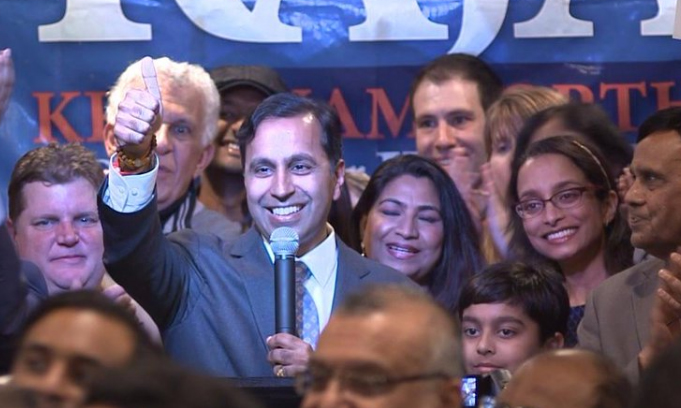
Avinash Iragavarapu: The Indian who helped Donald Trump win Arizona http://www.business-standard.com/article/international/avinash-iragavarapu-the-indian-who-helped-donald-trump-win-arizona-116111000492_1.html BS Web Team | New Delhi November 10, 2016 Last Updated at 13:04 IST
 Donald Trump successfully won the state of Arizona and the 47 delegates that come with it.

Avinash Iragavarapu, an MBA graduate from Indian Institute of Management, Lucknow, helped Donald Trump to win the US Presidential elections. Political campaigning is his natural forte. He joined the YSR Congress’s election campaign in Andhra Pradesh after quitting his job with HCL Technologies Ltd in New Delhi.
His keen interest in politics could not keep him away from it even in the US. Avinash's wife works for Intel in Arizona. He went to join her for holidays in 2014, and it was then where it all began.
Arizona was going for polls to elect its governor. Avinash did his own research and polls chose Doug Ducey as his candidate for the primary and wrote to his campaign.
Ducey's campaign made Avinash a part of itself and he used to do a lot of “data work and polling”, primarily identifying the areas where they could spend the money they raised to gain votes.
Arizona traditionally is a Republican leaning state. Ducey went on to win the primaries, and even the Arizona Gubernatorial election in November 2014, defeating Fred DuVal comfortably. Avinash’s data work was well praised by the Arizona GOP chairman Robert Graham.
With his astounding performance, he went on to achieve heights within the Arizona GOP. He was promoted to political director and then to executive director within a span of a year. This portfolio put him in charge of all the elections for Arizona, including the general elections.
Avinash was tasked to help Donald Trump win Arizona, a state that has been a Republican stronghold since George Bush won it in 2000.
Donald Trump successfully won the state of Arizona and the 47 delegates that come with it.
“I have met Donald Trump personally. He knows I am from India. He’s a totally fine person, and he’s embraced me with open arms. He has only spoken out against illegal immigration,” says Avinash.
https://youtu.be/WDNb3oihLMc
Avinash Iragavarapu - The Indian who helped Trump win !
New Delhi: Chandler, Arizona seems a long, long way from Kovur in Andhra Pradesh’s West Godavari district.
Two years ago, it was in Kovur where Avinash Iragavarapu, an MBA graduate from Indian Institute of Management, Lucknow, joined the YSR Congress’s election campaign in Andhra Pradesh after quitting his job with HCL Technologies Ltd in New Delhi.
Political campaigning and strategy, in many ways, were his natural calling. In his college years, Iragavarapu would begin with “the basic” distribution of pamphlets and knocking on doors to enrol volunteers. It was hard, at times painstaking work, but one that he hoped would ultimately pay off.
It did. Last week, Iragavarapu was at the Republican National Convention in Cleveland, Ohio. You read that right. The same convention where Melania Trump read out a speech in which a portion was plagiarised from a 2008 Michelle Obama speech, or where Ted Cruz urged Republicans to vote their conscience, and the same convention where Donald Trump was officially nominated the Republican Party’s candidate for the upcoming presidential election.
Iragavarapu isn’t your quintessential Trump supporter, in fact, far from it. Nor is he a donor to Trump’s super-PACs (political action committees). Heck, he can’t even vote in the US election. But he, like several million Americans, wanted to help Donald Trump “Make America Great Again”.
He made his way to the convention as a member of the Republican Party’s delegation from Arizona, a key state in America’s “Mountain West”. He was, after all, the executive director of the Arizona Republican Party, a post he has held since last year.
But how did a 30-year-old electrical engineer-turned-entrepreneur-turned political communicator from Rajahmundry in Andhra Pradesh’s East Godavari district end up with the Republican Party in the first place? This is his story.
“My wife works for Intel and was based out of its Chandler campus in Arizona,” Iragavarapu said over the phone. “In 2014, after the general elections in India, I decided to join her for a holiday. I spotted a road sign near our home, which said that the Chandler City Council was going to polls soon. I thought to myself, “Why don’t I give it a shot?”, and around the same time, Arizona was also due to elect its governor, a much bigger race. I sat down, analysed old election data of all the counties, did my own polling. I chose Doug Ducey as my candidate for the primary and wrote to his campaign.”
Initially, Ducey’s campaign did not take Iragavarapu seriously. But after a flurry of calls, tweets and emails to those in charge of his campaign, they got back to him with a simple “Let’s meet!” phone call.
His work, as part of the Ducey campaign, included a lot of what he calls “data work and polling”, often identifying key areas where the campaign could effectively spend the money it raised. Arizona, for the record, is what is popularly referred to as a ‘Red State’, which in American political parlance means, a traditionally Republican leaning state. “We had a 7-point advantage over the Democrats, which means, for every 100 registered voters, we had 36, and they had 29. We used this to our advantage,” he says.
Ducey would go on to win the primaries, and even the Arizona Gubernatorial election in November 2014, defeating Fred DuVal comfortably. Thanks to his role in Ducey’s success, Iragavarapu’s data work would come for praise from the Arizona GOP chairman Robert Graham, who as per news reports is also in contention to replace GOP chairman Reince Priebus in January next year.
Iragavarapu’s rise within the Arizona GOP was a meteoric one. From being hired as the party’s data director, he was soon elevated to the ‘political director’ and later as executive director, all within a span of a year. The post puts him directly in charge of running the party’s campaigns in Arizona, across all its levels, including the general elections, congressional elections, senate races and even councils.
‘Making America Great Again’
Iragavarapu, as part of the presidential elections, is now tasked with helping Trump carry Arizona, a state the Republicans have held since George W Bush wrested it in 2000. “There’s a lot of enthusiasm for Trump in Arizona,” he says. “During the primaries, we registered around 50,000 new people to vote for Donald Trump.” Trump went on to win the Arizona primaries, with 47 delegates and 47.1% of the votes.
Iragavarapu’s story is rather interesting, especially given his background as an immigrant, a word that has dominated Trump’s approach to making America great again. “I have met him personally. He knows I am from India. He’s a totally fine person, and he’s embraced me with open arms. He has only spoken out against illegal immigration.”
The US presidential election has come to an end and Donald Trump is all set to be POTUS 45. In the thick of the action in Arizona, a state which voted for the tycoon, campaign strategist and the executive director of the Arizona Republican party, Avinash Iragavarapu, is ecstatic.
Mr Iragavarapu, originally from Rajahmundry, has called it a big win for Donald Trump. “Mr Trump is happy and very excited. He knows there is a lot of work to be done and promises to be fulfilled,” he says.
“People were celebrating the win. It is definitely a big victory. In the last couple of months, there were a few videos that had come out, with various allegations against Mr Trump. And because of those allegations we weren’t expecting a win but all the way, we knew that we were doing the right things. We were outspent by Hillary Clinton’s campaign by 2:1 — for every $2 they spent, we spent a dollar.”
The strategist also explained the forces behind the Trump victory. “There are multiple reasons behind his win. One: people were tired of the Democratic Party. They saw Ms Clinton as just an extension of Barack Obama, which they didn’t like. “Ms Clinton’s campaign always came across as overconfident. We focused on the voter group, kept microtargeting,” he said.
Many Indians backed Trump, says Avinash
Campaign strategist and the executive director of the Arizona Republican party Avinash Iragavarapu is ecstatic over Donald Trump’s win over Hillary Clinton.
“When surveys showed Ms Clinton was leading, we redirected our resources. All the while, we were very agile. We had a last-minute action plan ready for various scenarios.”
“Especially in my state (Arizona), there are not many Indian-American votes. However, in other states such as New Jersey there were quite a few Indian-Americans who backed Mr Trump.”