
NFC early mover Yeldi, the queue buster
By Anusha Ashwin
http://www.voicendata.com/queue-buster-yeldi/
Can an ordeal on a boat ride in the Island of Maldives pave way for the origin of a digital wallet company? Yes! It can. Way back in early 2008, Ra Arjunamurthy the Founder of Yeldi Softcom, was holidaying in Maldives when he encountered an ordeal in paying cash to the boatman for a ride in the middle of the sea. A born-entrepreneur, Arjunamurthy, then had a sudden brainwave about using Near Field Communication (NFC) technology to create products in cashless transaction and digital payment space. He believed that the NFC technology could bring a revolution in the cashless payment ecosystem.
Chennai-based Yeldi has now emerged as a company that is actively engaged in research, products and end-to-end services based on NFC technology. The company is co-founded by Arjunamurthy’s daughter Lakshmi Deepa, who is a rare woman entrepreneur in the digital wallet space.
In 2009, the breakthrough was quite naturally set for Arjunamurthy, as that was the time when Android-based smartphones were progressively developed and as he worked on the prototype for an NFC Device and a digital payment card, Google, in 2011, launched ‘Google Wallet’, which validated that his research and product development were on the right track. Google Wallet is a peer-to-peer payments service developed by Google that allows people to send and receive money from a mobile device.
Queue Buster Product Strategy
Talking about the genesis of Yeldi, Founder Arjunamurthy says, “I wanted to create a product using NFC technology which would disrupt the market and as a seasoned telecom entrepreneur my experience indicated that the best bet was to target the cash market. With the line slowly blurring between offline and online world, there was a need to create cashless transactions for enhanced customer experience. I wanted to hit cash transactions at a level for people in the bottom of the pyramid as well as the top. That is the area where real financial inclusions take place. Also, I just did not want to create an NFC-based product but also wanted to be a value-added-service company catering to the needs of the customer from start to end in cashless transactions.”
While product development started in 2008, Yeldi’s business launch took place only in 2012 and commercial operations, in fact, started in mid-2015. In the interim period, Yeldi’s core product development team consulted various technology experts based out of US, UK, France and China. Yeldi developed its core NFC technology in collaboration with NXP Semiconductors. In 2009, the company was registered; 2010 to 2012 were the formative years for the company, where considerable investment was made in R&D. Arjunamurthy collaborated with NXP for the highly-secured chips and also identified a Chinese manufacturer for the NFC-based handset.
“My vision was to create a product that caters to every cashless petty transaction like the day-to-daykirana shop. Just imagine a housekeeper or maid using a pre-paid card to make a small transaction for purchase of groceries. You just need to top-up the card with money and the transaction details are sent through an SMS to your handheld Yeldi device. Similarly, I found a significant need for cashless payments in every vertical. Be it at restaurants, gas stations, healthcare centers, booking tickets and many more. If there is a queue for any service, my product should be that queue buster there,” says Arjunamurthy.
Catering to both B2B as well as B2C verticals, Yeldi’s products have found success in varied verticals like healthcare, hospitality, multiplex, airlines, corporate establishments and banks. Yeldi caters not only to the Indian markets but also overseas markets. A brief explanation of Yeldi’s products and services are listed below:
Yeldi’s Handset: Yeldi’s NFC-enabled handset has all the features of a latest Android smartphone. Besides the obvious functionality as a 3G/4G smartphone, it works as a secure mobile Point-of-Sale Terminal. In its functionality as a POS terminal, Yeldi’s handset will interact only with Yeldi’s own tags, ensuring utmost security. Currently, there are two models priced approximately at Rs 8,500 and Rs 12,000 respectively.
iTapIt: The National Development Bank Plc (NDBP) in Sri Lanka has launched a pre-paid wallet cum debit card, iTapIt, for use among its customers, malls, restaurants, tea plantations and at schools with the technology being provided by Yeldi. Sri Lanka’s tea and rubber plantation workers use this card to mark their attendance, record the number of hours worked and even collect wages through a simple tap.
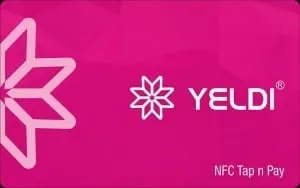
Meal Card: National carrier Air India has implemented Yeldi’s pre-paid cards for micro-payments at its Chennai and Hyderabad IRCTC-run canteens. Some 3,000 ground staff employees have subsidized meals at these canteens. This is Yeldi’s first venture in offline transaction and in a closed group format. With Yeldi’s pre-paid card wallet, Air India employees just flash their NFC-enabled cards at Yeldi’s NFC-enabled smartphone that acts as a payment receiver to make payments for their coffee or lunch. The canteen management certainly rate Yeldi’s technology as advantageous as it busts the queue and is more secure and the hassle behind handling cash and tendering change has been eliminated. The queue gets cleared within minutes and it avoids the cumbersome transaction of small payments.
Laundromat Card: Upmarket Delhi-based Laundromat Gaurdini, which caters to a host of politicians, celebrities and industrialists, now accepts Yeldi cards for payments. Explaining in detail, Arjunamurthy says, “Usually such high profile people do not pick their clothes from Laundromats on their own. A chauffeur or a maid is assigned this work, and they might not necessarily have the knowledge to operate a debit or a credit card. This is where Yeldi plays a role. The Gaurdini laundry card owner can pre-load a fixed amount between Rs 1,000-2,000 onto the card. And anyone with the card can make payments by flashing it near the Yeldi device and the bill amount is automatically deducted from the card.”
Hospitality Card: High-end condominiums like Bounce Back and Nirvana are one of Yeldi’s clients in the hospitality sector. Yeldi’s cards act as a pre-paid card for residents at every point as an access card like at the gymnasium, club house and other in-house facilities.
Ara eTap: This was launched in 2012. Ara eTap is an NFC sticker-based mobile payments service. Consumers who sign up for the service will be provided with an NFC sticker or a tag to attach to their mobile phones. The customer can buy an ara eTap, which is a tag, use the secret PIN given to him/her and can transact across all major product and service outlets.
Merchant Business Boosters: This is best suited for owners of portable restaurants, small (Kirana) shops, retail chains or an e-commerce online portal. When a merchant purchases Yeldi’s handset, he is given 500 Yeldi’s digital wallet cards. A tap-and-pay feature allows the merchant’s customers to pay for the transaction, which can be mobile recharge, payment of bills, and booking movie tickets among others.
Yeldi’s Mobile App: The mobile app is inbuilt and can be customized for every customer. The app will allow customers to place orders or schedule appointments, check the latest offers, view past transactions, etc.
Ambitious Roadmap
With a strong belief that his products have the potential to disrupt the digital wallet market and the potential to replace credit cards, Arjunamurthy spells out his plans for the future. He says, “Being at the cusp of digital wallet innovation, scaling up will be a natural phenomenon for Yeldi. Our products have been widely accepted nationally and internationally. In the coming years, Yeldi will foray into Qatar, Philippines, Bangladesh and Malaysia. By the end of 2016, Yeldi will tie-up with 16 national and international banks to launch a service similar to Sri Lanka’s National Development Bank.”
In the next 18 months, Yeldi intends to sell 300,000 units of NFC phones, which means that consequently along with the phone there will be a scale-up of sales of digital cards, tags or stickers. Yeldi will gain commissions from each transaction. A plan is also underway to manufacture the phones in India. “I am in advanced stage of talks with a manufacturer to make my handsets here in India as the demand rises. The reason behind this thinking is that once my phone is sold to a customer, my job does not end there. My company has to be a continuous service provider like an email service provider. Every time a customer makes a recharge with Yeldi’s card I am benefitted. Large part of the Return on Investment (RoI) for me is dependent on this recharge market.” The company is also in talks with some of India’s premier educational institutions to seek advice on creating an absolute secured handset in India.
Currently, Yeldi has an employee base of 100 and is planning to expand the headcount to 240 by 2017. Building an efficient sales team will be the company’s human resource manager’s primary focus as the company has three products in the pipeline and the launch has been scheduled for the next two years. Creating a pan-India presence will be the sales team’s top priority.
Yeldi, since inception, has been a bootstrapped company. Until recently in March 2016, the promoters of the company diluted 26 per cent stake in favor of an undisclosed private equity investor. Yeldi is currently valued at $200 million and Arjunamurthy’s aim is to touch $2 billion by 2018. “$2 billion is just a figure. My company’s true value will be recognized when my products earn 1 million subscribers. Garnering 1 million subscribers is my ultimate goal,” he says.
http://www.voicendata.com/queue-buster-yeldi/
Can an ordeal on a boat ride in the Island of Maldives pave way for the origin of a digital wallet company? Yes! It can. Way back in early 2008, Ra Arjunamurthy the Founder of Yeldi Softcom, was holidaying in Maldives when he encountered an ordeal in paying cash to the boatman for a ride in the middle of the sea. A born-entrepreneur, Arjunamurthy, then had a sudden brainwave about using Near Field Communication (NFC) technology to create products in cashless transaction and digital payment space. He believed that the NFC technology could bring a revolution in the cashless payment ecosystem.
Chennai-based Yeldi has now emerged as a company that is actively engaged in research, products and end-to-end services based on NFC technology. The company is co-founded by Arjunamurthy’s daughter Lakshmi Deepa, who is a rare woman entrepreneur in the digital wallet space.
In 2009, the breakthrough was quite naturally set for Arjunamurthy, as that was the time when Android-based smartphones were progressively developed and as he worked on the prototype for an NFC Device and a digital payment card, Google, in 2011, launched ‘Google Wallet’, which validated that his research and product development were on the right track. Google Wallet is a peer-to-peer payments service developed by Google that allows people to send and receive money from a mobile device.
Queue Buster Product Strategy
Talking about the genesis of Yeldi, Founder Arjunamurthy says, “I wanted to create a product using NFC technology which would disrupt the market and as a seasoned telecom entrepreneur my experience indicated that the best bet was to target the cash market. With the line slowly blurring between offline and online world, there was a need to create cashless transactions for enhanced customer experience. I wanted to hit cash transactions at a level for people in the bottom of the pyramid as well as the top. That is the area where real financial inclusions take place. Also, I just did not want to create an NFC-based product but also wanted to be a value-added-service company catering to the needs of the customer from start to end in cashless transactions.”
While product development started in 2008, Yeldi’s business launch took place only in 2012 and commercial operations, in fact, started in mid-2015. In the interim period, Yeldi’s core product development team consulted various technology experts based out of US, UK, France and China. Yeldi developed its core NFC technology in collaboration with NXP Semiconductors. In 2009, the company was registered; 2010 to 2012 were the formative years for the company, where considerable investment was made in R&D. Arjunamurthy collaborated with NXP for the highly-secured chips and also identified a Chinese manufacturer for the NFC-based handset.
“My vision was to create a product that caters to every cashless petty transaction like the day-to-daykirana shop. Just imagine a housekeeper or maid using a pre-paid card to make a small transaction for purchase of groceries. You just need to top-up the card with money and the transaction details are sent through an SMS to your handheld Yeldi device. Similarly, I found a significant need for cashless payments in every vertical. Be it at restaurants, gas stations, healthcare centers, booking tickets and many more. If there is a queue for any service, my product should be that queue buster there,” says Arjunamurthy.
Catering to both B2B as well as B2C verticals, Yeldi’s products have found success in varied verticals like healthcare, hospitality, multiplex, airlines, corporate establishments and banks. Yeldi caters not only to the Indian markets but also overseas markets. A brief explanation of Yeldi’s products and services are listed below:
Yeldi’s Handset: Yeldi’s NFC-enabled handset has all the features of a latest Android smartphone. Besides the obvious functionality as a 3G/4G smartphone, it works as a secure mobile Point-of-Sale Terminal. In its functionality as a POS terminal, Yeldi’s handset will interact only with Yeldi’s own tags, ensuring utmost security. Currently, there are two models priced approximately at Rs 8,500 and Rs 12,000 respectively.
iTapIt: The National Development Bank Plc (NDBP) in Sri Lanka has launched a pre-paid wallet cum debit card, iTapIt, for use among its customers, malls, restaurants, tea plantations and at schools with the technology being provided by Yeldi. Sri Lanka’s tea and rubber plantation workers use this card to mark their attendance, record the number of hours worked and even collect wages through a simple tap.

Meal Card: National carrier Air India has implemented Yeldi’s pre-paid cards for micro-payments at its Chennai and Hyderabad IRCTC-run canteens. Some 3,000 ground staff employees have subsidized meals at these canteens. This is Yeldi’s first venture in offline transaction and in a closed group format. With Yeldi’s pre-paid card wallet, Air India employees just flash their NFC-enabled cards at Yeldi’s NFC-enabled smartphone that acts as a payment receiver to make payments for their coffee or lunch. The canteen management certainly rate Yeldi’s technology as advantageous as it busts the queue and is more secure and the hassle behind handling cash and tendering change has been eliminated. The queue gets cleared within minutes and it avoids the cumbersome transaction of small payments.
Laundromat Card: Upmarket Delhi-based Laundromat Gaurdini, which caters to a host of politicians, celebrities and industrialists, now accepts Yeldi cards for payments. Explaining in detail, Arjunamurthy says, “Usually such high profile people do not pick their clothes from Laundromats on their own. A chauffeur or a maid is assigned this work, and they might not necessarily have the knowledge to operate a debit or a credit card. This is where Yeldi plays a role. The Gaurdini laundry card owner can pre-load a fixed amount between Rs 1,000-2,000 onto the card. And anyone with the card can make payments by flashing it near the Yeldi device and the bill amount is automatically deducted from the card.”
Hospitality Card: High-end condominiums like Bounce Back and Nirvana are one of Yeldi’s clients in the hospitality sector. Yeldi’s cards act as a pre-paid card for residents at every point as an access card like at the gymnasium, club house and other in-house facilities.
Ara eTap: This was launched in 2012. Ara eTap is an NFC sticker-based mobile payments service. Consumers who sign up for the service will be provided with an NFC sticker or a tag to attach to their mobile phones. The customer can buy an ara eTap, which is a tag, use the secret PIN given to him/her and can transact across all major product and service outlets.
Merchant Business Boosters: This is best suited for owners of portable restaurants, small (Kirana) shops, retail chains or an e-commerce online portal. When a merchant purchases Yeldi’s handset, he is given 500 Yeldi’s digital wallet cards. A tap-and-pay feature allows the merchant’s customers to pay for the transaction, which can be mobile recharge, payment of bills, and booking movie tickets among others.
Yeldi’s Mobile App: The mobile app is inbuilt and can be customized for every customer. The app will allow customers to place orders or schedule appointments, check the latest offers, view past transactions, etc.
Ambitious Roadmap
With a strong belief that his products have the potential to disrupt the digital wallet market and the potential to replace credit cards, Arjunamurthy spells out his plans for the future. He says, “Being at the cusp of digital wallet innovation, scaling up will be a natural phenomenon for Yeldi. Our products have been widely accepted nationally and internationally. In the coming years, Yeldi will foray into Qatar, Philippines, Bangladesh and Malaysia. By the end of 2016, Yeldi will tie-up with 16 national and international banks to launch a service similar to Sri Lanka’s National Development Bank.”
In the next 18 months, Yeldi intends to sell 300,000 units of NFC phones, which means that consequently along with the phone there will be a scale-up of sales of digital cards, tags or stickers. Yeldi will gain commissions from each transaction. A plan is also underway to manufacture the phones in India. “I am in advanced stage of talks with a manufacturer to make my handsets here in India as the demand rises. The reason behind this thinking is that once my phone is sold to a customer, my job does not end there. My company has to be a continuous service provider like an email service provider. Every time a customer makes a recharge with Yeldi’s card I am benefitted. Large part of the Return on Investment (RoI) for me is dependent on this recharge market.” The company is also in talks with some of India’s premier educational institutions to seek advice on creating an absolute secured handset in India.
Currently, Yeldi has an employee base of 100 and is planning to expand the headcount to 240 by 2017. Building an efficient sales team will be the company’s human resource manager’s primary focus as the company has three products in the pipeline and the launch has been scheduled for the next two years. Creating a pan-India presence will be the sales team’s top priority.
Yeldi, since inception, has been a bootstrapped company. Until recently in March 2016, the promoters of the company diluted 26 per cent stake in favor of an undisclosed private equity investor. Yeldi is currently valued at $200 million and Arjunamurthy’s aim is to touch $2 billion by 2018. “$2 billion is just a figure. My company’s true value will be recognized when my products earn 1 million subscribers. Garnering 1 million subscribers is my ultimate goal,” he says.


