Showing posts with label China. Show all posts

Monday, 24 October 2016

China owns & runs Pakistan today-Would China declare War on India if India ever attacked Pakistan first?


While we sit and do politics over irrelevant issues and regional state governments function like family fiefdoms and pander to the interests of every so called minority and our very cultural fabric is being torn apart slowly but surely by all these vested interests, China has established its complete hold over Pakistan and most of Africa. Here is an article giving some valuable information on the reality that confronts India. Of course, most political parties dont care cos they are busy looking for the next loot. I wish most state governments in India can be dismissed and India can be ruled by one central elected government.

Would China declare War on India if India ever attacked Pakistan first?
https://www.quora.com/Would-China-declare-War-on-India-if-India-ever-attacked-Pakistan-first/answer/Santhosh-Kumar-337?share=b8568036
http://kiranasis.blogspot.in/


Would China come forward to help Pakistan or would it stay away from a conflict with India?

Why is Pakistan obsessed with Kashmir?

Well everyone have always wondered what makes Kashmir so attractive to Pakistan, that they are willing to keep the issue burning forever. What is there?
{Prem Shekhar, a well known Kannada columnist informed a few weeks that Pakistan had even offered to give up East Pakistan in 1950s, in return for Jammu and Kashmir on the sidelines of official discussions with India! So definitely it is not religion or Kashmiris.. it is much deeper than that. It was water sources then, but now much more deeper...}

Why is India so reluctant to hit back at Pakistan? Also why does India always seem to be unable to retaliate to Pakistan in kind (it should, totally) and pussyfoots around Pakistan, despite all the atrocities it commits in India from daily incursions in Kashmir to the Mumbai attacks. They spend too much money on all this and the country, despite no visible revenue-generating industry (terrorism no revenue) has managed to survive until today, develop nukes and has so much international clout? Where does it get its money from? Why?? Why is India reluctant to strike? There must be reasons.

Yes, water is an issue. The Indus and its tributaries. But where do they get money to keep the issue alive? There is more to this than water. Today, someone told me about this thing and I was stumped about how bloody obvious this is, and even then, NOBODY in India talks about this!

It is China... It is China and CPEC: The "thing" is the CPEC: China-Pakistan Economic Corridor. If you look at it closely suddenly everything falls into place. Kashmir, Balochistan, India's unwillingness to strike, silence of international community, everything else. Pakistan is just a front.

The real sponsor is hiding behind.

Maybe it is because Indian method of viewing everything in black & white. Pakistan sponsors terrorism to get Kashmir. It is not that simple. Pakistan kept the Kashmir flame burning until the 1990s to meet their ends, when China conceived the CPEC and decided to take over. A bit on the CPEC as no one seems to have heard about it. China has a huge geographic handicap: no access to southern world oceans.

So Chinese shipments from Europe, Middle East, Africa have to travel all the way around India, Malacca and ASEAN. China has serious problems with most countries in that region due to its aggressive military posture.

Source - Twitter. Please excuse since J&K map is not accurate.

Why Pakistan is so important for Chinese economy?

What if China could get a route through Pakistan to access the Arabian Sea? That line in blue. Look at it, so much distance, money saved! That, is the CPEC. A corridor of highways and railways will run from Kashgar in China to Gwadar in Pakistan (Baluchistan) on the Arabian sea near Iran border. And ALL the infrastructure and associated stuff for CPEC will be constructed for Pakistan by China, free or cost or for negligible loans.

What is CPEC?Four Six-lane Expressways from north to south Pakistan, four different routes. All main railway lines being upgraded to 160 kph double. A six to eight lane super expressway Karachi to Gwadar and Hyderabad Innumerable coal, thermal, solar and hydro power plants all across Pakistan. All of Gwadar, including a mega international airport! Then Hospitals, schools, colleges, tech institutes, even a Metro line in Lahore!

And of course, the capstone: reconstruction of the Karakoram highway to six to four lanes. All projects listed here. Click, zoom and read.


But why is Jammu and Kashmir involved here? Now, on the Karakoram highway, this is where it matters most for India. It connects China and Pakistan, though India! Through Jammu and Kashmir, which legally acceded to India in 1947 October. This is a route map of the Karakoram highway (grey). Look at the top,inside the red circle. It is Gilgit Baltistan area of Jammu and Kashmir state, which legally belongs to India, but illegally occupied by Pakistan. Keep in mind, China also occupies illegally the eastern and northern part of Jammu and Kashmir - Shaksgam valley (gifted by Pakistan in 1960s) and Aksai Chin (occupied by China in 1950s when it annexed Tibet).


The highway passes through Gilgit-Baltistan, Pakistan Occupied Kashmir. The red line is the LOC. Pakistan and China are connected through Pakistan Occupied Kashmir (PoK for short). Pakistan calls this Gilgit-Baltistan area of Jammu and Kashmir, as Northern Territories sometimes.

More on Karakoram highway: Soon to be a 4/6 lane highway through some of the world's toughest terrain. A high-capacity highway across the Himalayas!

Now, though the CPEC is a recent thing, the idea had taken birth long back. The Karakoram highway started building in 1959, opened in 1979! Possibly Pakistan had refused China access to Gwadar then as they could. But now they have no other choice but hand over to China.

Why CPEC? OIL: Gwadar is just 400 km away from Muscat and 500 from the Strait of Hormuz through which all Gulf oil passes. 12 hours at sea! Proximity to Africa: China virtually owns much of Africa today. Billions in investment, buys natural resources. Nothing better than this. Pakistan as a market: China will flood Pakistan and Gulf with its cheap products and make a windfall there too. Proximity to new friend Sri Lanka.If USA/UK (control Malacca strait - Singapore) or India in Indian ocean decide to choke it, China will have no problem as it has CPEC.

But, all of CPEC and China's ambitions bearing fruit depends on the Karakoram highway. That depends on PoK continued to be occupied by Pakistan.

Money Involved: With the CPEC, China has sunk close to 50 BILLION Dollars in Pakistan. Of course, China gets free access to all this infrastructure in Pakistan. With this, 20% of Pakistan's GDP is now Chinese. China has Pakistan now firmly by the b***s, so much so that Pakistan can now be China's 24th province. With so much invested and at stake, China wouldn't even think twice about ruthlessly suppressing any attack on Pakistan, because they own it now.

Doesn't India know all this? Of course India knows all this. If we were to attack Pakistan, we would have to deal with China. Pakistan is small fry. China is not.

Who would side with India? Mostly nobody. Why? Because China is involved. How international geopolitics work, most don't get that either. USA wants to support us because China makes it nervous. But US corporations are over invested in China, so Uncle Sam will look the other way. Russia - Don't even think about it. Putin has enough troubles at home, and India's pandering to Obama hasn't got him amused. Europe will sit just and watch (because China), and all of the Middle East will (clandestinely) support Pakistan for obvious reasons (Islam).

People think alliances between countries are forget like high school friendships - on emotional grounds of some sort - No. Not at all. International friendships are always based on "how can I benefit by allying", "what terrible things can this guy do to me if I don't ally".

So, India will be left out cold if it were to as much as touch Pakistan. We will mostly have to take on BOTH Pakistan and China. Mostly. Can India take on both Pakistan and China alone? From two (or three) flanks? We are surrounded by China's friends. What do we do? Dunno.

A bit more on the Karakoram highway: 1962, remember? What if the Chinese were testing the Indian waters before building the highway? China could've walked through India. Still, they withdrew. They were only testing India's resolve to defend PoK if it came to that. We have all but written off PoK. All Wikipedia articles tell all of PoK as "Pakistan". Not Pakistan administered", but Pakistan. Hurts :(

Here is the Khunjerab Pass (PoK): the "top" of India, the border between India and China, but now Pakistan


Here is the Karakoram highway near Gilgit in India (PoK) and under construction somewhere in the mountains. It should be obvious by now that China does NOT want India to reclaim its land lost to Pakistan in 1947 and 1948 - the strategic Karakoram ranges in Gilgit-Baltistan area of Jammu and Kashmir. It is as simply as that!


Here is the entire map of the Karakoram Highway from Kashgar to Rawalpindi. Look where all it passes through


China owns Pakistan for most part today: CPEC and all associated stuff are called "China-Pakistan Friendship" something or the other. No friendship there. Just Chinese business. China is not doing business with Pakistan. It is running its business in Pakistan. It is running Pakistan. China pays for protection. If things get push to shove, China can tell US: "We will nationalize your businesses if you don't tell India to withdraw". What will we do?

What we should first realize is that there is no Pakistan. There is only China. Pakistan is just a front.We should deal accordingly. It is in China's interest to keep Kashmir burning. If there is peace in the valley, India MIGHT set its eyes on PoK. Chinese know that India has a strong Prime Minister today who can think of that. China does not want India to even think of getting PoK back. Of course, China did not light the Kashmir fire, but it certainly looks like it is them who keeps it burning that no consensus is reached. So, in addition to water, religion, ego, demographics and so on there is one more reason behind the Kashmir unrest: China and CPEC.

Is dialogue with Pakistan sensible? It is utter foolishness to think that in such a case we can resolve this through dialogue! We talk one thing while issue is another! Issue is NOT what we think is the issue! We and our govt should first understand this. I am sure they have. Hopefully they aren't helpless. China is waging a proxy-proxy-deceptive war which we cannot understand or prove or blame. We need to mobilize some other way.

War with Pakistan? Vadakkus said at the end - I am not generally a warmonger, but this has gone too far. We should strike. Do something. I only wish something be done about those 17 Indian soldiers who were killed without any provocation. They didn't have to die. Take on both China and Pakistan. Maybe. Can we? I don't know what we should do. Hopefully our hands aren't tied and someone is coming up with a plan to hit them. Hopefully.

Baluchistan's role: Why Pakistan got all worked up when India raised Balochistan? Gwadar is in Balochistan. Much of CPEC infra passes through Balochistan. The CPEC is China's hope at lifting its sagging economy and securing its strategic position in the region. Its future maybe depends on it. Karakoram- Hindukush- Pamir region since ancient times been strategically sensitive. The Silk Road. China wants control of the new Silk Road. If India were to take PoK we would squeeze the Karakoram Highway shut. No more CPEC, Silk Road. China done for. That is the whole game. Highways are primary military conduits rather than civilian. Whoever controls the highway controls the region.

Ultimately.. Pakistan's ultimate aim is to establish an Islamic caliphate. Apart from this China helps them through CPEC. You might disagree with Modi et al but please support the govt right now in whatever action it takes. Politicking can wait. Wait two more months before taking any harsh decisions. Things might change post November.

Thursday, 10 March 2016

China’s Inflation

China’s Inflation Flashes Warnings for Smokestack Industries

Industrial and energy stocks doing well, but latest data points to prolonged malaise in rust belt


A vegetable vendor counts his money Thursday at a market in Beijing. 
ILLUSTRATION: REUTERS
By
GREGOR STUART HUNTERUpdated March 10, 2016 1:09 a.m. ET

Chinese industrial stocks have rallied this month as investors see faint signs of life returning to the country’s rust-belt heartland.

But for all the buzz about supply-side reform emanating from Beijing and gains for commodities, China’s inflation is still flashing warning signals about the strength of the broader economy.

Hong Kong-listed commodities stocks have outperformed this month, while industrial and energy sector names—last year’s worst performing sectors— have bounced back.


Today’s inflation data may give some hope to optimists.

Consumer inflation in February rose to 2.3%, the highest rate since June 2014. But the Chinese consumer-price index basket is mostly weighted to food. 

Commonwealth Securities says food prices rose 7.3% year-on-year in February; non-food items rose just 1%. It’s also affected by the timing of Chinese New Year—when Chinese families gather for enormous family meals—which was in February this year.


A better gauge may be China’s producer price index. This measure of prices at a wholesale level fell year-on-year for the 48th consecutive month, down 4.9%, worse than market estimates of a 4.8% decline. 

The latest data marks four straight years of deflation in Chinese industry—a symptom of the country’s chronic overcapacity.

The low level of inflation comes despite rising commodity prices. 

They’ve made gains as speculation mounts of an output cut from Organization of the Petroleum Exporting Countries (OPEC) producers later this month, which could boost the price of other commodities in the energy-intensive sector.

That said, the reading was the slowest pace of deflation since June. Economists say there are encouraging signs in the data, but they have to wait to see whether the trend can become entrenched.

“The government pumped in more money than it’s letting on in recent months to revive construction activity in China,” said Frederic Neumann, managing director and co-head of economic research at HSBC. “We’re seeing a gradual pickup in construction activity, which is easing some of the deflationary pressures. The question is, can this be sustained?” The pick up in PPI may be a ‘dead cat bounce,’” he adds.

Meanwhile, Purchasing Manager’s Index data, another gauge of demand from Chinese companies, fell during February. Both official gauges and a private sector survey by Markit declined, with the official measure hitting the lowest level since December 2011.

The discrepancy could be explained by a collapse in global trade, which has been reflected in China’s exports in recent months, Mr. Neumann said.

Write to Gregor Stuart Hunter at gregor.hunter@wsj.com

Thursday, 11 February 2016

China's 'String of Pearls' backfires

China's 'String of Pearls' backfires :: Dhaka cancels port to be built by China - Modi Effect ?

With India's relations with Bangladesh on an upswing, New Delhi has expressed interest in developing the neighbour's newest deep sea port, Payra.

It's a big move by India and an expression of the trajectory of strategic ties between the two countries. Separately, Japan may develop another deep sea port, Matarbari, in Cox's Bazar.

As the Asian allies synergise converging interests, Bangladesh has quietly killed the Sonadia project in Cox's Bazar, which was to have been developed by China.

For India, the Sonadia port, as the Hambantota and Gwadar ports, were deemed to be part of China's much talked about "string of pearls" strategy to encircle India in its maritime neighbourhood.

The Payra seaport, which is on the south-western corner of Bangladesh, close to Chittagong, is much closer to the Indian coastline.

Dhaka has cancelled a port that China proposed to build at Sonadia, on the south-eastern corner of Bangladesh, which if completed would have brought the Chinese presence close to India's Andaman and Nicobar Islands.

While the official reason for cancellation of the Sonadia port was lack of commercial viability,the Japan-developed Matarbari is only 25km away. China had not only prepared a feasibility study for Sonadia, it had reportedly promised deep funding for the port. The cancellation of Sonadia is clearly a strategic decision by Bangladesh, doubtlessly helped along by India, Japan and the US.

The Payra port has gathered steam only since 2014, with a Payra Seaport Authority being setup under the Chittagong administrative authority.

The Bangladeshi government has decided the port will be built on a public-private partnership (PPP) basis and sources said a UK-based consultant is in the process of working out a feasibility study.

The port will take over seven years to build, but it's not just the port, a deep channel would have to be cut through the heavily silted port to allow big vessels to come through. The Chittagong port is so heavily silted that only small vessels, taking advantage of incoming and outgoing tides, can come in at present.

Indian companies have reportedly started taking an investment interest in the Payra project. Bangladesh has also invited Chinese companies to build the port, and reports from Dhaka say some 10 countries have expressed interest in the project. That, sources said, was very different from China designing, funding and building a port all on its own, which would have a commercial as well as a potential military role. The loss of Sonadia for China comes after it lost its competitive edge in Sri Lanka with the loss of Mahinda Rajapaksa's government.


Thursday, 16 July 2015

China struggles to contain the environmental damage of its rapid growth


China struggles to contain the environmental damage of its rapid growth

  • 2 hours ago
  •  
  • From the sectionChina
Media captionCarrie Gracie reports: "Unregulated smokestack industries have ravaged the environment and damaged the health of generations"
At a conference in Ethiopia this week, the world is discussing the funding for a new set of international goals on sustainable development. Any global attempt to push for sustainability will need the world's biggest country on board. China represents a fifth of the world's population, and after more than three decades of high speed growth it is grappling with the challenge of cleaning up environmental damage and creating a more sustainable future. China Editor Carrie Gracie visited Hunan Province in central China to assess the progress of the cleanup there.
Water should be a life giver. But in the fields of Zhubugang it is a silent killer.
Yang Juqing, 68, is irrigating her fields of green pepper and aubergine. But her water is polluted with industrial waste. She leads me along a fetid ditch which is full of black bubbling water leading back to a high brick factory wall with smokestack chimneys behind.
This land was once known as China's basket of rice and fish. But Zhubugang is also rich in minerals. So as China became the factory to the world, this area became a centre for the chemical industry.
The crops began to suffer: untreated effluent in the water, heavy metals in the soil, sulphur dioxide in the air.
Tendrils of vine wind up a bamboo frame and Mrs Yang reaches across to pluck a winter melon, cracking it open and showing me the rotten inside. She's been farming here all her adult life but she says that in recent years, the crops have been useless.
"Here in this village, many people have cancer. Three people died in the space of as many months. They were all so young. It's so toxic here," Mrs Yang says.
null
China's next generation will depend on leaders making good on their promises for cleaner growth
China is often congratulated for pulling hundreds of millions of people from poverty. But wealth has come at a terrible price. Unregulated smokestack industries have ravaged the environment and damaged the health of generations.
Next door to Mrs Yang, the neighbours are sliding the lid off the well in their courtyard to pump water from twenty metres underground.
They tell me they buy bottled water for the baby, but they can't afford it for the rest of the family.
The wife holds the end of the rope as the husband tentatively lowers the pump down the well shaft. She jerks her chin in the direction of the forest of chimneys on the other side of the fish pond.
"If it wasn't for the factories that would be clean water down there but because of them it's heavily polluted."
null
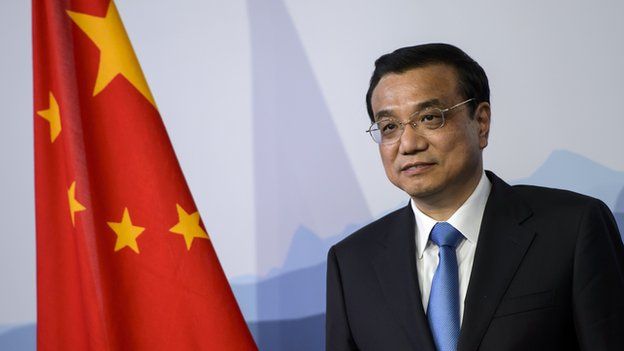
Premier Li Keqiang has said pollution is a "blight on people's quality of life"
It's not just Zhubugang. A fifth of China's arable land is poisoned with heavy metals, most of its groundwater is polluted and some experts say air quality is now a bigger killer than smoking.
Numbers like this are forcing Beijing's hand. Across the country, some of the largest anti-government protests now focus on pollution problems. And the wealthy middle classes in the big cities are increasingly impatient for action to guarantee clean air, water and food.
In March this year Premier Li Keqiang told the annual session of China's parliament, the National People's Congress: "Environmental pollution is a blight on people's quality of life and a trouble that weighs on their hearts…We must fight it with all our might."
From province to city to township level, the message has made its way down to Zhubugang that creating jobs and turning a profit can no longer come at the expense of public health.
All the chemical complexes which have sprung up haphazardly and without regulation have now been ordered to move.
Local environmentalist Song Wei says she is encouraged: "No more economic growth stained by blood. Under the new environment law, every factory has to be approved before it's built. We're putting an end to unregulated chaos."
null
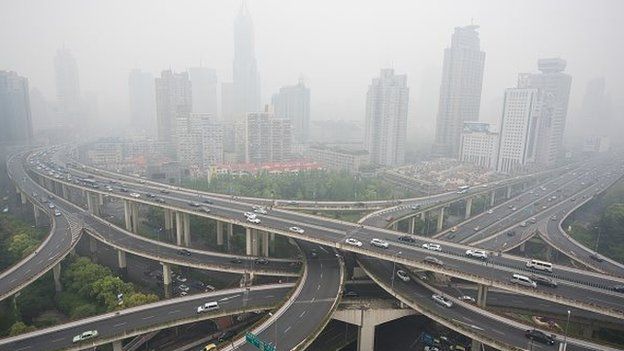
Smog has choked major cities, including Beijing and Shanghai, regularly in recent years
We visit one of the factories forced to move to a dedicated industrial zone, a supplier of enamel paints and glazes for cookware.
Company boss Liang Menlin tells me that in the Zhubugang days, the minerals were mixed by hand, no one bothered with masks and there was toxic dust everywhere. Now the minerals are machine ground in sealed chambers and dust is extracted by vacuum pumps.
"Internationally, standards are rising and technology is more advanced. What's more, environmental inspections are much more frequent than in the old days. Traditional methods of manufacturing have to give way to the big trend for environmental protection. No company can afford to fall behind."
As for the basket of fish and rice that all these people remember from the Zhubugang of their childhood, there is no going back. The soil is too contaminated to be farmed again. Instead factory sites will be reassigned as urban real estate and the remaining farmers will be moved out to apartment blocks.

Right incentives

Pan Jiahua of the Research Centre for Sustainable Development at China's Academy of Social Sciences reminds me of the enormous pressure that urbanisation itself places on China's resources and ecology.
"The real concern is consumer behaviour. People want a modern, comfortable way of life…a big car, a large apartment, air-conditioning in the summer, heating in the winter. All of this is new in China. It's not wrong but it's so vast and so sudden. We are just not prepared for the consumption of energy and natural resources," Prof Pan says.
But Prof Pan is confident that with the right incentives for government officials and a determination to enforce regulations, China will move from its headlong rush for growth to a future of sustainable development.
"Now we have the investment, the demand, the technologies, the determination. If we decide to get things done I don't think that will be a huge challenge."
null
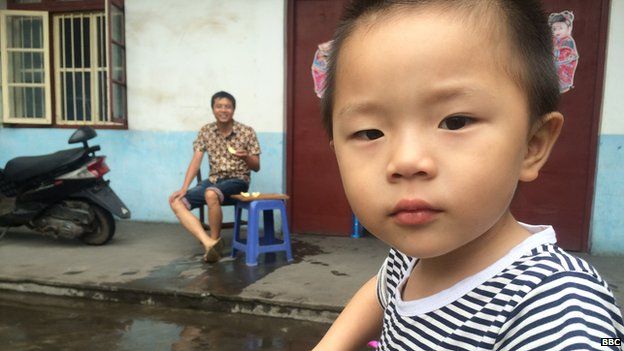
China's rapid industrial growth has left children like Yangyang as victims
Everyone has a stake in Prof Pan being right, and for some its urgent. The Zhubugang sprawl is being demolished, but close by lies another maze of crumbling factories and according to the families who live among them, they show no sign of leaving.
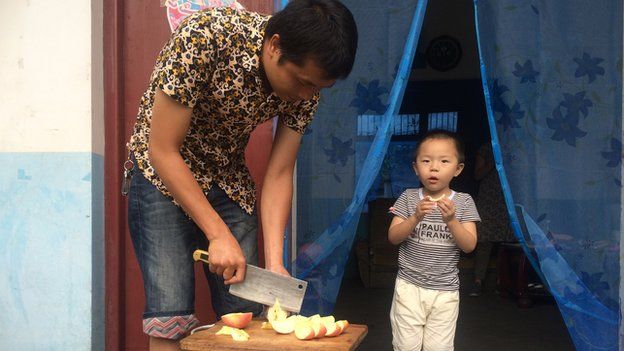
Next door to a foundry, we visit three-year-old Yangyang who has three times the safe level of lead in his blood. The air smells foul and stings our eyes.
As Yangyang spins round the yard on his scooter, his grandmother tells me she's never had a lungful of clean air in her life. His father says they are all the voiceless victims of the country's rush for wealth.
"The central government has good intentions. It does want to clean up the pollution. But we don't know where the money goes on the way down the chain. By the time it gets down here there isn't any money left."
Yangyang's father washes an apple in a tin basin, pointing out that he has no idea how safe either the water or the apple is to Yangyang's health.
So how confident is he that the air will improve in his son's lifetime?
"Things should get a bit better …maybe in ten years or twenty years, things should improve somewhat."
China has a long, long way to go to make good on its promise to children like Yangyang: a sustainable future in which every life counts.
http://www.bbc.com/news/world-asia-china-33546231