Saturday, 15 October 2016

90 per cent of the galaxies in the cosmos have never been studied.

Universe is far bigger and more stuffed with galaxies than previously thought, scientists reveal-
More than 90 per cent of the galaxies in the cosmos have never been studied. Scientists aren't sure what they'll find there
Andrew Griffin @_andrew_griffin http://www.independent.co.uk/life-style/gadgets-and-tech/news/universe-galaxies-how-big-many-size-observable-map-history-nottingham-a7360736.html
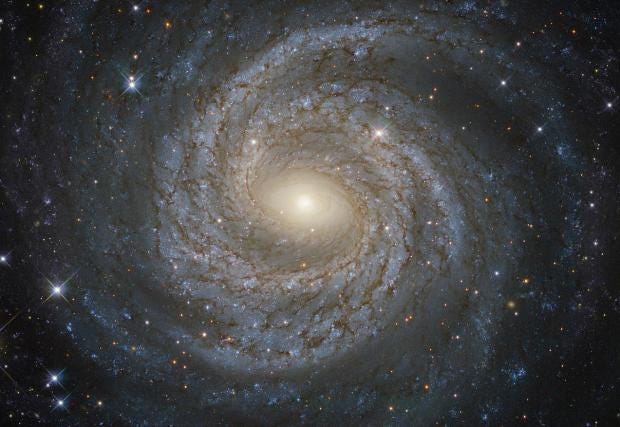


The universe was already far too big to understand. But scientists just found that it’s actually much bigger than we’d previously thought.

The observable universe is made up of at least two trillion galaxies, according to a new study. That’s 20 times more than had previously been thought.

The new estimate comes from a British-led study that used images from the Hubble Space Telescope to create a 3D map of the universe. That allowed scientists to understand how dense the galaxies were, and how large separate small regions of space are.

And when that was all put together, the scientists found that the map was far larger than they’d ever thought. It was previously thought that the observable universe had about 100 billion galaxies – until the new study found far more.


The observable universe refers to the part of the cosmos that we can see from Earth, since the light from it has had time to reach us.

The study found that early in the universe’s history it was far more full, and so had far more galaxies. When our cosmos was just a few billion years old, each part of it had 10 times more galaxies than take up that space today.

"Finding more galaxies in the past implies that significant evolution must have occurred to reduce their number through extensive merging of systems,” said lead scientist Professor Christopher Conselice, from the University of Nottingham. “We are missing the vast majority of galaxies because they are very faint and far away.

"The number of galaxies in the universe is a fundamental question in astronomy, and it boggles the mind that over 90% of the galaxies in the cosmos have yet to be studied.

"Who knows what interesting properties we will find when we study these galaxies with the next generation of telescopes?"

The research, co-funded by the Royal Astronomical Society, appears in the Astrophysical Journal.

Wednesday, 12 October 2016

Calcium supplements may damage the heart

Calcium supplements may damage the heart

Date:October 11, 2016 Source:Johns Hopkins Medicine
https://www.sciencedaily.com/releases/2016/10/161011182621.htm 
Summary:Taking calcium in the form of supplements may raise the risk of plaque buildup in arteries and heart damage, although a diet high in calcium-rich foods appears be protective, say researchers at conclusion of their study that analyzed 10 years of medical tests on more than 2,700 people.Share:

FULL STORY

More than half of women over 60 take calcium supplements -- many without the oversight of a physician -- because they believe it will reduce their risk of osteoporosis, researchers estimate.
Credit: © sasimoto / Fotolia

After analyzing 10 years of medical tests on more than 2,700 people in a federally funded heart disease study, researchers at Johns Hopkins Medicine and elsewhere conclude that taking calcium in the form of supplements may raise the risk of plaque buildup in arteries and heart damage, although a diet high in calcium-rich foods appears be protective.

In a report on the research, published Oct. 10 in the Journal of the American Heart Association, the researchers caution that their work only documents an association between calcium supplements and atherosclerosis, and does not prove cause and effect.

But they say the results add to growing scientific concerns about the potential harms of supplements, and they urge a consultation with a knowledgeable physician before using calcium supplements. An estimated 43 percent of American adult men and women take a supplement that includes calcium, according the National Institutes of Health.

"When it comes to using vitamin and mineral supplements, particularly calcium supplements being taken for bone health, many Americans think that more is always better," says Erin Michos, M.D., M.H.S., associate director of preventive cardiology and associate professor of medicine at the Ciccarone Center for the Prevention of Heart Disease at the Johns Hopkins University School of Medicine. "But our study adds to the body of evidence that excess calcium in the form of supplements may harm the heart and vascular system."

The researchers were motivated to look at the effects of calcium on the heart and vascular system because studies already showed that "ingested calcium supplements -- particularly in older people -- don't make it to the skeleton or get completely excreted in the urine, so they must be accumulating in the body's soft tissues," says nutritionist John Anderson, Ph.D., professor emeritus of nutrition at the University of North Carolina at Chapel Hill's Gillings School of Global Public Health and a co-author of the report. Scientists also knew that as a person ages, calcium-based plaque builds up in the body's main blood vessel, the aorta and other arteries, impeding blood flow and increasing the risk of heart attack.

The investigators looked at detailed information from the Multi-Ethnic Study of Atherosclerosis, a long-running research project funded by the National Heart, Lung, and Blood Institute, which included more than 6,000 people seen at six research universities, including Johns Hopkins. Their study focused on 2,742 of these participants who completed dietary questionnaires and two CT scans spanning 10 years apart.

The participants chosen for this study ranged in age from 45 to 84, and 51 percent were female. Forty-one percent were white, 26 percent were African-American, 22 percent were Hispanic and 12 percent were Chinese. 


At the study's onset in 2000, all participants answered a 120-part questionnaire about their dietary habits to determine how much calcium they took in by eating dairy products; leafy greens; calcium-enriched foods, like cereals; and other calcium-rich foods. Separately, the researchers inventoried what drugs and supplements each participant took on a daily basis. 

The investigators used cardiac CT scans to measure participants' coronary artery calcium scores, a measure of calcification in the heart's arteries and a marker of heart disease risk when the score is above zero. Initially, 1,175 participants showed plaque in their heart arteries. The coronary artery calcium tests were repeated 10 years later to assess newly developing or worsening coronary heart disease.

For the analysis, the researchers first split the participants into five groups based on their total calcium intake, including both calcium supplements and dietary calcium. After adjusting the data for age, sex, race, exercise, smoking, income, education, weight, smoking, drinking, blood pressure, blood sugar and family medical history, the researchers separated out 20 percent of participants with the highest total calcium intake, which was greater than 1,400 milligrams of calcium a day. That group was found to be on average 27 percent less likely than the 20 percent of participants with the lowest calcium intake -- less than 400 milligrams of daily calcium -- to develop heart disease, as indicated by their coronary artery calcium test.

Next, the investigators focused on the differences among those taking in only dietary calcium and those using calcium supplements. Forty-six percent of their study population used calcium supplements.

The researchers again accounted for the same demographic and lifestyle factors that could influence heart disease risk, as in the previous analysis, and found that supplement users showed a 22 percent increased likelihood of having their coronary artery calcium scores rise higher than zero over the decade, indicating development of heart disease.

"There is clearly something different in how the body uses and responds to supplements versus intake through diet that makes it riskier," says Anderson. "It could be that supplements contain calcium salts, or it could be from taking a large dose all at once that the body is unable to process."

Among participants with highest dietary intake of calcium -- over 1,022 milligrams per day -- there was no increase in relative risk of developing heart disease over the 10-year study period.

"Based on this evidence, we can tell our patients that there doesn't seem to be any harm in eating a heart-healthy diet that includes calcium-rich foods, and it may even be beneficial for the heart," says Michos. "But patients should really discuss any plan to take calcium supplements with their doctor to sort out a proper dosage or whether they even need them."

According to the U.S. Centers for Disease Control and Prevention, coronary heart disease kills over 370,000 people each year in the U.S. More than half of women over 60 take calcium supplements -- many without the oversight of a physician -- because they believe it will reduce their risk of osteoporosis.


Story Source:
Materials provided by Johns Hopkins Medicine. Note: Content may be edited for style and length.

Journal Reference:
John J.B. Anderson, Bridget Kruszka, Joseph A.C. Delaney, Ka He, Gregory L. Burke, Alvaro Alonso, Diane E. Bild, Matthew Budoff, Erin D. Michos. Calcium Intake From Diet and Supplements and the Risk of Coronary Artery Calcification and its Progression Among Older Adults: 10‐Year Follow‐up of the Multi‐Ethnic Study of Atherosclerosis (MESA). Journal of the American Heart Association, 2016; 5 (10): e003815 DOI:10.1161/JAHA.116.003815

Tuesday, 11 October 2016

Rajendra Chola’s Portrait For Mazgon Docks: A Tribute To The Naval Might Of Cholas

Rajendra Chola’s Portrait For Mazgon Docks: A Tribute To The Naval Might Of Cholas 
Swarajya Staff - September 30, 2016, 8:30 am  http://swarajyamag.com/books/rajendra-cholas-painting-for-mazgon-docks-a-tribute-to-the-naval-might-of-cholas


This occasion gives Indians an opportunity to reflect on how they approach their own history.


According to this report in The Times of India, the governor and chief minister of Maharashtra will dedicate a portrait of the Chola king Rajendra Chola I to Mazgon docks. This is fitting as the Cholas had arguably the best organised navy in all of Indian history.

This occasion though, also gives Indians an opportunity to reflect on how they approach their own history. For, in India, except for a handful of icons, all other history makers are remembered regionally and not nationally. So, Krishnadeva Raya remains an icon only in south India; a leader like Lachit Borphukan of only the Assamese; Marthanda Varma, who defeated the Dutch at sea, remembered in Kerala alone, and so on.

Southern India, per se, seems to suffer disproportionately from this approach to history. While the Rajputs, the Marathas, and the rulers of the Gangetic delta still find mention in history books, leaders and change-makers, who belonged to the south don’t in the same proportion.

There are more chances of a student in south India reading about the imperial dynasties of the north than a student in north India reading about a ruler like Rajendra Chola I.

It is in this context that the Maharashtra administration’s decision to dedicate Rajendra Chola’s portrait to Mazgon docks should be welcomed. Especially because, the Cholas were a great naval power themselves.

This aspect of their reign can hardly be described better than has been done by author Sanjeev Sanyal in his new book, The Ocean of Churn.

Given below is an excerpt:

“The Cholas were one of the three clans, who dominated the southern tip of India in ancient times. During the period of Pallava rule, they had accepted the overlordship of Kanchi but still retained significant political clout. At the end of the ninth century, a Chola general called Aditya helped the Pallavas crush a revolt by the Pandyas, the other ancient Tamil clan. As a reward, he seems to have been given sizeable new territories. Aditya used the new resources to build up his military capability and in AD 873 he marched against his Pallava overlords. The Cholas defeated and killed the last Pallava king Aparajita (whose name ironically means ‘he who cannot be defeated’). Aditya took care, however, to marry a Pallava princess and thereby absorb their lineage into his own.

Over the next several decades, the Cholas steadily expanded their kingdom. They repeatedly defeated the combined armies of the Pandyas and their Sri Lankan allies. However, not all their military campaigns went well. When the Cholas attempted to expand northwards, they were beaten back by the Rashtrakutas who had replaced the Chalukyas in the Deccan plateau. In fact, the Rashtrakutas pushed back and occupied the old Pallava capital of Kanchi. It took several years for the Cholas to recover from the defeat but they seemed to have clawed back the lost territory by the time Rajaraja Chola came to the throne in AD 985.

Rajaraja is widely regarded by Tamils as their greatest king. He defeated the combined armies of the Pandyas, the Sinhalese and the ruler of Kerala. This gave him control over ports on both the eastern and western coasts. Next he decided to teach the Sri Lankans a lesson. A naval raid occupied the north of the island and sacked the Sinhalese capital of Anuradhapura. The Maldives was also added to the empire. As thanksgiving for his victories, Rajaraja then built the enormous Brihadeswara temple dedicated to Shiva. It is now a UNESCO World Heritage Site.

The next Chola ruler was Rajaraja’s son Rajendra, who assumed the throne in 1014. He initially had to put down revolts by the old rival clans and consolidate his control over Sri Lanka. He then led an extraordinary military expedition that made its way north to the banks of the Ganga. Although the Cholas did not attempt to maintain control over these northern lands, Rajendra was clearly very proud of having made his way to the holy river. Water from the Ganga was carried back in golden vessels and a new capital was built—‘Gangaikonda Cholapuram’ meaning, ‘The City of the Chola who brought the Ganga’.

From the perspective of Indian Ocean history, however, the most significant event of Rajendra’s rule was a major naval raid on the Sri Vijaya kingdom of Sumatra and Malaya. In order to appreciate the historical context of this event, one needs to step back and understand the geo-political dynamics of the times. The maritime trade route between India and China had become very lucrative and there were two main routes. The first passed through the Straits of Malacca, between the Malay peninsula and Sumatra. The Sri Vijaya kingdom controlled this route. The second, more southerly route, passed through the Sunda straits between Sumatra and Java. Although it was a bit of a detour for those going to China or Champa, it had better access to the spice growing Maluku and Banda islands. This route was usually controlled by the Javans. Not surprisingly, there was constant rivalry between the Sri Vijaya and the Javanese kingdoms.

The late tenth century was a period of prosperity in the Indian Ocean rim as trade boomed between the Song empire in China, the Cholas in southern India and the Shiite Fatimid caliphate that controlled Egypt and the Red Sea. The rivalries of South East Asia were proving to be a major threat to this economic pipeline. In AD 987, a Sri Vijaya diplomatic mission made its way to China. During its stay in China, the diplomats were informed that their country was under attack from the Javan kingdom of Mataram.

They decided to head home but the war escalated and the mission found itself stranded in Champa for a year. It is likely that they received new instructions from the capital for they headed back to China and pleaded with the Song emperor to place Sri Vijaya under its protection. Thus, China came to have influence in the region.

The Sri Vijaya would have been aware that the entry of the Chinese into the Indian Ocean could elicit a response from the Cholas. Thus, they simultaneously sent missions to the Chola kings as well as made generous grants to Hindu and Buddhist temples in Chola ports. Amusingly, Chinese records show that the Sri Vijaya were playing a double game because their diplomats were deliberately misrepresenting the situation by claiming that the Cholas paid tribute to them!

The Sri Vijaya seem to have used Chinese protection to build up their own strength. Not surprisingly, this caused their neighbours to become concerned. Around 1012, Suryavarman I, the king of Angkor, chose to send an unusual gift to Rajendra Chola — his personal warchariot with which he had defeated his enemies. In the Indic cultural context, such a gift has great symbolic importance and it is likely that Angkor was trying to woo the Cholas as a way to counter-balance the Sino-Sri Vijaya alliance. It is also possible, that Angkor was trying to reopen the old trade route through the Isthamus of Kra as a way to bypass the contested straits. Amidst all this hectic diplomacy, the Cholas sent a direct diplomatic mission to China in 1015.

The ground situation, however, suddenly changed in 1016 when the Sri Vijaya and their allies defeated the Javanese and sacked the Mataram capital. This left the Sri Vijaya in control of both sea routes. We have evidence to suggest that it soon exploited this situation by exacting exorbitant tolls on merchant ships. Rajendra Chola probably sent a small naval expedition to Sumatra in 1017 as a warning but it was not taken seriously. Thus, the Chola returned in 1025 with a much larger fleet.

We do not know the exact sequence of events, but a study of the available information suggests the following: The fleet probably assembled near the main Chola port of Nagapattinam. Appropriately for a port that traded with South East Asia, the name means ‘Port of the Nagas’. There is still a major port there but the medieval port was probably several kilometres to the south. The Chola fleet would have first sailed south towards Sri Lanka before swinging east using ocean currents that would have taken them across to Sumatra. They probably then sailed down the west coast of the island towards the Strait of Sunda where they may have been resupplied by Javanese allies and picked up local guides.

The fleet now made its way north into the Straits of Malacca and systematically sacked Sri Vijaya ports along the way. Finally, we are told that the Cholas decisively defeated the main Sri Vijaya army in Kadaram (now Kedah province in Malaysia). The invading force then withdrew, stopping by at the Nicobar Islands on their way home.

The Chola raid significantly diminished Sri Vijaya power but it is remarkable that the Chinese did not do anything to support their supposed vassals. It is possible that the Chinese were just as annoyed at Sri Vijaya’s rent extraction and had entered into an understanding with the Indians. The Sumatrans too seem to have accepted their reduced status as they continued to send ambassadors to the Chola court and even participated in a joint diplomatic mission to China. When a Chola naval fleet returned to Kadaram in 1068, it was in support of a Sri Vijaya king against his local rivals. Meanwhile, with external threats diminished, Java began to rebuild itself under a Balinese price, Airlangga. The process of revival would culminate in the great Majapahit empire in the fourteenth century.”


Maharashtra to dedicate Tamil emperor Rajendra Chola's portrait to Mazgon Docks
TNN | Sep 29, 2016, 06.31 AM IST http://timesofindia.indiatimes.com/india/Maharashtra-to-dedicate-Tamil-emperor-Rajendra-Cholas-portrait-to-Mazgon-Docks/articleshow/54574985.cms

 
NEW DELHI: Governor of Maharashtra Dr Vidya Sagar Rao and chief minister Devendra Phadnavis will dedicate the portrait of the great naval emperor from Tamil Nadu Rajendra Chola I to Mazgon Docks. Chairman of celebration committee Tarun Vijay and MD of the Mazgon Docks Ship Builder Rear Admiral (retd) Rahul Kumar Shrawat will receive the portrait in a solemn function on Thursday at 3.30pm. Defence minister Manohar Parrikar has sent a special congratulatory message for the occasion.

Ravi Bhusari, org secretary BJP, Maharashtra, Prof Sanjay Deshmukh, VC of the Mumbai University and Capt. Selvan, BJP MLA, (the lone Tamil MLA in Maharashtra) shall also join as special guest.


"Rajendra Chola was the greatest naval emperor of the world, India produced a millennium ago (1014 CE — year of coronation) and his memory is essential not only for national unity but also to get inspiration to keep Indian Ocean as a zone of peace," Tarun Vijay said. "Exactly 35 years before UN had passed a resolution declaring Indian Ocean a peace-zone but today India needs to increase its presence and activities in the region to have that come true," he added.


Eyewitnesses give graphic details Indian Surgical strikes

Surgical strikes: Bodies taken away on trucks, loud explosions, eyewitnesses give graphic details
From classified intelligence documents accessed by The Indian Express, it appears the assault caught the Lashkar and other jihadist groups by surprise.
Written by Praveen Swami | New Delhi | Updated: October 7, 2016 1:57pm http://indianexpress.com/article/india/india-news-india/pakistan-border-terror-camps-surgical-strikes-kashmir-loc-indian-army-jihadist-3065975/
Surgical strikes: The eyewitnesses described brief but intense fire engagements that destroyed makeshift buildings that housed jihadists before they left for the last stage of their journeys across the LoC. (Source: PTI)

Eyewitnesses living across the Line of Control (LoC) have provided The Indian Express with graphic accounts of last week’s Indian Army special forces strikes on jihadists’ staging posts, describing how bodies of those killed in clashes before dawn on September 29 were loaded onto trucks for secret burials. The eyewitnesses also described brief but intense fire engagements that destroyed makeshift buildings that housed jihadists before they left for the last stage of their journeys across the LoC.

WATCH VIDEO: Surgical Strikes: Eyewitnesses’ Accounts Validate India’s Claim Of A Lethal Strike
Their accounts corroborate India’s claims that it carried out strikes against terror launch pads — a claim Pakistan has denied, saying, instead, that its military’s forward positions were targeted with small-arms and mortar fire.

Their accounts corroborate India’s claims that it carried out strikes against terror launch pads — a claim Pakistan has denied, saying, instead, that its military’s forward positions were targeted with small-arms and mortar fire.

They also provide, for the first time, details on some of the locations targeted in the operation, information which the governments of India and Pakistan have not made public.

However, eyewitness accounts, as well as intelligence records obtained by The Indian Express, suggest that fatalities in the raids may have been lower than the 38-50 killed attributed to Indian officials in reports, including in this newspaper, and have caused little damage to jihadist logistics and infrastructure.


Lethal strike

Five eyewitnesses were contacted by The Indian Express through their kin living on the Indian side of the LoC and questions were sent to them using a commercially available encrypted chat system. The eyewitnesses’ identities are being withheld for their safety at the request of their families.

Indian journalists have no access to the Pakistani side of the LoC and the only Pakistan media reporting from these regions has been after a team of journalists were taken to some areas by the military there.

The most detailed account of the fighting came from two eyewitnesses who visited Dudhnial, a small hamlet some 4 km across the LoC from India’s nearest forward post, Gulab, ahead of the town of Kupwara. The eyewitness reported seeing a gutted building across the Al-Haawi bridge from the hamlet’s main bazaar, where a military outpost and a compound used by the Lashkar are both sited.

Al-Haawi bridge is the last point where infiltrating groups are loaded with supplies before beginning their climb up to the LoC towards Kupwara, both eyewitnesses said.

Local residents told one of the eyewitnesses that loud explosions — possibly rounds fired from 84-mm Carl Gustav rifles — were heard from across the Al-Haawi bridge late in the night, along with intense small-arms fire. “People did not come out to see what was going on,” the eyewitness reported, “so did not see Indian soldiers but they gathered from the Lashkar people the next day that they had been attacked.”

Five, perhaps six, bodies were loaded on to a truck early next morning, and possibly transported to the nearest major Lashkar camp at Chalhana, across the Neelum river from Teetwal, on the Indian side of the LoC, the eyewitness said he was told by local residents.

The Indian Army has made no official claim on casualties, but Director General of Military Operations Lieutenant General Ranbir Singh said the strikes caused “significant casualties” to “terrorists and those providing support to them.”

Friday prayers at a Lashkar-affiliated mosque in Chalhana, another eyewitness said, ended with a cleric vowing to avenge the deaths of the men killed the previous day. “The Lashkar men gathered there were blaming the Pak Army for failing to defend the border”, he said in one message, “and saying they would soon give India an answer it would never forget”.

From classified intelligence documents accessed by The Indian Express, it appears the assault caught the Lashkar and other jihadist groups by surprise. Intelligence Bureau records, one released on September 30 for a scheduled inter-agency meeting in New Delhi, spoke only of one major build-up, saying up to 40 jihadists had massed in Kél, facing India’s Machil sector. This unusual number was interpreted to be a preparation for a last-ditch infiltration push before the passes closed in early winter.

Terrorists unprepared

Elsewhere, though, nine intelligence alerts seen by The Indian Express, and issued in the week prior to the strike, flagged only small groups of five to 10 infiltrators biding their time at so-called “launch-pads”, essentially rural homes located close to military facilities, from where jihadists are guided towards India’s LoC defences.

“They were basically sitting around thinking it was business as usual”, an official familiar with the intelligence said. “Many of them would have died crossing the LoC anyway, when they hit our defences but this (the strikes) has made them feel unsafe one step back in their journeys”.

Leepa, a complex of some 25 hamlets located at the bottom of the Qazi Nag stream flowing down from the mountains above Naugam, on the Indian side of the LoC, was among the “launch-pads” targeted in the cross-LoC raids, one eyewitness said. Though the eyewitness was unable to visit the area, he said he spoken to villagers who had seen a Lashkar-occupied three-storied wooden building destroyed by Indian troops near the hamlet of Khairati Bagh.

Khairati Bagh was, until 2003, a major Lashkar base, which was slowly scaled down once the LoC ceasefire went into place and the terrorist group’s cross-LoC operations slowly declined. It remains, though, of key importance to the group, offering multiple lines of access into northern Kashmir through Chowkibal and the Bangas bowl.

The eyewitness said local residents said “three or four” Lashkar personnel were thought to have been killed in the raid, while others fled into the adjoining forests after the firing began.

Interestingly, the eyewitness said the Jamaat-ud-Dawa’s charitable wing, the Falah-i-Insaniyat Foundation, had held a major eye-surgery camp in Khairati Bagh in August, using the opportunity to deliver speeches on alleged atrocities by Indian soldiers in Kashmir. Fire and explosions were also heard, an eyewitness said, from the east bank of the Neelum river in Athmuqam, the district headquarters of the region.

Next to Pak Army

The fighting, the eyewitness said, appeared to have taken place near military camps along the Katha Nar stream that empties into the Neelum river just north of the town. A bustling town that serves as a hub for tourism and commerce, Athmuqam is also a major military hub, with several army facilities on the ridges the east bank of the river, sheltered from artillery bombardment.

The ghost villages of Bicchwal and Bugna, almost entirely abandoned by their residents who fled when the long jihad in Kashmir began in 1990, are barely 2 km from Salkhanna, the first village on the Pakistani side of the LoC, and the last loading point for jihadist infiltrators.

An eyewitness who visited the Neelum District Hospital in Athmuqam said he heard several Lashkar personnel had been killed and injured in the clash last Thursday but said no bodies had been buried locally.

Neelum valley residents, tied by kinship to mountain peoples on the other side of the LoC, have had a fraught relationship with jihadists operating in the area, fearing the collapse of the India-Pakistan ceasefire could lead to the return of the artillery exchanges which claimed the lives of hundreds of civilians before 2003.

In 2011, India-Pakistan military clashes led scores of Athmuqam women and children to march to the local army unit, demanding that it stop cross-border movement by jihadists.

The Pakistan Army responded by locating jihadist launch-pads alongside its camps, thus minimising contact between local residents and groups like the Lashkar. However, the massive street violence in Kashmir has led to a surge in the visibility of jihadists across the Neelum valley.


'Surgical strikes' should become the norm against an errant Pakistan
http://southasiamonitor.org/news/-surgical-strikes-should-become-the-norm-against-an-errant-pakistan/sl/19637
By Cecil Victor
 
"Surgical strikes" by the Indian military visited upon Pakistani terror launchpads in Pakistan-occupied Kashmir in the dark hours of Thursday should become standard operating procedures rather than the exception.

The mathematics of counter-insurgency demands it.

Such a doctrine carries a promise of multiple cascading advantages. The Indian Army knows that the archpriests of guerrilla warfare, China’s first Chairman Mao Tse-tung and the charismatic Latin American Ernesto Che Guevara (even T.E. Lawrence -- Lawrence of Arabia fame), in their independent and largely separated in time and location empirical studies on their type of warfare had pointed to the disproportionately high number of security forces required to neutralise one guerrilla fighter.

The ratio ranged from 50:1 in difficult terrain like dense forests or even 20:1 that the British used to curb the Malayan emergency. This means that if one infiltrator manages to cross the Line of Control, India would need up to 50 troops to find and neutralize him. If they are in groups of four to six as happened in Pathankot and Uri, the immediate requirement for quick neutralization would be between 200 to 300 security personnel. The prolonged exchanges of fire in nearly every instance points to both a paucity of manpower as well as abundant caution in the cleaning-up phase because of unpleasant experience of booby-trapped bodies.

In short, in a manpower-intensive kind of warfare that counter-insurgency is, we are unable to shape the battleground according to our wishes and requirement as per our current counter-infiltration strategy.

Conversely, in a surgical strike of the kind executed by the Indian Army on the night of September 29 India was in total control from which launchpads to hit, how to get in and how to get out without suffering casualties. All this was accomplished by Special Forces who went in without helicopters that are vulnerable to rifle fire from the ground.

Five widely dispersed specially camouflaged launchpads were destroyed. Thirty-five Pakistani dead bodies were counted and it is estimated that an equal number were pulverized by the flamethrowers and rocket propelled grenades.

Among the dead were nearly a dozen Pakistan Army personnel whose close proximity (cheek-by-jowl) to the terrorists and presence in the launchpads indicates their role as masterminds and facilitators.

The fact that the attack was executed by about 200 Indian soldiers and everything was over within four hours brings to the fore the cost-benefit of such an operation.

---Among the multiple cascading advantages that have emerged from this surgical strike (no harm irritating the Pakistanis by using this formulation) is that Pakistan has swiftly wrapped up more than a dozen training camps/launch pads from Pakistan-occupied Kashmir and shifted them closer to the Pakistani Punjab border. This shows that they were Pakistani nationals because if they were so-called “Kashmiri freedom fighters” they would have been left to die in much the same manner in which the Pakistan Army Inter-Services Intelligence abandoned the Shia fighters of the Northern Light Infantry (drawn from PoK) that were used to infiltrate into the Kargil salient in 1999 dressed in civilian kurta/pyjama.

---India has found the panacea to counter the Chinese stratagem of using nuclear weapons to deter a conventional response to attacks by highly trained Pakistanis posing as jihadi fighters.

---Pakistan cannot sustain its gambit of deniability in the face of the evidence that will very likely be unveiled before diplomats posted in New Delhi.

---Pakistan’s promise at the UN General Assembly that it would provide every means to help “Kashmiris” secure their desire for “freedom” lies dented and discredited.

---Several psychological issues have emerged that can be pursued with profit. Enumerating them here would render them inert.

Finally, it has taught Indian military commanders that overdependence on static defences leads to complacency and a syndrome of casualness and carelessness that has allowed Pakistan to successfully breach our defences time and again.

For many years Pakistan has been trying to create conditions to convert Kashmiri unrest into a liberation scenario through the infiltration of sleeper cells and pre-positioning of warlike stores, weapons and ammunition. From Hillkaka several years ago and many other places later Indian security forces have discovered caches and underground accommodation for as many as 40 personnel.

It is not an accident that there is an element of multiples of ten involved. Both Pakistan and India use this format to structure their conventional land forces. Forty is the number that comprises a platoon strength.

Returning to the empirical studies of Chinese chairman Mao, of Ernesto Che Guevara and of Lawrence of Arabia it is stated that “ratio of space to forces” plays a crucial role in guerrilla warfare. Hence the 50:1 calculus. If Pakistan is able to mobilize 40 persons who could use these dumps to hide and arm themselves the “enemy behind the lines effect” would be catastrophic.

The manner in which the strike force collected local intelligence can and must be applied to supplement the static defences. Using dogs as terrestrial eyes and ears should be coalesced into a more effective defence of which sanitizing the hinterland on the other side of the fence/reconnaissance/surveillance gadgetry is an integral part.

Hence surgical military operations (not all the time but at a time and place of our choosing) must be made the norm.
 
(Cecil Victor is an Indian military analyst. Comments and suggestions on this article can be sent on: editor@spsindia.in)

In sickness and in health, a parallel in the journeys of MGR and Jayalalithaa

In sickness and in health, a parallel in the journeys of MGR and Jayalalithaa

If credible reports during MGR's prolonged illness were scarce in 1984, information now seems to be in even shorter supply. Apollo's medical bulletins on the condition of the Tamil Nadu chief minister

A.R. Venkatachalapathy October 5, 2016 Last Updated at 10:47 IST
http://www.business-standard.com/article/current-affairs/in-sickness-and-in-health-a-parallel-in-the-journeys-of-mgr-and-jayalalithaa-116100500125_1.html
MGR campaigning in an election in Tamil Nadu. Credit: Wikimedia

When M.G. Ramachandran (MGR) was shot by fellow actor M.R. Radha on January 12, 1967, I was probably a few weeks old in my mother’s womb. MGR’s next near-brush with death was 32 years ago, and as an aware 17-year-old, I have distinct memories of it. MGR was admitted to the same Apollo Hospital where his protégé J. Jayalalithaa is now apparently battling for life. The parallels are stronger than mere calendrical coincidence.

MGR was then 68 – so far as birth records are reliable for a man who came from such humble beginnings as him, about the same age as Jayalalithaa is now. He had suffered a kidney failure, and was soon flown to Brooklyn Hospital, New York for treatment. In the wake of Indira Gandhi’s assassination on October 31, 1984, Rajiv Gandhi went in for snap polls a few months ahead of schedule. MGR’s All India Anna Dravida Munnetra Kazhagam (AIADMK) was in alliance with the Congress.

Those were pre-satellite channel days, and the media had great prestige but could easily be thwarted by the government. During the long months of treatment, there was little real news of MGR’s condition but for the periodical press releases that H.V. Hande – now a member of the Bharatiya Janata Party, a physician himself and a minister in his cabinet – issued. The press releases carried little credibility, and in one of his famous wordplays, MGR’s erstwhile friend, sworn political enemy and many-time chief minister of Tamil Nadu, M. Karunanidhi, called it ‘Hande pulugu, anda pulugu, aakasa pulugu’. The line is untranslatable, but the rhyming reference is to ‘blatant lies of universal proportions’.

Access to MGR and his wife, Janaki Ramachandran was controlled by a major faction of the party led by Rm. Veerappan, a successful film producer and a minister in the cabinet. In this, the Congress was a willing ally. MGR filed his nominations papers to the Andipatti constituency from his hospital bed in the presence of India’s Ambassador to the United States. Those were pre-RTI days and no one has seen the signed nomination papers to date. Indira’s assassination and MGR’s ill-health formed an unbeatable combination and the coalition swept the polls. Until MGR’s miraculous recovery and return to India some months later, there was no acting chief minister. And when MGR was sworn in, Doordarshan and Films Division, the only media allowed inside Raj Bhavan, decided to mute the cameras!

MGR ruled for three years until his death on Christmas eve, 1987. And these years remain one of the many dark spots in Tamil Nadu’s post-independence governance. Jayalalithaa was side-lined, with little or no access to her mentor, and fought a rear-guard battle with the help of some dissidents. Matters reached their nadir when she was pushed from the gun carriage hearse at MGR’s funeral.

In the waters troubled by MGR’s death, the Congress, which had not ruled  Tamil Nadu by itself for two decades, began to fish. In a single year, in 1988, Rajiv Gandhi visited the state 17 times, making tall promises. With P.C. Alexander playing the pliant governor, the Congress desperately tried to shore up its fortunes. In the January 1989 elections, it contested on its own under the leadership of G.K. Moopanar. The results not only exposed the Congress’s limitations, but also confirmed Jayalalithaa’s claim to MGR’s mantle. After her resounding victory in the 1991 elections riding the sympathy wave generated by Rajiv Gandhi’s assassination, Jayalalithaa ensured that the AIADMK survived MGR’s death. But, in a bid to emerge as a leader in her own right, she did everything to erase MGR – invoking his name only in crises.

Marx must be turning in his grave every time a lazy political commentator alludes to his famous dictum: ‘Hegel remarks somewhere that all great world-historic facts and personages appear, so to speak, twice. He forgot to add: the first time as tragedy, the second time as farce.’

And yet, it is impossible not to invoke Marx in this context. The parallels and analogies leap off the first page of his Eighteenth Brumaire of Louis Bonaparte.

If MGR made history by being the longest serving chief minister of Tamil Nadu, Jayalalithaa has similar, and other dubious, records to her credit. And her stint in power has not only been longer but also spread over a quarter of a century. If anything, she has widened the AIADMK’s vote bank.

Due to apparent ill-health, accentuated evidently by her incarceration in Parpana Agrahara jail in late 2014, Jayalalithaa has sported a jaded look over the past few years. Her campaign in the recent elections was lacklustre. Public appearances have been stage-managed to give a modicum of normalcy. If heavy make-up disguised possible signs of ill-health, special arrangements were made not to expose her limited mobility. And the sojourns in her Kodanadu estate have, if anything, got only more frequent and longer.

If credible reports were scarce in 1984, paradoxically, in the face of a phenomenal media glut, information now seems to be in even shorter supply. Apollo’s medical bulletins will not convince a primary school student. That even ministers of the central cabinet and the governor of the state have not actually met her only confirms the hold of Jayalalithaa’s friend, Sasikala, and her extended family.

The government remains paralyzed, and none dare even hint that an acting chief minister should hold the baby. At this moment, the BJP at the centre is as soft as the Congress was during MGR’s times, desisting from calling the state government to account. Questions are already being raised if the union government is not failing in its constitutional duties. If the Congress was hoping to gain a foothold in Tamil Nadu in a post-MGR scenario, the BJP is in an analogous position now. But the union government’s volte face in the Supreme Court on October 3, challenging the court’s powers to intervene in the constitution of the Cauvery Management Board, suggests that the BJP is torn between regaining power in Karnataka and gaining a foothold in Tamil Nadu.

The other constant is M. Karunanidhi, and it does speak for the phenomenal staying power of this ever-sharp politician. After two consequent defeats, in 1977 and 1980, he was desperate for a victory in 1984 but could do little to wrest the initiative in the face of twin odds: Indira’s death and MGR’s ill-health. But he had the last laugh at least in relation to MGR, surviving him by three decades, completing two terms in office, and still being in the reckoning for another shot at power. However, it’s been a see-saw battle with Jayalalithaa whom he would have scarce imagined to be a rival when she was prancing on the screen. As he now fights his own son, M.K. Stalin, inside the party, Karunanidhi must fancy that the throne is once more within striking distance.

One wonders what other parallels lie in store.

A.R. Venkatachalapathy is a historian of the Dravidian movement.

Sunday, 2 October 2016

The US government will no longer control the internet.

The US government will no longer control the internet. And that's huge
 
The US government will no longer control the internet. And that's huge
Amer Ghazzal/Barcroft Media

The internet, as you know it, is about to fundamentally change. Nothing will change visually or in the way you've been using it all these years, but a significant change, perhaps the most significant ever, will happen at 12:01 AM Eastern Standard Time on Saturday, 1 October.

The US government will now be walking away from their Internet Assigned Numbers Authority (IANA) contract. The United States have had partial control of the internet for more than 20 years (they've been the primary manager of the address books since1988) but their time is finally up. This contract meant that the US government has "defined how the internet has grown and been structured for nearly 20 years".
This, however, doesn't mean that the US owns the internet. Nobody does, at least not so far. It's a decentralised network. Bits and pieces of the internet are controlled by different governments.

Owning the internet

But that's going to change as non-profit organisation and global community of stakeholders, the Internet Corporation for Assigned Names and Numbers (ICANN) will be taking over the reins now. As Fortune describes it, "ICANN, a California-based nonprofit, manages the database for top-level domain names such as .com and .net and their corresponding numeric addresses that allow computers to connect."
National Telecommunications & Information Administration (NTIA), part of the US Department of Commerce, officially had the authority over the naming of domains. Since 1998 though, ICANN has mostly been running the show, and the decision to give them full control, has been in the works for a long time.

In 1998, NTIA said it was committed to the transition. In 2014, the Department of Commerce officially announced its intent to work with ICANN and to create a plan for the transition. The long planned transfer has now cleared its last hurdle. AS NBC News writes, "Over 33,000 emails have been exchanged and more than 800 hours have been spent in meetings discussing the transition, according to ICANN".

The US Department of Commerce will be ceding control after a lawsuit which sought a halt in the transition, which was denied by a federal judge in Texas. The lawsuit argued that .mil and .gov (used for military and government domains) could be messed with.

The implications

Critics have argued that the transition will stifle free speech. The lawsuit has argued that the handover is unconstitutional and requires congressional approval before going through. Some critics like Donald Trump and Ted Cruz say that handing over the power amounts to handing it over to the likes of China and Russia.

In fact, Cruz even asked if ICANN was bound by the First Amendment to the US constitution (freedom of speech) and the reply was a clear no.

This transition is significant because it shifts control over to internet users. It's now in the hands of a 'multi-stakeholder' non-profit. This non-profit will be taking on the views of academics, technical experts, companies, public interest advocates, individuals and nation states in the naming system of the web.

While the transition is a good step, there is one key point to be remembered. ICANN does not control the internet and neither does the US Department of Commerce.

Understanding DNS

DNS stands for Domain Name System and has been just what the internet required to take it to the next level. Essentially, DNS gives easy to remember names to complicated strings of numbers. Jon Postel, named as 'god of internet' was the original bearer of the DNS. When the internet started blowing up, Pastel couldn't handle it all on its own. The IANA was formed subsequently.

The control of IANA was given to ICANN in 1998. ICANN was seen as a free and fair organisation but one thing prevented it from being completely free of any interference - the government's interference.
The fact that the US's National Telecommunications and Information Administration (NTIA), part of the Department of Commerce had the final say over whatever the IANA did was a major bone of contention. Even though this power was used sparingly, it was still significant.

Perhaps, the transition is for the better. Perhaps it needs to be viewed with some skepticism. In any case, this is a momentous occasion in the short life of the internet.
http://www.catchnews.com/science-technology/the-us-government-will-no-longer-control-the-internet-and-that-s-huge-1475330187.html/fullview

Tuesday, 27 September 2016

Paul Brunton-His experience in front of Sri Ramana Maharshi


Paul Brunton : A search in secret India : Page 303:

His experience in front of Sri Ramana Maharshi:

I return hastily from an exploration of some usually veiled sanctuaries of the great temple and enter the hall when the evening meditation period has run out half its life. 


I slip quietly to the floor and straightway assume my regular meditation posture. In a few seconds I compose myself and bring all wandering thoughts to a strong centre. 

An intense interiorization of consciousness comes with the closing of eyes. The Maharishee's seated form floats in a vivid manner before my mind's eye. 

Following his frequently repeated instruction I endeavour to pierce through the mental picture
into that which is formless, his real being and inner nature, his soul. To my surprise the effort meets with almost instantaneous success and the picture disappears again, leaving me with nothing more than a strongly felt sense of his intimate presence.


The mental questionings which have marked most of my earlier meditations have lately begun to cease. I have repeatedly interrogated my consciousness of physical, emotional and mental sensations in turn, but, dissatisfied in the quest of self, have eventually left them all. 


I have then applied the attention of consciousness to its own centre, striving to become aware of its place of origin. Now comes the supreme moment. In
that concentration of stillness, the mind withdrawn into itself, one's familiar world begins to fade off into shadowy vagueness.


One is apparently environed for a while by sheer nothingness, having arrived at a kind of mental blank wall. And one has to be as intense as possible to maintain one's fixed attention.


But how hard to leave the lazy dalliance of our surface life and draw the mind inwards to a pin-point of concentration!


To-night I flash swiftly to this point, with barely a skirmish against the continuous sequence of thoughts which usually play the prelude to its arrival. Some new and powerful force comes into dynamic action within my inner world and bears me inwards with resistless speed. 


The first great battle is over, almost without a stroke, and a pleasurable, happy, easeful feeling succeeds its high tension. In the next stage I stand apart from the intellect, conscious that it is thinking, but warned by an intuitive voice that it is merely an instrument. I watch these thoughts with a weird detachment. 

The power to think, which has hitherto been a
matter for merely ordinary pride, now becomes a thing from which to escape, for I perceive with startling clarity that I have been its unconscious captive. There follows the sudden desire to stand outside the intellect and just be. I want to dive
into a place deeper than thought.
I want to know what it will feel like to deliver myself from the constant bondage of the brain, but to do so with all my attention awake and alert.


It is strange enough to be able to stand aside and watch the very action of the brain as though it were someone else's, and to see how thoughts take their rise and then die, but it is stranger still to realize intuitively that one is about to penetrate into the mysteries which hide the innermost recesses of man's soul. I feel like some Columbus about to land on an uncharted continent. A perfectly controlled and subdued anticipation quietly thrills me.


But how to divorce oneself from the age-old tyranny of thoughts? I remember that the Maharishee has never suggested that I should attempt to force the stoppage of thinking. "Trace thought to its place of origin," is his reiterated counsel, "watch for the real self to reveal itself, and then your thoughts will die down of their own accord.


So, feeling that I have found the birthplace of thinking, I let go of the powerfully positive attitude which has brought my attention to this point and surrender myself to complete passivity, yet
still keeping as intently watchful as a snake of its prey. This poised condition reigns until I discover the correctness of the sage's prophecy. 


The waves of thought naturally begin to diminish. The workings of logical rational sense drop towards zero point. The strangest sensation I have experienced
till now grips me. Time seems to reel dizzily as the antennas of my rapidly growing intuition begin to reach out into the unknown. The reports of my bodily senses are no longer heard, felt, remembered. I know that at any moment I shall be standing outside things, on the very edge of the world's
secret. . . .


Finally it happens. Thought is extinguished like a snuffed candle. The intellect withdraws into its real ground, that is, consciousness working unhindered by thoughts. I perceive, what I have suspected for some time and what the Maharishee
has confidently affirmed, that the mind takes its rise in a transcendental source. The brain has passed into a state of complete suspension, as it does in deep sleep, yet there is not the slightest loss of consciousness. 


I remain perfectly calm and fully aware of who I am and what is occurring. Yet my sense of awareness has been drawn out of the narrow confines of the separate personality; it has turned into something
sublimely all-embracing. Self still exists, but it is a
changed, radiant self.
For something that is far superior to the unimportant personality which was I, some deeper, diviner being rises into consciousness and becomes me. With it arrives an amazing new sense of absolute freedom, for thought is like
a loom-shuttle which is always going to and fro, and to be freed from its tyrannical motion is to step out of prison into the open air.


I find myself outside the rim of world consciousness. The planet which has so far harboured me, disappears. I am in the midst of an ocean of blazing light. The latter, I feel rather than think, is the primeval stuff out of which worlds are created, the first state of matter. It stretches away into unreliable infinite space, incredibly alive.


I touch, as in a flash, the meaning of this mysterious universal drama which is being enacted in space, and then return to the primal point of my being. I, the new I, rest in the lap of holy bliss. I have drunk the Platonic Cup of Lethe, so that yesterday's bitter memories and to-morrow's anxious cares have
disappeared completely. 


I have attained a divine liberty and an almost indescribable felicity. My arms embrace all creation
with profound sympathy, for I understand in the deepest possible way that to know all is not merely to pardon all, but to love all. My heart is remoulded in rapture.

~~~~~