Showing posts with label TAX. Show all posts

Wednesday, 9 November 2016

Depositing black money? Income tax notices you should get ready for

Depositing black money? Here are the income tax notices you should get ready forBy ECONOMICTIMES.COM | Updated: Nov 09, 201 6, 1 0.38 PM IST
http://economictimes.indiatimes.com/wealth/tax/missed-the-tax-return-filing-deadline-heres-what-to-do/articleshow/53597715.cms
Black money refers to the sum that you own which is unaccounted i.e. which you have not declared to the income tax department as having earned or received. 


In simple words, the amount on which tax was payable to the government as per the income tax laws, but, the sum was hidden or not disclosed to the
department in order to evade the tax payment.
 

De­monetisation of the Rs 500 and Rs 1000 notes is a massive blow for those who have unaccounted money as they will face various penalties and prosecution proceedings under the Income Tax Act.
 

Consequences for people depositing unaccounted money:
CASE­ I: Someone who has never filed a return deposits unaccounted money
"Let's start with a case study, in which a person has unaccounted money (Black money) with him, and he has not filed any Income Tax Return (ITR) in earlier
years. Say, this man has not received any notice from the Income tax department and has been successful in concealing his income so far. The possible consequences he might have to face as per the provisions of current Income tax laws if he is found to have deposited unaccounted money
are as follows:
Launch of new currency notes and ban on old notes of Rs 500 and Rs 1000 will force the assessee to get his cash exchanged or deposit it in banks. While
depositing the unaccounted cash into his bank account or exchanging he will have to submit his PAN and other details to the banking officials. This would
make the likelihood of his case being caught by the Income tax Department very high. As a result, he would be likely to get notices from the income tax
department asking him the source of this amount deposited by him in the bank.
 

1. Notice under section 142(1):
This notice would require him to furnish his ITR within the time period allowed in the notice which is normally 15 days. Further the Assessing officer (A.O) would require him to produce his books of account, other documents and information.


You might be astonished but here the A.O has powers even to enquire about your personal belongings and can ask you to submit your personal books of accounts. This notice can ask for information relating to the 3 years immediately preceding the financial year for which assessment is to be made.
Generally this notice would come along with a notice under section 144, 148 or153A.
If you don't comply with notice under section 142(1):
If the assessee does not comply with the directions, conditions specified in thenotice, then he might have to face best judgement assessment under section
144 ­ this means that the A.O will assess your income and impose tax and penalty as per his own judgement. Also, in this case the A.O would not be liable to issue you any show cause notice under section 144 meaning that you would not be given any opportunity to convince the AO that section 144 should not beimposed on you.
Further, not complying with the notice directives would lead to a minimum fine of Rs 4 per day which may extend up to Rs 10 per day for each day the failure continues. Apart from this you might end up in prison for up to 1 year.
Also a penalty of Rs 10,000 will be levied on you for not complying. However, this penalty would not be imposed in case you satisfy your A.O. that there were
reasonable causes for not complying with the notice directives in time (such as death in family)
 

2. Notice under section 148:
You might receive a notice under this section in which case you would be subject to 'income escaping assessment.' This assessment is done under section 147 and the A.O has very wide powers while doing this assessment.
Here the A.O can open your assessment for the last 6 financial years i.e. he can ask you to explain source of your income , provide income related proofs
etc for the last 6 years.
The A.O can ask for all the documents he thinks are necessary for him to compute your true income and finally assess your correct income and thereafter
issue you a notice under section 156 demanding the amount of tax payable by you (as re­calculated by him), along with interest and penalties and
prosecution.
 

3. Assessment under section 153A i.e. income tax raid:
After detecting your unaccounted income deposits, the tax department may decide to conduct an income tax raid at your place to find out other assets like
gold, property papers, benami transactions etc in your possession/ ownership.
In such a case you would not get any advance notice. Such search and seizure proceedings are the most aggressive step which can be taken by the income
tax department and hope that you are not the one who gets in its ambit.
 

4. Directions under section 144A:
If your income tax return for any year is already being assessed under any section other than the normal self assessment, then your case could be hurt if you are detected depositing unaccounted income. The tax law permits the joint commissioner to instruct your A.O to take a stricter view of your case pending before him.
 

CASE­II­-Someone who has not declared full income in returns filed
Let us take the case of a person who has filed the ITR for earlier years but the income declared in his returns is way less than what he was actually
earning/receiving. Consequently, he has been evading tax. The consequences these people might have to face as per the provisions of current Income tax laws are as follows.

1. Notice under section 143(2):
You might receive a notice under section 143(2) which simply means that your case has been picked up for scrutiny by the income tax department. Now you would be asked to submit the evidences to substantiate the income declared in your ITR. For the financial year 2015­/16, a notice under this section can be issued till 30.9.2017. 


In the notice the A.O can ask for books and accounts for any number of previous years.
Finally an assessment order under section 143(3) will be issued to you along with a notice to pay additional tax , interest thereon and penalty charges.
2. Notice under section 148 and section 153A can be issued here as well.

Wednesday, 20 July 2016

Income tax returns: July 31

Income tax returns: July 31 nears, here are risks and penalties if you skip the deadline or avoid filing
Income tax filing date nears: 

In case you miss July 31 deadline, you can file your returns later with appropriate penalty, avoiding filing your returns could lead to serious problems for you in the long run.

By: FE Online | Updated: July 20, 2016 11:02 AM


Income tax filing: Last dater for filing returns is July 31.


Though you can file your returns later with appropriate penalty, avoiding filing your returns could lead to serious problems for you in the long run. 

Taxsmile.com, a online tax filing portal has put together the risks that assesses who do not file their tax returns invite for themselves.

Here is the quick glance at the risks you run if you do not file your tax returns:
  • You can invite prosecution u/s section 276CC of the I-T Act if the tax liability is beyond Rs 3000
  • Your CIBIL credit score may be lowered
  • Banks and other lenders will be reluctant to give you loans
  • There is a possibility of your credit card issuer not extending special benefits to you
  • You may have difficulty in obtaining visa for going abroad
  • You might invite notice from the I-T department if you fall in any of the following categories:

a) Have purchased gold above Rs 2 lakh in an year

b) Deposited cash of Rs 50,000 or above into saving bank account

c) Undertaken a foreign holiday

d) Had credit card transaction exceeds Rs 2 lakhs in the financial year

Here are the tax penalties you invite for not filing your returns within July 31:
You would be paying the following additional amounts too, if not filed or not filed in due time
A Penalty of Rs. 5,000 may be imposed under section 271F if belated return is submitted
Additional Interest upto 3%

i) u/s 234A at the rate of 1% per month/part of the month would be charged till the date of filing

ii)u/s 234B at the rate of 1% per month/part of the month would be charged till the due date of filing

iii)u/s 234C at the rate of 1% per month/part of the month would be charged till the end of financial year

Tuesday, 24 May 2016

Home Loan Tax Incentives

1. You can claim tax benefit on interest paid even if you missed an EMI.

Unlike the deduction on property taxes or principal repayment of home loan, which are available on 'paid' basis, the deduction on interest is available on
accrual basis. Meaning, even if you have missed a few EMIs during a financial year, you would still be eligible to claim deduction on the interest part of the EMI for the entire year."Section 24 clearly mentions the words "paid or payable" in respect of interest payment on housing loan.Hence, it can be claimed as a deduction so long as the interest liability is there," says Kuldip Kumar, partner-tax, PwC India. However, retain the documents showing the deduction so that
you can substantiate if questioned by tax authorities. The principal repayment deduction under Section 80C, however, is available only on actual repayments.

2. Processing fee is tax deductible.

Most taxpayers are unaware that charges related to their loan qualify for tax deduction. As per law, these charges are considered as interest and therefore
deduction on the same can be claimed."Under the Income Tax Act, Section 2(28a) defines the term interest as 'interest payable in any manner in respect of any money borrowed or debt incurred (including a deposit, claim or other similar right or obligation)'. This includes any service fee or other charge in respect of the loan amount," says Kumar. Moreover, there is a tribunal judgement which held that processing fee is linked to services rendered by the bank in relation to loan granted and is thus covered under service fee. Therefore, it is eligible for deduction under Section 24 against income from house property. Other charges also come under this category but penal charges do not.

3. Principal repayment tax benefit is reversed if you sell before 5 years.

You score negative tax points if you sell a house within five years from the date of purchase, or, five years from the date of taking the home loan. " As per rules, any deduction claimed under Section 80C in respect to principal repayment of housing loan, would get reversed and added to your annual taxable income in the year in which the property is sold and you will be taxed at current rates," says Archit Gupta, CEO, ClearTax.in. Thankfully , the loan amortisation tables are such that the repayment schedule is interest heavy and the tax­ reversal rule only apply to Section 80C.

4. Loans from relatives and friends is eligible for tax deduction.

You can claim a deduction under Section 24 for interest repayment on loans taken from from anyone provided the purpose of the loan is purchase or
construction of a property . You can also claim deduction for money borrowed from individuals for reconstruction and repairs of property . It does not have to be from a bank. ""For tax purposes, the loan is not relevant, the usage is. The taxpayer should be able to satisfy the assessing officer how the loan has been utilised for constructing or purchasing a house property and completion of construction was within five years and other conditions are met," says Gupta.
Remember, the lender must also file an income ­tax return reporting the interest income and paying tax on it. "The interest charged should be reasonable and a legal certificate of interest should be provided by the lender along with name, address and PAN," says Gupta.This rule, however, is only applicable for interest repayment. You will lose all tax benefits for principal repayment if you do not borrow from a scheduled bank or employer. The additional benefit of Rs 50,000 under Section 80EE is also not available.

5. You may not be eligible for tax break even if you are just a co­borrower.

You cannot claim a tax break on a home loan even if you may be the one who is paying the EMI. For one, if your parents own a property for which you are paying the EMIs, you can't claim breaks unless you co­own the property . "You have to be both an owner and a borrower to claim benefits. If either of the titles are missing you are not eligible," says Gupta. Even if you own a property with your spouse, you can't claim deductions if your name's not on the loan book as a co­borrower.

6. You can claim pre­construction period interest for up to 5 years.

You know you can start claiming your home loan benefits once the construction is complete and you receive possession. So, what happens to the installments you made during the construction or before you got the keys to the house? As per rules, you cannot claim principal repayment but interest paid during the period can be accrued and claimed post­possession."The law provides a deferred deduction on the interest payable during pre­construction period. The deduction on such interest is available equally over a period of 5 years starting
from the year of possession," says Vaibhav Sankla, director, H&R Block.

Tuesday, 2 February 2016

Maximise sections 80C, 80D benefits available under the Income-tax Act


Tue, Feb 02 2016. 01 52 AM IST


Many taxpayers don’t maximise sections 80C, 80D breaks

If you prefer aggressive investments albeit with higher risk, you can choose an equity-linked savings scheme (ELSS) or a unit-linked insurance plan (Ulip)
Archit Gupta


Shyamal Banerjee/Mint
Of the people who filed their taxes through our website, 70% did not make full use of the section 80C benefits available under the Income-tax Act, 1961. 

They could have saved a few thousands by claiming the full `1.5-lakh benefit. Given the host of eligible expenses and investments, I am astounded that such a large number (70%) of taxpayers did not make use of the breaks they had. Here’s how one can make the most of tax breaks available.

Start filling your cup with EPF: Your employer deducts 12% of your basic salary to put in Employees’ Provident Fund (EPF). This contribution can be claimed under section 80C. For a basic of `30,000 per month, an amount of `43,200 (`3,600 x 12) is contributed to EPF by you annually. Claiming your EPF as deduction takes you one step closer to the `1.5-lakh mark.

Choose a safe investment: Invest in Public Provident Fund (PPF), National Savings Certificate (NSC) or Sukanya Samridhi Account Yojana if your aim is steady returns and secure investment, and you are willing to stay invested for a longer term.

Even today you are not late to make these investments. NSCs can be bought from the post office. PPF and Sukanya Samridhi accounts can be opened with some banks. Don’t worry if you can’t make a lump sum investment right away; you have time until 31 March.

As section 80C deductions can be claimed directly in your tax returns, you can choose to stagger your investments over the next two months. Though your employer will end up applying a higher rate of tax deducted at source (TDS), you can claim a refund by filing your tax return.

PPF, too, is a great way to save and invest, for freelancers, too, as they do not contribute to EPF. Investing `1.50 lakh brings discipline in your savings and helps builds a good corpus over time.

Benefit from the equity markets: If you prefer aggressive investments albeit with higher risk, you can choose an equity-linked savings scheme (ELSS) or a unit-linked insurance plan (Ulip). An ELSS invests at least 65% of its funds in equity. Lock-in period is 3 years and returns are tax-free. Pick a consistent fund and if you plan to invest now, you can spread your investment over the coming two months. Deduction is also allowed on premium paid for a Ulip. 

Do remember though to weigh the Ulip for its benefits and conditions. Buying a Ulip involves investing regularly over a few years. Many taxpayers purchase Ulips in haste and do not pay premiums on time. If a Ulip is discontinued before two years, tax benefits availed under section 80C can be added back to your taxable income in the year in which the Ulip is closed.

Getting there without funds to invest: Don’t worry if you don’t have sufficient funds to make the above investments; that’s because a bunch of expenses are also allowed to be deducted under section 80C. Life insurance premium payments, school fees of children, principal repayments on home loan, stamp duty and registration charges paid on purchase of a house property, can all be claimed.
Purchase medical insurance: Medical insurance has also been largely ignored as a tax-saving mechanism. About 60% of tax filers with us did not claim deduction under section 80D, and earned in excess of `5 lakh. Medical costs have been rising. A visit to the hospital or a short stay can set you back by a few thousands if not lakhs. While you may still enjoy the benefits of a corporate health cover, consider purchasing medical insurance for your family, including parents. A variety of ailments and situations can be covered. This year, there has been an enhancement in the deduction allowed. For medical insurance for self, spouse and children, `25,000 can be claimed. An additional `30,000 can be claimed for securing your parents. If your parents are more than 80 years of age and are uninsured, medical expenses of up to `30,000 can be claimed under section 80D. But total deduction for parents should not exceed `30,000.

Saving for pension: Those who belong to the higher tax bracket with taxable income in excess of `10 lakh, could consider the National Pension System (NPS). If your employer does not offer NPS, you can open an account yourself. Deposits of up to `50,000 can be claimed under section 80CCD(1B). Currently, withdrawals from NPS are taxable. But given the intensive lobbying by fund houses, in the coming years, NPS is likely to be brought at par with PPF and withdrawals and maturity shall be made exempt from tax. Pension funds when committed to over a long term (close to 20 years) can also offer higher returns than the traditional products.

Filing a tax return for capital losses: Several taxpayers who incur short-term losses in equity markets do not file a tax return or do not include losses. Not all losses are bad; short-term capital losses can help you save tax. Short-term loss from equity shares can be adjusted against short-term and long-term capital gains. If these are not set off fully in the year they are incurred, they can be carried forward for eight years. These can be set off against capital gains income in future. The only requirement to get this advantage is that tax return be filed before due date.

Staying invested in equities for the long term, upwards of 12 months, is tax efficient. There is zero tax on long-term gains on sale of equities.
Archit Gupta, co-founder and chief executive officer, ClearTax.in
http://www.livemint.com/Money/AEcY17qXIjhh0TTcjW1iBK/Many-taxpayers-dont-maximise-sections-80C-80D-breaks.html?google_editors_picks=true

Sunday, 22 November 2015

4 Lesser Known Ways to Save Tax

4 Lesser Known Ways to Save Tax


Gain from Permitted Tax Strategies not Evasive Loopholes

Every year, when the time comes to file taxes, it’s an itchy interlude, when most of us are filled with anxiety about the deductions that are going to burn a hole in our pockets.

Here are five subtly obvious ways you can save tax.

#1: Gain from capital losses by balancing it off

Did you know you could balance short term losses against long term capital gains? Short term capital losses such as that incurred from investing in stocks can be set against long term capital gains like that gained from debt funds or sale property.

For instance, you've paid off the home loan and sold the property for a profit of Rs. 40 lakh. At 25%, the amount of tax payable is Rs 10 lakh. In the same year, however, if you have sold stocks at a short term loss of Rs. 4 lakh, then your taxable amount will be Rs. 36 lakh.

Proof Required - Ensure you keep the statement of your trading account, including the details of transactions for which you have incurred losses.

#2: Learn More to Save on Educational Expenses

Increasing cost of education is a major concern for parents. In the case of education, the taxman is relatively favorable.

Under Section 80C and 80E, interest on educational loans for children as well as spouses (excluding relatives and siblings) is deductible from taxable income for the first eight years.

Proof Required – For claims on interest paid on education loans, you need to present your loan account statement as proof.

#3: Lighten the weight of medical expenses on illness of dependants

The taxman understands that in circumstances where a dependent is chronically ill, medical expenses can weigh down taxpayers. Therefore, under Section 80DDB, an annual deduction of INR 40,000 or INR 60,000 for senior citizen dependents can be claimed.

Deductions can be claimed on only certain diseases, some of which include, advanced stage of AIDS, hematological disorders such as hemophilia, neurological diseases such as Parkinson’s, dementia, chorea, and chronic kidney failure.

To be eligible for a claim, dependents (parents, children, spouses and siblings) should not have claimed for deduction separately.

Proof Required – For claims on medical expenses on illness of dependants, you need a medical certificate and details of the illness from a certified medical professional in a government hospital.

#4: Politicians are not the only ones to gain – Benefit from deduction on political contributions and charitable donations

Being socially responsible and politically inclined seems to be the current trend. Whether you contribute to a recognized political party, volunteer to donate money to a NGO or charitable organization, you are eligible for a tax deduction.

Under Section 80GGC (80GGB for corporates), donations to registered political parties (excluding contributions to individual) or electoral trusts can be entitled for a deduction. A fascinating point to note is that there is no upper limit on the amount that can be claimed as a deduction.

Under Section 80G, 100% or 50% of your donation to a charitable organization and up to 10% of your income is entitled for deduction.

Proof Required – For claims on contributions to political parties, you need a stamped receipt from the party or trust. For claims on donations made to charitable organizations, a tax exemption certificate or receipt is required.

Remember: It’s not about avoiding taxes. It’s all about reducing your tax liability

11 Tax-Saving Options

No more excuses! 11 Tax-Saving Options that Save Tax and Grow Your Wealth

“In this world nothing can be said to be certain, except death and taxes”- Benjamin Franklin.

If you are reading this, you are likely to be someone whose income exceeds the threshold of Rs 2.5 lakhs for paying taxes. 

There are some legitimate ways of saving taxes and the good thing is that most of them also help you grow your wealth. 

These options usually have a lock in period and vary in the nature and amount of return they provide. You must also remember that each of these alternatives also serve specific purposes and tax saving is not the purpose but an ancillary benefit of that.

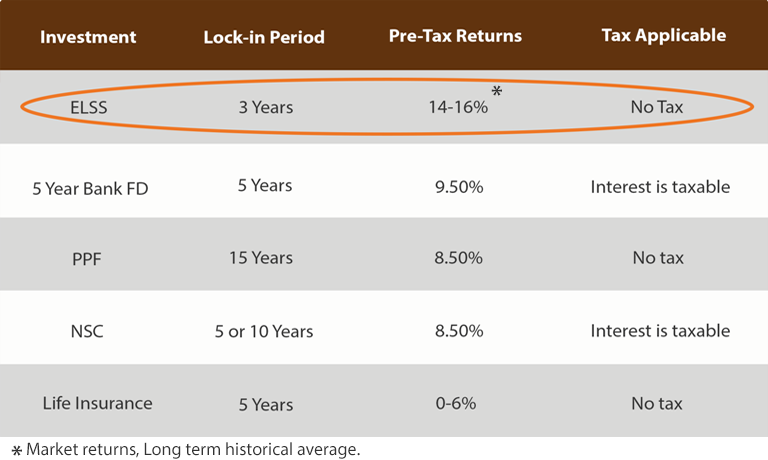
Comparing the different optionsSummary: 

The best way to look at the various 80C investment options is to see what is pre-determined and what is optional. 


InvestmentLock-in PeriodPre-Tax ReturnsTax Applicable
ELSS3 Years14-16%No tax
5 Year Bank FD5 Years9.50%Interest is taxable
PPF15 Years8.50%No tax
NSC5 or 10 Years8.50%Interest is taxable
Life Insurance5 Years0-6%No tax

Based on your risk appetite and expected returns, you can choose a product that’s best suited for your situation.

What does Scripbox recommend?
ELSS Mutual Funds – For people who want superior returns and also have higher risk appetite

PPF – For people who want returns at par with inflation and have very low risk appetite.

For a more detailed understanding of the most popular tax saving investment options, please read our detailed review below.


ELSS Tax Saving Mutual Funds

ELSS or Equity Linked Saving Schemes, are a kind of equity linked mutual funds. As they invest in equity or stocks, ELSS funds have the ability to deliver superior returns - 14-16% over the long term. That’s a full 6-8% above inflation.This return is not guaranteed though but historical evidence suggest that these returns are achievable over the long term.

ELSS funds have a lock in period of only 3 years – the lowest amongst the options available. The return from ELSS funds is also tax free.

You can investup to Rs 150,000 in ELSS funds either as a lump sum or on a monthly basis (SIP) thereby spreading your investments over the course of the year. The latter also helps in reducing volatility that’s typical of equity linked products.

You can invest in these mutual funds through an advisor or an online portal like Scripbox.

Public Provident Fund

PPF is a good option if you are looking for an option with certain returns.

Your PPF investments earns interest at a rate announced every year – currently 8.7%. PPF return is therefore mostly at par with inflation. However, it is tax-free and you can do a lump sum or small regular investments.

The duration of a PPF account is 15 years which is extendable by 5 years at a time. You cannot withdraw money from your PPF account except under certain conditions but not before 5 years.

You can invest in PPF through a bank or Post Office. Ability to invest online is limited.

5 Year Bank FDs

This is a variant of the regular Bank FD with a 5 year lock in. They offer slightly higher interest rates compared to normal FDs (0.25-0.5% higher) but does not offer liquidity option-even premature withdrawal with penalty is not possible.

The amount you can invest is limited to Rs 1,50,000. 

The interest you earn on your 5 year bank FD is fully-taxable and you will have to pay taxes on a yearly basis for the interest you earn for that period. TDS typically collected by banks is only 10% (20% in case you have not submitted your PAN) and if you happen to be in the 20 or 30% tax bracket, you need to pay the remaining interest while filing your IT returns.

Post-tax, 5 year bank FDs are not particularly attractive- especially for people in the 20 and 30% tax brackets since the post-tax returns (6-7%) are typically lower than other tax saving investment options.

National Savings Certificate (NSC)

NSC interest rates are fixed in April every year. The current rate is 8.5% for 5 year lock-in NSCs, and 8.8% for 10 year lock-in NSCs.

The interest accumulated is fully taxable. However, one key difference here is that the interest amount is not paid out to the investor. Instead, it’s re-invested in NSC and therefore can be considered as your investment in NSC for the subsequent year. Needless to say, this is complex.

Investments up to Rs 150,000 are eligible. You can invest in NSC via your local post office.

Life Insurance Premium

This was almost the default tax saving option for years. However, over the last few years, most informed investors have learnt the perils of choosing this option

There are 2 kinds of Life Insurance Policies:

Pure risk also called term life which ensure a risk to the life of the insured

Risk+ investment: which pay you back money over time. While pure risk life insurance is something everyone with a dependant must have, it’s not an investment. 

Life insurance is an expense-something you pay to ensure that your dependents are not left stranded should something unfortunate happen to you. 

Term life insurance is cheap and for a sum of about Rs 10000, you can purchase a cover of Rs 1 Cr

The returns from and costs of investment oriented insurance policies are not transparent and usually not attractive. We won’t go into length on this topic but suffice to say that you should not consider Life Insurance as a tax saving investment option.

National Pension Scheme

National Pension Scheme is a lot like investing in mutual funds with its Safe, moderate and Risky options. The returns are not guaranteed.

You cannot withdraw until 60 and the corpus amount must necessarily be invested in an Annuity. The withdrawals are also taxable.

Contributions up to Rs 150,000 are eligible for deduction under Sec 80C. You can invest via the specified list of NPS fund managers with points of presence operated through banks.

However, given the restrictions that come with NPS, it’s not a recommended option.

Pension Funds

Pension funds are designed to provide you an income stream post retirement. They come in two flavours: Deferred Annuity and Immediate Annuity.

For deferred annuity plan, you invest annually until your retirement. Once you reach your retirement, you have can withdraw up to 60% of your accumulated corpus and have to re-invest the remaining in an annuity fund which will give you a monthly pension.

When it comes to immediate annuity plans, you invest a bulk amount one-time and get monthly pension from the next month itself. You would typically use these to invest your retirement corpus.

Pension funds are not very popular because of the sub-par returns (around 6%) that they give and the restriction they come with. That’s less than India’s inflation rate and not even half of what ELSS funds provide in the long run.

Pension funds are offered by a number of providers. Contributions up to Rs 150,000 are eligible for deduction.

Senior citizens savings scheme

The senior citizens savings scheme is a product aimed at senior citizens to save tax. It can only be opened by people who are above 60 years old.

There is a maximum cap of 15 lakhs and a lock-in period of 5 years. You may withdraw the money before subject to penalty as follows

  • More than 1 year but less than 2 years – 1.5% of deposit amount
  • More than 1 year but before maturity – 1 % of deposit amount.This scheme is offered via the post office. Investments up to Rs 150,000 are eligible.

EPF (Employee Provident Fund)

For salaried employees, this is not necessarily an optional thing. You will need to follow your company’s policy with some leeway available. 

However, a lot of people forget that the amount contributed to EPF is also eligible for 80C deduction.

EPF is typically deducted from your salary every month and it includes 12% of your Basic salary + DA up to a maximum limit of INR 6500 per month (inclusive of the optional matching employer contribution).

You can withdraw EPF when you change jobs. However, your accrued amount will be taxed as other income. If you withdraw EPF after 5 years, you do not attract any tax. Withdrawal after 5 years is based on qualifying criteria.

The interest rate varies every year (for e.g. interest rate in 2010-11, was 9.5%, while in the previous five years it was 8.5%). For 2014-15, the interest rate is fixed at 8.5%.

Other Tax Saving Investments & Expenses

Apart from voluntary contributions we make, there might be some forced savings/ expenses that already qualify for tax saving.

Tuition Fees for Children: Tuition fees for up to 2 children are covered under section 80C. Please note that it covers tuition fees only and not development fees or donations.

Home Loan Principal Repayment: You are eligible for tax exemption for the repayment you make towards your home loan principal. Do note that the interest component is not eligible for tax benefits.

The scripbox recommended portfolio of tax saving ELSS funds will help you invest in the ELSS funds with the best prospects and also provide you the convenience of online investing and tracking.

Please note that this article does not attempt to be a comprehensive tax saving guide, only a listing of the most common alternatives. Other alternatives include Infrastructure bonds, PO deposits etc. It’s also recommended that you get proper tax advice for your situation.

ELSS funds-80C investment options to save income tax

Comparing popular 80C investment options to save income tax
There are various options to save tax under section 80C of the Income Tax Act. But,one of them is better than the others.

Comparing some of the most popular 80C investment options.


What are ELSS funds?

They are open-ended equity mutual funds that are eligible for tax deductions under Section 80C of the Indian Income Tax Act. They have the dual advantage of growing your wealth in addition to saving tax.

ELSS funds provide the best combination of

  1. Potential for Long term inflation beating returns (14-16%)
  2. Lowest lock in period (only 3 years) among all 80C investments and
  3. Zero tax on your income from investment

Like all equity funds, the returns on ELSS funds are not guaranteed but this is the historical average for long term investments in ELSS funds.

How to invest in ELSS funds?

At Scripbox, using our scientific algorithm, we carefully select ELSS funds with the best long term prospects for you.

How will my money grow by investing in ELSS funds?
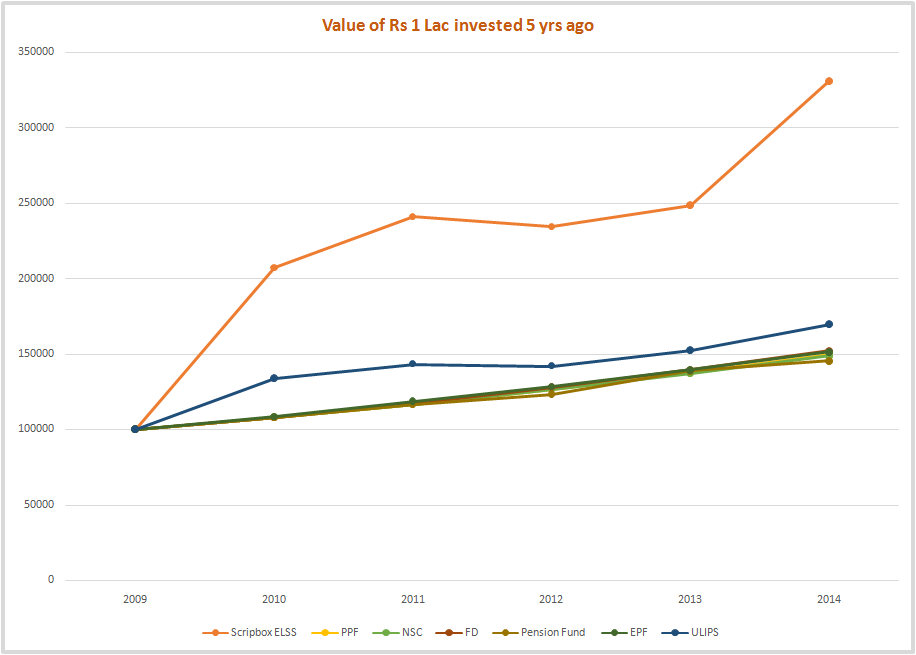
Careful ELSS fund selection can help you grow your wealth quickly compared to other 80C investment options.


ELSS funds potentially give you inflation beating returns (14-16% historical long term average), which help you grow your wealth in addition to saving tax.

6 most common financial planning mistakes


The 6 most common financial planning mistakes people make (and so might you.)


Effective financial planning is about building your wealth gradually and consistently. It entails setting specific goals, saving regularly, investing those savings, and protecting your assets. There are, however, some worryingly common financial planning mistakes that can keep you from doing any good to your money.

Here are those 6 mistakes that you should avoid:

#1. Ignoring inflation

When planning finances, the time value of money, or how money loses its value over time is usually ignored by the vast majority. While incorporating increase in income with time, it is vital to consider the increase in expenses and the drop in the value of money thanks to the annual overall increase in prices of common goods and services.

Being over-dependent on “safe” investments such as saving accounts, Bank FDs, and government bonds will lead to your portfolio giving returns at a rate lower than the inflation rate.

Ignore inflation and you might just see your savings slowly erode away while your financial plan goes haywire.

#2. Undervaluing long term expenses when considering retirement

When investing and saving for your retirement, the most important point to consider is the correct valuation and estimation of health care and other long term expenses, owing to the process of aging.

Health care and other long term costs increase with age, and incorporating these expenses correctly is necessary for an effective retirement plan. Not doing so would compromise your savings and finances during your years of zero income.

#3. Not saving enough or investing when you are young

The initial years of your investing life must be focused on savings. The rate of savings during that time should be more than the rate of returns.

An effective investment plan can be made, gradually, once you are saving consistently and as much as you can in those initial years. Remember, the earlier you start, the more time compounding has to double or triple your money.

Savings should be made not just by controlling daily expenditures, but also by considering the money paid towards taxes. Figure out a good plan to maximize your savings during the initial years of your investment life. If you are in a higher income category, tax savings (through the correct choice of investments) should be important.

#4. Investing too aggressively or too conservatively

A common financial advice is that people falling into the age group of 20-40 yearsshould invest aggressively. Although this idea makes sense, it is necessary to invest using reasonable logic and not to be blind towards risk. Exposing yourself to more risk than your goals allow for may end with you losing too much and, move you completely away from investing in the future.

Just as being too aggressive is not recommended, being too conservative when investing has its downside too. Being too conservative when investing can lead to loss in the value of your money. Stocking up cash in your savings account will bring down its value over a period of time. Rs 100 today would be practically worth half its value, in less than a decade, if it stays just in your bank account.

It is important to invest across investment options with varying degrees of risk, to make your money grow at a consistent and an increasing rate.

#5. Making financial planning all about investing

It is a common mistake to believe that financial planning is all about investing. It must be noted that investing is just one part of an ideal financial plan that you must make to meet your long term goals.

It is important to focus on day-to-day budgeting, appropriate insurance cover (for everything of real value to you, including your health) and smart tax decisions, to make an effective and appropriately long term financial plan.

#6. Thinking that Insurance is about saving tax

Far too many individuals make this common mistake in India. Insurance of any kind is an expense and not an “investment”. Buying insurance (life or health) just to save tax is one of the worst ways you can spend your money, unless you actually need the insurance.

Health Insurance in today’s expensive healthcare scenario is a must. Life Insurance is a must only if you have dependents. Think about the utility of the insurance first before you think about the tax benefits.