Showing posts with label Spiritual. Show all posts

Thursday, 28 July 2016

Kali Yuga: When Did It End and What Lies Ahead?

Kali Yuga: When Did It End and What Lies Ahead? 
By Sadhguru Jaggi Vasudev | Nov 05, 2015 | 18,150 views 


In the yogic astronomy, we divide the orbit of the Earth around the Sun into 27 segments, called nakshatras. Each nakshatra is further divided into four equal sectors called padas or steps.

Multiply 4 by 27 and it equals 108. These 108 units mark the 108 steps that the Earth takes through space. Each nakshatra corresponds to one half of the lunar orbit around the Earth. The cycles within the human body respond and correspond to that.

In a woman’s body, there are very obvious cycles of 27.55 days if she is perfectly healthy. In a man’s body, the cycles are less obvious and pronounced – they happen in a different way and are of a larger span of time. In any case, these cycles are happening all the time in the solar system and the larger universe.

The microcosm and the macrocosm both are playing the same game. But who should play whose game? If you think the macrocosm is going to play your game, you will waste your life. If you play the macrocosm’s game, your life will be beyond your expectations.

The Cycle of Four Yugas 

The precession (caused by gradual rotation of the Earth’s axis) of the equinoxes is the period of time that it takes the Earth’s axis to pass through one complete cycle of the zodiac. It takes the planet 72 years to pass through one degree of the zodiac and 25,920 years to complete one full circle of 360 degrees.


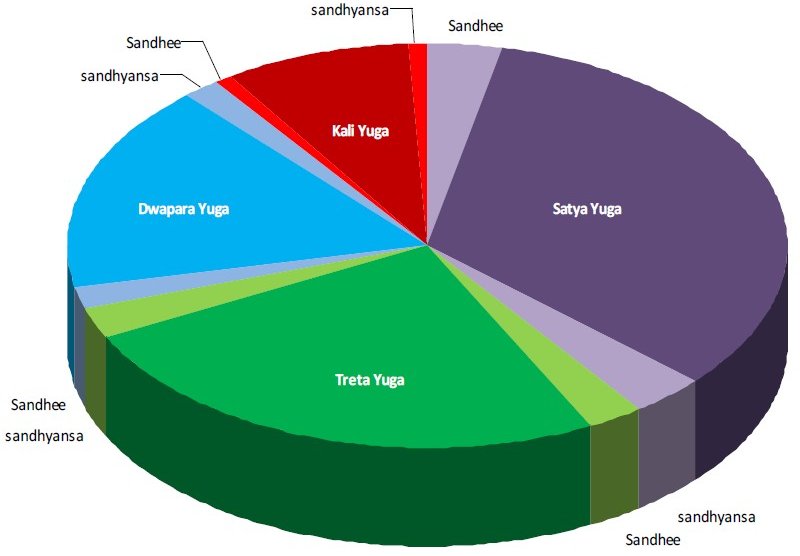
One half of the journey takes 12,960 years and covers the four yugas. 
Satya Yuga lasts 5184 years. 
Treta Yuga lasts 3888 years. 
Dwapara Yuga lasts 2592 years. 
Kali Yuga lasts 1296 years. 
These four yugas taken together come to a total of 12,960 years

The Beginning of Kali Yuga 

The story of Mahabharat needs to be seen in a certain context. 
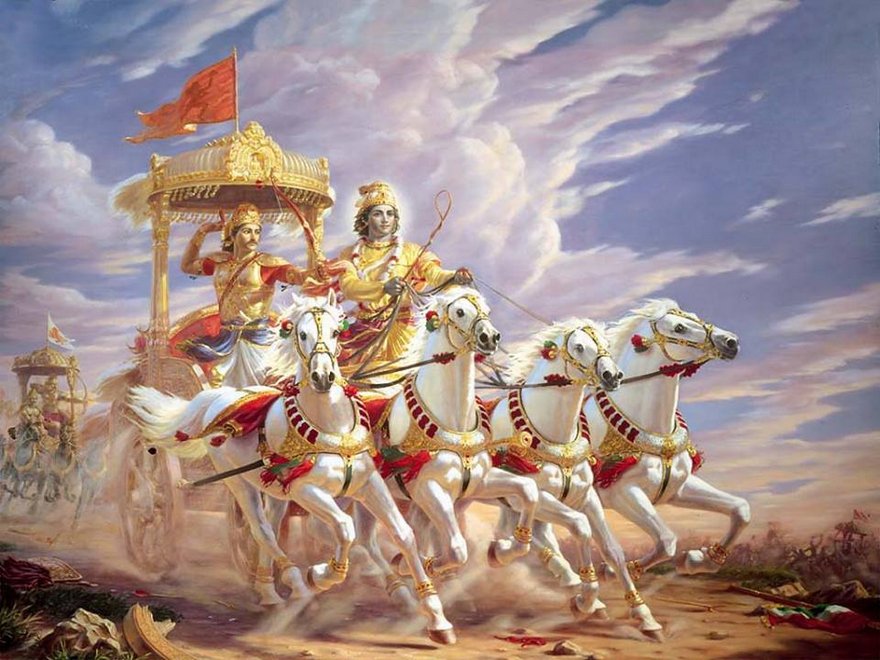
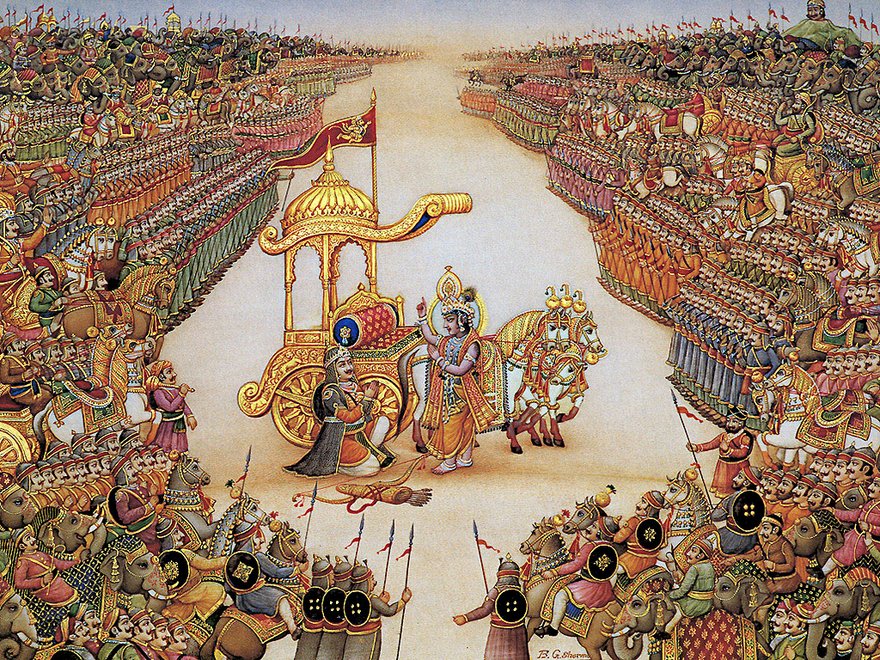
In 3140 BCE, the Kurukshetra War ended, and in 3102 BCE, Krishna left his body. Three to four months after the war, the Kali Yuga began. 

As of 2012 AD, Krishna’s era ended 5,114 years ago. If you subtract 2592, which is the cumulative number of years of the two Kali Yugas that are at the bottom of the ellipse which describes the axial precession, you arrive at 2522 years.

That means we have already completed 2522 years of Dwapara Yuga, and since its total duration is 2592 years, we still have 70 years until its completion. 

In the year 2082, we will complete Dwapara Yuga and move on to Treta Yuga. 

The world will go through another upheaval, not necessarily in terms of war but probably in terms of population explosion and natural calamities, before moving on to this new era of wellbeing and upward movement of human consciousness.

Yugas and Human Consciousness 

The solar system with the Sun and the planets around it is moving in the galaxy. It takes 25,920 years for our solar system to complete one cycle around a larger star. 

From the effects upon the planet, we believe this big star or big system that our system is going around is not located in the center of the orbit but somewhere to the side. 

Whenever our solar system comes closer to this big system, all the creatures living in our system rise to greater possibilities. Whenever our system moves away from it, the creatures living in our system come to the lowest level of possibility – we say this is Kali Yuga. 

When our solar system is closer to the “Super Sun,” Satya Yuga will begin. The human mind will be at its highest capability. 

People’s ability to know life, people’s ability to communicate, people’s ability to live joyfully will be at its highest. Or in other words, we will have sensible people. All it takes to live well on this planet is a bunch of sensible people.

In Satya Yuga, human ability to communicate will be at its best because the ether will be very close. Right now, the etheric sphere of the planet is raised to a certain point. There was a time when it was much higher – now it has come a little closer. When the ether is very close and I want to convey something to you, I do not have to say it. Even when my eyes are closed, you will know what I want to say. When the ether rises a little bit but is still at a certain distance, if I close my eyes, you will not know, but if I open my eyes and look at you, you will know what I want to convey.

The Ether and Spiritual Possibilities 

If the ether rises some more, you can know by breath. If you go into the forest, you will see, because your vision is blocked to some extent, after some time, the most significant way of knowing things is by smell. Most animals that live there know things only by smell. Because of such concentrated life energy, the ether is high. Because the ether is high, they do not have to see.

If you talk, they will get confused. When the ether is very low, you have to talk all the time – otherwise, people will not get it. Even if you talk, they will not get it. You have to knock and talk continuously to make them get it. The etheric content in the atmosphere determines how sensitive you are in terms of your ability to communicate.

Krishna also said that after over 5000 years, there will come a many thousand year period of time that will be fabulous.


At the same time, no matter which time, which yuga, which planetary position we are in right now, still, individual human beings can rise above all this. Still, individual human beings can live in a golden time within themselves. Even in the worst of times, the possibility to be well above it is always there for an individual human being.

There are many things one can do to enhance the ether or create etheric content. This is why Krishna said, in Kali Yuga, which is down there, far away from the Super Sun, the ether will be so low that there is no point in trying to teach them yoga, meditation, mantras, or yantras – they will not get it.

Just teach them devotion. If they are devout, they will generate their own ether. And because of this etheric content in the atmosphere, they will perceive. Devotion is not for the dumb – but even if you are the dumbest, you can still get it.

Thousands of years ago, they said that as the solar system moves closer to the Super Sun, human intelligence will blossom. As the solar system moves closer, the realization that the whole body and the whole universe are electric structures will come naturally. Right now, we are moving towards Treta Yuga, which is the second best time that can happen in a cycle of yugas.

Krishna also said that after over 5000 years, there will come a many thousand year period of time that will be fabulous. We will not make it there, but we can set the foundations for it and have the joy of creating an atmosphere for a stretch of thousands of years of golden time upon the planet.

This is not all predictions and conjecture – this is based on a deep-rooted understanding about what happens with the human mind in relation to the planet on which we live. We do not only live on this planet – we are the planet. If you do not understand this today, you will understand this when you are buried. The planet understands that you are a part of it – only you think something else of yourself.

Mahabharat – The Story of Every Human Being 

The story begins because you have false ideas about yourself. Mahabharat represents the grand misconception of human beings about life; their sufferings, their rises and falls. It goes on and on, simply because human beings are struggling to come in tune with life. Whatever someone who is in tune with it tries to say, everyone else will misunderstand. Light cannot be put in words, but if you open your eyes, you can see the light. Similarly, if this life that you are opens up, it can feel life, it can become life.


Life cannot be told. Telling is only to inspire, to de-mesmerize you from your own self-mesmerism. Every human being has hypnotized himself or herself into their own limitations and they believe this is it. If you undo that hypnotism, they will feel fearful because existence is limitless. Therefore, if they are spinning one way, you have to spin them the opposite way for some time for them to feel they are going somewhere.

The whole Mahabharat is just this effort. No matter what they are doing, everyone thinks they are doing it for the good. Whether it is “my good,” “your good,” someone else’s good, or everyone else’s good – whatever kind of good, everyone thinks they are doing it for the good. But everyone is neither good nor bad, neither right nor wrong – the story just goes on.

The story is not about a particular person – Mahabharat comes under the classification of Itihasa. In India, there are three categories of great texts: Itihasa, Purana, Veda. Vedas are full of abstract ideas, scientific theories, and explanations for celestial happenings.

Puranas are stories of beings who are not human. Itihasa is the story of the human being, not in terms of history, though there is a historic element to it. The facts are rooted in history, but this is the story of every human being – it is about the meaning of your life. Only if it is your story, it can be a process of growth for you.

Source: www.ishafoundation.org

15 Predictions for Kali Yuga from the Bhagavata Purana

15 Predictions for Kali Yuga from the Bhagavata Purana


In the last canto of the Bhagavata Purana there is a list of predictions and prophecies about the dark times for the present age of Kali Yuga. 


The following 15 predictions, written more than 5,000 years ago by sage Vedavyasa, are amazing because they appear so accurate. Despite the negative tone of these prophecies, there is still one bright spot for all of us, which is mentioned at the end.

Prediction 1:

Religion, truthfulness, cleanliness, tolerance, mercy, duration of life, physical strength and memory will all diminish day by day because of the powerful influence of the age of Kali.

Source: Srimad Bhagavatam 12.2.1

sri-suka uvaca
tatas canu-dinam dharmah
satyam saucam ksama daya
kalena balina rajan
nanksyaty ayur balam smrtih

Prediction 2:

In Kali Yuga, wealth alone will be considered the sign of a man’s good birth, proper behaviour and fine qualities. And law and justice will be applied only on the basis of one’s power.

Source: Srimad Bhagavatam 12.2.2

vittam eva kalau nṝṇāḿ
janmācāra-guṇodayaḥ
dharma-nyāya-vyavasthāyāḿ
kāraṇaḿ balam eva hi

Prediction 3:

Men and women will live together merely because of superficial attraction, and success in business will depend on deceit. Womanliness and manliness will be judged according to one’s expertise in sex, and a man will be known as a brahmana just by his wearing a thread.

Source: Srimad Bhagavatam 12.2.3

dāmpatye ‘bhirucir hetur
māyaiva vyāvahārike
strītve puḿstve ca hi ratir
vipratve sūtram eva hi

Prediction 4:

A person’s spiritual position will be ascertained merely according to external symbols, and on that same basis people will change from one spiritual order to the next. A person’s propriety will be seriously questioned if he dos not earn a good living. And one who is very clever at juggling words will be considered a learned scholar.

Source: Srimad Bhagavatam 12.2.4

lińgaḿ evāśrama-khyātāv
anyonyāpatti-kāraṇam
avṛttyā nyāya-daurbalyaḿ
pāṇḍitye cāpalaḿ vacaḥ

Prediction 5:

A person will be judged unholy if he does not have money, and hypocrisy will be accepted as virtue. Marriage will be arranged simply by verbal agreement, and a person will think he is fit to appear in public if he has merely taken a bath.

Source: Srimad Bhagavatam 12.2.5

anāḍhyataivāsādhutve
sādhutve dambha eva tu
svīkāra eva codvāhe
snānam eva prasādhanam

Prediction 6:

A sacred place will be taken to consist of no more than a reservoir of water located at a distance, and beauty will be thought to depend on one’s hairstyle. Filling the belly will become the goal of life, and one who is audacious will be accepted as truthful. He who can maintain a family will be regarded as an expert man, and the principles of religion will be observed only for the sake of reputation.

Source: Srimad Bhagavatam 12.2.6

dūre vāry-ayanaḿ tīrthaḿ
lāvaṇyaḿ keśa-dhāraṇam
udaraḿ-bharatā svārthaḥ
satyatve dhārṣṭyam eva hi
dākṣyaḿ kuṭumba-bharaṇaḿ
yaśo ‘rthe dharma-sevanam

Prediction 7:

As the earth thus becomes crowded with a corrupt population, whoever among any of ther social classes shows himself to be the strongest will gain political power.

Source: Srimad Bhagavatam 12.2.7

evaḿ prajābhir duṣṭābhir
ākīrṇe kṣiti-maṇḍale
brahma-viṭ-kṣatra-śūdrāṇāḿ
yo balī bhavitā nṛpaḥ

Prediction 8:

Harassed by famine and excessive taxes, people will resort to eating leaves, roots, flesh, wild honey, fruits, flowers and seeds. Struck by drought, they will become completely ruined.

Source: Srimad Bhagavatam 12.2.9

śāka-mūlāmiṣa-kṣaudra-
phala-puṣpāṣṭi-bhojanāḥ
anāvṛṣṭyā vinańkṣyanti
durbhikṣa-kara-pīḍitāḥ

Prediction 9:

The citizens will suffer greatly from cold, wind, heat, rain and snow. They will be further tormented by quarrels, hunger, thirst, disease and severe anxiety.

Source: Srimad Bhagavatam 12.2.10

śīta-vātātapa-prāvṛḍ-
himair anyonyataḥ prajāḥ
kṣut-tṛḍbhyāḿ vyādhibhiś caiva
santapsyante ca cintayā

Prediction 10:

The maximum duration of life for human beings in Kali Yuga will become 50 years.

Source: Srimad Bhagavatam 12.2.11

triḿśad viḿśati varṣāṇi
paramāyuḥ kalau nṛṇām

Prediction 11:

Men will no longer protect their elderly parents.

Source: Srimad Bhagavatam 12.3.42

na rakshishyanti manujah
sthavirau pitarav api

Prediction 12:

In Kali-yuga men will develop hatred for each other even over a few coins. Giving up all friendly relations, they will be ready to lose their own lives and kill even their own relatives.

Source: Srimad Bhagavatam 12.3.41

kalau kakinike ‘py arthe
vigrihya tyakta-sauhridah
tyakshyanti ca priyan pranan
hanishyanti svakan api

Prediction 13:

Uncultured men will accept charity on behalf of the Lord and will earn their livelihood by making a show of austerity and wearing a mendicant’s dress. Those who know nothing about religion will mount a high seat and presume to speak on religious principles.

Source: Srimad Bhagavatam 12.3.38

sudrah pratigrahishyanti
tapo-veshopajivinah
dharmam vakshyanty adharma-jna
adhiruhyottamasanam

Prediction 14:

Servants will abandon a master who has lost his wealth, even if that master is a saintly person of exemplary character. Masters will abandon an incapacitated servant, even if that servant has been in the family for generations. Cows will be abandoned or killed when they stop giving milk.

Source: Srimad Bhagavatam 12.3.36

patim tyakshyanti nirdravyam
bhritya apy akhilottamam
bhrityam vipannam patayah
kaulam gas capayasvinih

Prediction 15:

Cities will be dominated by thieves, the Vedas will be contaminated by speculative interpretations of atheists, political leaders will virtually consume the citizens, and the so-called priests and intellectuals will be devotees of their bellies and genitals.

Source: Srimad Bhagavatam 12.3.32

dasyutkrishta janapada
vedah pashanda-dushitah
rajanas ca praja-bhakshah
sisnodara-para dvijah

Despite all of these dark prophecies, there is one good quality in this age of Kali yuga:

kaler dosha-nidhe rajann
asti hy eko maha gunah
kirtanad eva krishnasya
mukta-sangah param vrajet

“Although Kali-yuga is an ocean of faults, there is still one good quality about this age: simply by chanting the names of Krishna, one can become free from material bondage and be promoted to the transcendental kingdom.” (Source: Srimad Bhagavatam 12.3.51)


Tuesday, 2 February 2016

ABSTAINING FROM MEAT IS A MEANS OF ATTAINING WORLD PEACE-Chadral Rinpoche

ABSTAINING FROM MEAT IS A MEANS OF ATTAINING WORLD PEACE

An Interview with Chadral Rinpoche (1913-2015)
Question: Why did you decide to stop eating meat? How old were you when you made this decision?
Rinpoche: It is written in many Theravadayana and Mahayana texts that one should not eat meat. There is also a Vajrayana text that says the same thing, that one should not enjoy meat or alcohol. Because of this I am following the instructions of Shakyamuni Buddha. Being a religious person, I don’t take meat or alcohol and at the same time I try to tell other people not to consume these things. This is my reason — I’m just trying to motivate other people. I was forty-seven years old when I went to Bodhgaya and made a vow to all of the buddhas and bodhisattvas to give up meat and alcohol.
Question: Why do you think vegetarianism is an important aspect of practicing the Dharma?
Rinpoche: If you take meat, it goes against the vows one takes in seeking refuge in the Buddha, Dharma, and Sangha. Because when you take meat you have to take a being’s life. So I gave it up.

Question: Some claim that one can help the animals one eats by praying for them, and thus eating meat is compassionate. Other than for the most accomplished yogis and lamas, what do you make of this claim?
Rinpoche: With supernatural powers gained through certain meditation practices, it is true that there are some realized beings who can revive animals from the dead and help them reach a higher rebirth or enlightenment by consuming small amounts of their flesh. But this is not done for sustenance, only for the purpose of helping that animal. I personally do not have that power and, because of that, I never eat meat. 

Eating meat in one’s diet is much different than eating flesh to liberate a being through supernatural powers. I am just an ordinary practitioner who really doesn’t have these qualities. 

So, if I ate meat it would be the same if you or any other lay person ate meat. I would be committing a sin and I would be getting negative karma. I don’t pretend as if I have special powers and eat meat, I just avoid it altogether.

Question: Do you see Tibetan Buddhists in exile making a sincere effort to reduce their meat consumption and become vegetarian, or has meat eating become an entrenched aspect of Tibetan culture?
Rinpoche: In Tibet, there’s only meat and tsampa [roasted barley flour] — there is no other staple food. Tibet is at a high altitude and the climate is tundralike. There are not many fruits and vegetables. After coming to South Asia, you really don’t have to follow the Tibetan custom of meat and tsampa. 

There are many types of fruits and vegetables, nutritional supplements — all kinds of good foods. Everything is available. So there is really no need to talk about the customs of Tibet as an excuse for eating meat. 

From my experience, not eating meat has many benefits. I’m eighty-eight and ever since I stopped eating meat, I haven’t had any major sickness. When I sleep, I sleep well. When I get up, I can walk right away. When I read religious texts, I can see them properly. I have very good hearing and can listen attentively. These are the qualities I have experienced from not eating meat. I didn’t get sick or die when I stopped eating meat; no negative consequences came to me. 

I can travel by vehicle, airplane, or train without getting nauseous or dizzy and I never get headaches. I am a human being formed with flesh and blood like anyone else and am proof that giving up meat does not make one ill like many Tibetans seem to think. 

I’m telling you from my own experience; only good things have happened to me from giving up meat.

Question: Some monks have told me that since insects are killed in the production of rice and other vegetables, then there is really no difference in eating those things and eating meat. What do you think about this?
Rinpoche: This would mean that you wouldn’t eat anything and would starve to death. If you say you were going to go for a month without killing insects through the food you eat, then you would die. If you die, this precious human life is wasted. So if you just let your body be destroyed, that means you are taking your own life, which is killing in itself. 

You can always take the insect from the rice when you see it and let it free outside. You don’t necessarily have to kill beings to eat. Although, when we walk we crush many insects under our feet. We may not see them or observe them, but still we must be killing them. 

Not being aware doesn’t mean that we haven’t created any sin, because after all, cause and effect are always there.Read the whole article here: http://wildyogi.info/…/natalia-sander-vegeta
rianism-tibetan…

Monday, 18 January 2016

Three Bandhas: Introduction to the inner energy locks

Three Bandhas: Introduction to the inner energy locks – Part 1


In the Yogataravali Sutras it is said, “Jalandhara bandha, uddiyana bandha and moola bandha are situated in the throat, abdomen and perineum respectively. If their duration can be increased then where is the fear of death? By the practice of these three bandhas, the dormant kundalini awakens and enters into the sushumna. The breath becomes still (kumbhaka). With the performance of these three bandhas, the rechaka (exhalation) and pooraka (inhalation) ceases to function. With this the senses become purified and kevala (enlightenment) takes place. I pray for that vidya (knowledge) residing in Kevala kumbhaka.” (YS, 5, 6, 8 )

The word bandha (which should not be confused with the words bandh, bandha and bandhana, which have similar meanings) may be defined in several ways. A Sanskrit dictionary definition runs as follows: “binding, tying a bond, tie, chain, fetter, a ligature, to catch, hold captive, arrest, imprison, fix, fasten, hold back, restrain, stop, shut, close, to redirect, check, obstruct, clot and lock.”

Bandha may also be defined analogously and is likened to the “damming of a river”, “building a bridge” or “building over the sea.” This can be interpreted as meaning that, a bandha is a vehicle to traverse the ocean of samsara (worldly existence) and reach the other shore of enlightenment.

The bandha group consists of moola, uddiyana and jalandhara bandhas. The fourth, maha bandha, is a combination of these three. How is it that a group of only four practices is considered equal to or of greater importance than the hundreds of asana, pranayama and mudra practices and their variations? Traditionally, the fact that the spiritual aspirant was introduced to bandhas secretly and only after he had mastered the execution of many, often complex, asanas, pranayamas and mudras shows that the practice of bandhas was highly respected by yogic practitioners.

Seen physically, moola bandha is the conscious, willful contraction of the perineum or cervix, uddiyana bandha of the solar plexus and jalandhara bandha of the throat.

Concept of Lock

In most modern yogic literature, bandha is defined simply as a “lock.” However, the true meaning of bandha is essentially paradoxical, for it is said that by locking or contracting certain muscles on the physical level a subtle process of “unlocking” goes on simultaneously on the mental and pranic levels. Most modern muscle relaxation therapies advocate that by the total, systematic contraction and relaxation of muscles all over the body, one regains complete physical and mental relaxation. The underlying rationale of such a theory is that in order to remove physical and mental tension it is more effective to first learn to exaggerate the tension already existing in the body by willfully and selectively contracting all of its muscles.

Bandhas work in a similar way, simultaneously affecting the physical, pranic, mental, psychic and causal bodies. They have far reaching effects because they are associated with energy centers in the spine and brain. Therefore, bandhas are more dynamic, explosive and immediate in effect than simple contractions of muscles in the arms or legs.

Mechanics of Bandhas

Bandhas involve the contraction or squeezing of muscles. As there are three bandhas, there are three main muscle groups involved: the perineal muscles, the abdominal muscles and the cervical (neck) muscles. Contraction of these muscles affects the nervous, circulatory, respiratory, endocrine and energy systems. When a muscle is contracted a nerve impulse is relayed to the brain, triggering other neuronal circuits and nervous centers. This in turn affects our state of consciousness. In response to this stimulation, the brain adjusts its firing patterns. For example:

1. Moola Bandha (perineal contraction) stimulates both the sensory-motor and the autonomic nervous system in the pelvic region. When moola bandha is performed, pelvic stimulation activates parasympathetic fibers merging from the pelvic spinal cord. Parasympathetic fibers emerge from the cervical (neck) and sacral (pelvic) area only, while sympathetic fibers emerge from the thoracic (upper back) and lumbar (lower back) areas. The performance of bandhas has been experimentally shown to enforce all parasympathetic activities in the body which includes a decrease in heart rate, respiration and blood pressure (only in a person with normal blood pressure), and a general sense of rest and relaxation. Sympathetic nervous stimulation also occurs in moola bandha but at a subdued level. The overall effect of stimulating both parasympathetic and sympathetic nervous system is to re-balance these two major components of the nervous activity in the body. This has a very definite repercussion on the hypothalamus (responsible for the complete endocrine system), which relays its information to the whole limbic (emotional) system and the cerebral cortex (outer layer of the brain).

2. Uddiyana bandha (abdominal contraction) compresses the digestive organs, adrenal glands, kidneys, and most importantly the solar plexus. This “brain-in-the-stomach” is squeezed and in return a flood of energy is generated in the abdomen and chest. The energy has healing qualities and is experienced consciously as beneficial, enhancing our sense of well-being. Uddiyana bandha tones the sympathetic nervous system, encouraging it to work more efficiently. It also enables us to gain control over the sympathetic nervous system so that it does not function in unsuitable situations, thus avoiding the effects of stress and anxiety in psychosomatic disease.

3. Jalandhara bandha (throat compression) stretches the neck, pulling the spinal cord and thus the brain. This has subtle effects on the pituitary and pineal glands while the forward flexion (in jalandhara bandha the chin is placed on the chest) affects the thyroid, parathyroid and thymus glands. At the same time it stimulates the parasympathetic spinal area in the medulla oblongata (situated at the bottom of the brain and the top of the spinal cord) regulating heart rate, respiration, blood pressure, etc. Finally, jalandhara bandha also compresses the carotid sinuses which help in lowering the blood pressure. By reducing sympathetic tone, one achieves a sense of rest, relaxation and general well-being.

The performance of bandhas leads to a general massaging effect of the muscles and internal organs. Increased blood supply to these areas aids in a general purification of the body. Bandhas affect the endocrine glands. As these glands are intimately related to the chakras, it is a natural consequence that the bandhas also affect the chakras. When stimulated, the chakras influence every aspect of the organism, revitalizing it with life-sustaining energy.

Physical Effects of Bandhas

The performance of bandhas in conjunction with pranayama (breath and energy control) affects the whole body:

They harmonize the efficient functioning of the endocrine system: jalandhara directly influences the pituitary, pineal, thyroid, parathyroid, thymus; uddiyana bandha directly influences the adrenals and pancreas; moola bandha directly influences the gonads and the perineal body/ cervix (which are said to be vestigial endocrine glands). All bandhas have an indirect effect on the pituitary, pineal and brain.

As a result of the direct effect that the bandhas have on the endocrine glands, certain bio-rhythms in the body are also regulated. For example, both moola bandha and uddiyana bandha are extremely useful in stabilizing menstrual periods.

All bandhas, when performed correctly, lower respiration rate, inducing calmness and relaxation.
Blood pressure is decreased.
Heart rate is lessened.
Alpha brainwave production, an index of profound relaxation, is increased, indicating slowing of nervous activity.
Sympathetic activity in the body is decreased, a further index of relaxation.
Confused and/or crossed neuronal circuits in the brain are reordered, in effect “retraining the brain”.
The digestive system is toned, massaged and revitalized via pressure on the internal organs.
Harmony in the activity of the urogenital system occurs as a result of reflex action via the nervous system.

Pranic Effects of Bandhas

Each bandha is associated with the stimulation of a specific focus of prana. Bandhas are said to be mutually related to certain nerve plexus in the spine, the endocrine glands; as well as pranic energy centers known as chakras. For each nerve plexus and endocrine gland on the physical level there exists a corresponding chakra on the pranic level as follows: mooladhara – sacral/ coccygeal plexus; swadhisthana – prostatic plexus; manipura – solar plexus; anahata – cardiac plexus; vishuddhi – pharyngeal/ laryngeal plexus; for ajna and sahasrara, the pineal/ pituitary/ hypothalamic complex. Of the six chakras in the spine, the bandhas are directly associated with the active stimulation of three chakras as follows: moola bandha, mooladhara chakra; uddiyana bandha, manipura chakra; jalandhara bandha, vishuddhi chakra. Each of these physical and pranic locations are related, neurologically, to a specific counterpart in the spinal cord and brain, and therefore the psyche. Contraction at the physical level activates and awakens hitherto dormant faculties in the brain and mind, usually present in only the most evolved mind. Mastery of the bandhas, therefore, leads to the fullest realization of our potential.

The physical, endocrinological and neurological aspects of bandhas can be understood when we appreciate the fact that the body is a complex yet well organized field of various energy systems, based on one fundamental energy principle called prana. Though they have vast physical repercussions of a positive nature, their main effect is on the body’s energy systems at the pranic level.

According to many esoteric philosophies the downward flow of prana (apana) represents the part which leads man’s consciousness to the lower, earthier elements: for e.g. satisfaction of instinctual desire, over-indulgence, lethargy, apathy, laziness and so on. According to these philosophies, it is believed that man’s essential nature is Godlike and that in order to re-unite or realize the “first cause” he must re-direct his consciousness. Here the role of bandhas, and especially moola bandha, is to block the descending movement of consciousness and re-direct it upwards.

A useful analogy to aid our understanding of bandhas is to liken them to the locking, stopping, obstructing and re-directing power of a dam wall. Energy (physical mental and psychic) is centralized and focused at the site of contraction so that it can be re-directed for useful work as desired by the controller. These areas are infused with a fresh, vital force capable of checking imbalances in the body systems.

To further understand bandhas we must extend our view so as to see them not only as locks, but also as removers of locks, or blockages, in the form of physical and mental impurities. According to the scriptures there are granthis of psychic knots, located at mooladhara, anahat and ajna chakras. Granthis represent blockages in man’s awareness of himself at the different levels of consciousness; they obscure the true image of man’s essential nature. Traditionally, bandhas were prescribed as one of the most effective means of untying these knots or blockages, existing as tension, anxieties, repressions and unresolved conflicts, thereby allowing us to re-discover our true nature.

The force generated from the bandhas may be likened to that of increased pressure in a tube. Imagine a piece of tubing resting vertically to the ground. This tube represents sushumna nadi (the main pranic energy channel which runs up the spine).

Moola bandha represents the sealing of the lowest portion of the tube, thus preventing the downward motion of prana. It stimulates energy in mooladhara, awakening kundalini shakti.

Jalandhara bandha seals off the top portion of the tube. Prana is now locked within this tube.

Uddiyana bandha completes maha bandha. It further increases pranic pressure by stimulating the solar plexus (manipura chakra), filling and expanding the closed tube.

Thus, when maha bandha is performed, prana is compressed in sushumna. The locks prevent its downward and upward movement at the same time stimulating energy. Release of the bandhas flushes prana through the whole body, and as prana is by nature vital, life-giving energy, the body is relaxed, toned and rejuvenated. The granthis can then be pierced and untied, expanding consciousness.

– Dr. Hiren Parekh


Three Bandhas: Introduction to the inner energy locks – Part 2


In Part 1 of the Three Bandhas article, we had introduced and explained the three different bandhas and their effects on an individual. Here, in the 2nd part of this series, we further provide insights on the relationship of these bandhas with consciousness, the importance of moola bandha and also its effect on the mind and body.

Bandhas and Consciousness:

According to yogic scripture, control of muscles and nerves regulate breath. Control of breath controls consciousness. Bandhas are a means of extending control over breathing and are thus a means to extend our knowledge and control over consciousness.

Breathing rate and depth are said to be affected by: states of consciousness, disease, atmospheric conditions, thoughts, exercise and emotions. Research has shown that in a state of tension and fear, respiration becomes short and shallow, whereas in a state of relaxation, people take long and deep breaths.

When bandhas are performed in conjunction with pranayama, contraction of the muscles takes place simultaneously along with kumbhaka (internal or external breath retention). The physical lock or contraction is applied and at the same time the breath is also arrested or immobilized. As a result, consciousness is also arrested, stopping the flow between the polar opposites of inhalation and exhalation, birth and death, joy and sorrow, gain and loss.

Through the perfection of bandhas, a Yogi is able to lock himself into the ‘eternal now’ devoid of the dualities of existence, motion and change. His consciousness is unfettered by the modifications of thought enabling him to merge into the field of unified consciousness. As such, the bandhas induce pratyahara (sense withdrawal) and are preliminary techniques for meditation.

We find then that the bandhas induce five different kinds of ‘retention’ or immobility: retention of muscles, breath, senses, thought and consciousness. Once retention of consciousness is achieved, the Yogi is prepared for the next stage of his spiritual rebirth, the awakening of kundalini. The bandhas act as triggering mechanisms for the activation of this powerful force residing at the base of the spine.

Technically speaking, kundalini yoga comprises of any technique that leads to kundalini awakening. Bandhas fall into this category and thus may be classified as techniques of kundalini and kriya yoga, as systematized by Swami Satyananda Saraswati of Bihar School of Yoga, Munger.

Of the four bandhas, we aim to focus solely on moola bandha, regarded by many adepts as the most important of the bandhas. Without it, kundalini, dormant in the mooladhara chakra, will remain asleep eternally. Little has ever been written on this eminent yogic practice, depriving it of the respect and understanding which it so richly deserves.

Moola Bandha

The Sanskrit word moola (also written mula) means ‘root, firmly fixed, source or cause, basis, the foot, lowest part or bottom, foundation’. Bandha means ‘lock, restrain, shut or close’. Together the words moola and bandha refer to the contraction of mooladhara chakra, the seat of kundalini. This contraction is triggered at the ‘root’ of the spine or the trunk of the body, the perineum. Moola bandha is known as the ‘perineal lock’, contraction of the muscles around the perineal body in the male and the cervix in the female, in order to release and control energy generated by the mooladhara chakra. Moola bandha occurs simultaneously at many levels. On the physical level it is the physical contraction of muscles. However, when refined, moola bandha is the contraction of mooladhara chakra. It is important to note, therefore, that moola bandha is not just the contraction of the perineal body/cervix but also the ’locking’ (contraction) of mooladhara chakra. The perineal body and cervix act as trigger points to enable us to locate the psychic center of mooladhara chakra.

Kundalini shakti on awakening from her sleep acts as a medium for the expansion of consciousness, thereby allowing a complete achievement of one’s innate ability. This in turn enables the person to rise to the level of divinity, leaving behind the mundane realm of the cycle of birth and death.

Importance of Moola Bandha

The importance of moola bandha should not be underrated, because its perfection may lead to a spontaneous rearrangement of the mental, physical and psychic bodies. The physical contraction of the perineum has the beneficial effects of maintaining hormonal balance, and stimulating and regulating the nerves that innervate the lower pelvic region; thereby regulating all the internal organs.

Moola bandha is therefore an important tool in the treatment of physical diseases of the lower abdomen e.g. digestive ailments and sexual disorders. Because the body and mind are inextricably interlinked, ‘as in the body, so in the mind’, an effect on one cannot pass unnoticed by the other. Accordingly, moola bandha has the immediate effect of creating a deep sense of mental relaxation, thereby relieving most mental and psychosomatic disorders which are the direct or indirect effect of stress, tension and anxiety.

As a mental relaxant, moola bandha has been found extremely useful in the treatment of such mental disorders as depression, neurosis, some phobias, hysteria and mania. Little experimental evidence exists to substantiate the effects of moola bandha on psychosis. However, because of its effects on the brain and by virtue of the fact that moola bandha is effective in the treatment of both mania and depression, it has proved useful in correcting the extreme moods characteristic of manic-depressive psychosis, and in some cases of schizophrenia, especially in the early stages.

The effects of moola bandha on the pranic level are more pronounced than those on the physical and mental levels. It has a subtle yet powerful effect on the psychic body, acting as a trigger for the awakening of mooladhara chakra and kundalini. In doing so, moola bandha also helps in releasing the brahma granthi (psychic knot at mooladhara chakra) allowing the prana to flow up sushumna nadi. This means that moola bandha prepares one for a true spiritual awakening. An aspiring sadhaka should treat moola bandha as a part and parcel of his main sadhana. Though it may take time to perfect it, he will derive physical, mental and spiritual benefits far beyond his dreams or expectations.

Conclusion

Initially, since the brain may not be tuned to fine muscular manipulations in the perineal area, the student may have difficulty in asserting conscious control over this area. Moola bandha practice may reactivate the area in the brain controlling this region of the body, thus bringing the neuronal circuits responsible for its control into the sphere of consciousness.

This growth process may take some time. In the meantime, while practicing moola bandha, it is important not to get frustrated if you cannot contract the perineal body or the cervix without even contracting the anus or genital organs. In the initial stages of practice this is to be expected. Be assured that control will definitely come with time, practice and perseverance.

Neurological and Endocrinological Aspects

Though moola bandha seems to be concerned with events occurring at the southern pole of the body, it is a means of directly manipulating and influencing the brain and its neurological and endocrinological function at the northern most extremity. In this way, moola bandha influences our behavior, personality and mental state by exerting a positive and coordinating effect on the whole physical body via the brain. Moola bandha helps integrate the neurological and endocrinological function of the body by manipulation of the body energies.

Neuron cells are the basic units of the nervous system. Their function is to conduct energy impulses which transmit information. Varying in size and shape, there are more than twelve billion neurones in the body that make up the nervous system and play an important role in the shaping of consciousness and distributing the energies of the body. In this way the different body organs are controlled; turned on or off, slowed down or sped, given fine tuning and coordinated. The nervous system is coordinated with the endocrine system via a central mid brain structure, the limbic system. Within this, lies the hypothalamus which controls the autonomic component of the nervous system as well as the endocrine glands.

The nervous system allows fine, precise and immediate control of the body with very little delay. The endocrine system, on the other hand, is a slower controlling mechanism, regulating the metabolism and basic structure and function. In a normal individual both these systems are coordinated and harmonized within themselves and with each other, so that all the bodily processes function at an optimal level, where no system is trying to outdo any other. Each cell in the body works to maintain the health and integrity of every other cell, organ and structure.

The Nervous System

The nervous system is divided into the following components:

Central nervous system: This is an organization of two principal components, the spinal cord and the brain. The spinal cord serves as a conduction path to and from the brain which regulates the complex activities of the body and mind. It is a highly developed computer which integrates the whole body function in terms of sensation, movement, thought, feeling, intellectual faculties, and higher intuitive processes.

Peripheral nervous system: This is comprised of those neurones which lie outside the bony case formed by the skull and spine, and includes the autonomic and sensory/ motor nervous systems. Motor nerves take messages from the brain to the different parts of the body and sensory nerves bring back messages.

Autonomic nervous system: This regulates all automatic body functions including heart rate, blood pressure, endocrine and digestive processes, and so on. Although not normally under our conscious control, they can be controlled through the techniques of biofeedback and yoga. The sympathetic aspect of the autonomic nervous system generally comes into play when we experience stress, tension or strong emotions. The system tends to be active when we are calm and relaxed.

With the practice of moola bandha we see an elaborate interplay of the different aspects of the nervous system. The initial impetus to perform moola bandha stimulates the cerebral cortex of the central nervous system. The message to contract the perineum is relayed to the second, third and fourth sacral (peripheral) nerves through the spine. Having accepted the nervous stimulus, the sacral nerves proceed to contract the perineum (peripheral nervous system). The contraction completed, the effects on the autonomic nervous system may now come into play.

Parasympathetic fibers concerned with relaxation emerge only from the neck (cervical) and sacral (pelvic) areas of the spinal cord. Thus, with the stimulation of the sacral nerves not only has the perineum successfully been contracted but also the parasympathetic nervous system is now dominant over the sympathetic nervous system, resulting in a deep sense of rest and relaxation in the body and mind. The autonomic nervous system maintains constant tone and monitors any change in the body’s internal environment. With the performance of moola bandha the whole internal environment is altered: the blood pressure decreases, along with respiration and heart rate, and so on. The sensation of relaxation and pleasure generated by this practice are relayed back to the brain (via the peripheral nervous system) where they are analyzed by the higher mental faculties of the cerebral cortex, and transmitted to the mind for conscious appreciation and enjoyment.

A similar neurological process occurs in the practices of ashwini and vajroli mudras, the difference being that the initial mental impulse responsible for the contraction of the various muscles is generated from a different area of the brain’s cortex, or outer layer. The nature of nervous control over these muscles basically remains the same.

It is important to realize that there is a difference between the unconscious, involuntary processes involved in urination and defecation, and conscious contraction as experienced in yogic practice. In the first case, the neuronal circuits related to the perineal area are usually outside the normal range of conscious awareness. Through moola bandha we can learn to use those same neuronal circuits as part of an act of will, within the range of conscious awareness, thereby enabling us to:
Precisely control all physical activity in this area, projecting our control into deeper pranic or psychic areas.
Be consciously aware of the processes of the perineal area and arrest any disharmony before disease manifests e.g. piles, constipation, prostatic hypertrophy.
Retrain the brain to disentangle confused or crossed circuits so that the sensory motor system is coordinated, and health of the whole body maintained.
Have greater conscious control.

These effects have ramifications for all the other components of the body.

The nerve which supplies the perineum is the pudendal nerve. It derives its fiber from the second, third and fourth sacral nerves, which in turn originate from the sacral plexus in the lower back. This nerve sends branches to the vagina, clitoris, penis, scrotum, rectum, anus and perineal muscles and is both sensory and motor in function. The interaction of the nerves in the perineum with the brain and the rest of the body are extremely intricate. The nervous system is delicate and sophisticated, but our precise control over this instrument is often left wanting. Yet despite all its networks, myriads of pathways and connections, it is possible to unravel its mysteries and regain conscious control of the total organism. The technique of moola bandha is a way to that goal and the catch-word is ‘practice’.

Damage to the nerves, spinal cord or brain may seriously impede or render impossible control over the muscles in the body. In cases where people had no voluntary control over the muscles of their pelvic floor, it was impossible for them to contract any of the muscles or muscle groups of the perineum. Closer investigation revealed that in most cases, some damage had been incurred by the nervous system.

Similarly, the opposite phenomenon has also occurred. Namely, after the contraction of specified muscles the practitioner has failed to be able to let them go and relax. The brain fires off a train of continuous impulses which sends the muscles into spasm, leading to unpleasant subjective physical and mental sensations. From our experience, this is believed to be caused by a psycho-physical inability to properly control contraction and release of the muscles, coupled with an excessive discharge of pranic energy which the body has not yet been accustomed to handle. As a result the circuits overload. Thus, these phenomena require expert assistance and guidance.

Though such experiences are rare, the implications for the students are obvious. Any break in the complex links between the muscles and brain will have definite repercussions on the total system. Thus, sound health is a vital requisite for the practice of moola bandha. The preparatory techniques must also be fully mastered. Moola bandha must not be over practiced in the beginning and the guidance of an expert teacher must always be on hand.


Three Bandhas: Introduction to the inner energy locks – Part 3


Part 3 is the final and concluding part in the series of the three bandhas that we presented to you in the past week. In this article, we further delve into the yogic benefits of practicing the moola bandha. We hope to offer better understandings about the effects of the bandhas on the endocrine system and the neuro-endocrine axis, here in Part 3. Additionally we also see the effects of its combination with pranayama and other yoga disciplines.

Endocrine System:

The endocrine system is a body control system which comprises of glands emitting powerful hormones into the blood stream. The endocrine glands are not only responsible for metabolic processes and the control of all biological activity in the body, but also hormonal balance profoundly affects our personality and character. There are eight endocrine glands in the body: pituitary, pineal, thyroid, parathyroid, thymus, adrenals, pancreas and gonads.

The self regulating endocrine system incorporates the hormones secreted from any gland which are partly stimulated by the other hormones in the bloodstream. All information feeds back to the master controlling gland – the pituitary. Thus, the endocrine glands are all inter-related, inter-linked and inter-dependent. One diseased or malfunctioning endocrine gland will impair the efficient functioning of the others and will, at the same time, have direct or indirect bearing on the total well-being of the body, through its effect on the brain.

On a more subtle level, each of the endocrine glands are related to one of the chakras. There is, however, no endocrine gland specifically related to the mooladhara chakra, though according to yogic philosophy, the perineal body is the vestige of a gland which has atrophied in the course of evolution. The practice of moola bandha reactivates this vestige, which has every subtle effect on the brain and the pituitary/pineal/hypothalamic complex. At the same time it stimulates the gonads in both sexes, as it is intimately related to this system. This stimulation turns on the energy in the whole pelvic area, making it available for other body processes. In yogic terminology, the energy is called ojas and can be channeled by various techniques such as vajroli mudra, for productive and useful work in the body and mind. Moola bandha may lead to increased sexual energy; however it should not lead to ejaculation. The practice of vajroli mudra is therefore learned after moola bandha to prevent this dissipation of sexual (pranic) energy and encourage its sublimation for a higher purpose – the reanimation of the latent capacities in the brain.

Thus, moola bandha allows us to gain control over the endocrine system as well as energize the body and mind. This is because endocrine glands (at the physical level) correspond to the chakras, whirling vortices of energy (at the pranic level). Moola bandha stimulates mooladhara and swadhisthana chakras, sending energy through the body, invigorating us and making our personality positive and dynamic.

Neuro-Endocrine Axis:

With the energy gained through the control of the endocrine glands, we can act with determination and spontaneous creativity. Through moola bandha, combined with other yogic disciplines, we learn to channel the nervous energy at will so that we can act in a more graceful, flowing way, and are able to perform more difficult tasks with greater dexterity. When the brain becomes ordered and more synchronized, we function better at all levels with increased understanding and will-power, and are able to accomplish more in our life with attendant satisfaction and gain.

Moola Bandha and Pranayama:

For maximum benefits moola bandha should be practiced in conjunction with pranayama. This is because, while pranayama stimulates and allows the control of the flow of prana, the bandha directs it to required areas, thus preventing dissipation. In the context of pranayama, apana moves up with inhalation (pooraka) and prana moves down with exhalation (rechaka), while a balance between inhalation and exhalation signifies the retention of breach (kumbhaka) which occurs spontaneously when prana and apana unite.

Moola bandha is utilized with kumbhaka as it helps turn the apana upwards. In the beginning moola bandha should be practiced with antar kumbhaka (internal breath retention). Simultaneously the region of the perineum is contracted and pulled up towards the diaphragm. When the practitioner can perform moola bandha while holding the breath inside, without the slightest strain or discomfort; then he should attempt the more difficult practice of moola bandha with bahir kumbhaka (external breath retention) which has a more powerful effect.

The Hatha Yoga Pradipika states that kumbhaka is of two kinds – sahit kumbhaka (borne, endured, supported by will-power, produced by conscious effort) and kevala kumbhaka (spontaneous, absolute, highest possible). Sahit kumbhaka should be practiced until one achieves mastery over pranayama, when we achieve kevala kumbhaka. The essential difference between these forms is that sahit is ‘the way’ and kevala is ‘the end’. Kevala kumbhaka occurs automatically when kundalini enters the sushumna, but takes place only after mooladhara chakra has been fully awakened. Kevala has many names: vidya (knowledge), samvit (pure consciousness) and turiya (beyond the three dimensions of consciousness). It is the highest experience of yoga, the end goal.

One should not confuse kevala kumbhaka with the simple kumbhaka that occurs during the beginning stages of meditation when the breath seems to stop. Many yoga students, while in meditation, may themselves have experienced the slowing down of the breath. It is not uncommon that as the breath becomes no more than a mild flicker, many students are overcome by a sense of fear and uncertainty and discontinue the practice. Some people may also become extremely frightened and think, ‘If I stop breathing altogether surely I will die’. Experience will show that this is not the case, rather once the barrier of the breath is overcome, one is transported into divine realms.

If you have met with this fear, rest assured that experience is only the suspension of the breath, not the actual stopping of the breath. This is the springboard into your own inner consciousness, but if fear is not overcome by strong will and unconquerable faith, you will find that the moment you experience fear, breathing pattern will increasingly become more rapid, leading your consciousness back to extroversion and the meditation is lost. This suspension of breath (kumbhaka) plays a definite role in the perfection of moola bandha. Only when the mind is completely concentrated will the breath cease, and moola bandha is a powerful means to concentrate the mind and energy. When combined with breath control and awareness it is an even more powerful means to attain kevala kumbhaka.

Moola bandha can be performed in conjunction with nadi shodhana pranayama, for example. In this way the maximum benefits of moola bandha can be derived, and at the same time acute sensitivity toward inhalation (apana/pooraka), exhalation (prana/rechaka), and breath retention (angtar/bahir kumbhaka) is developed. From this control, awareness is developed and prana can then be consciously directed. As mooladhara chakra is the storehouse of prana, and moola bandha the key to release it, control is essential.

After having gained mastery over the practice, one can begin to slowly awaken mooladhara chakra and even the kundalini shakti from within it. After which, it may be possible for one to enjoy the bliss arising from the union of the formed with the formless; i.e., the union of prana and apana, nada and bindu and so on.

Medical Benefits:

Female: Moola bandha may be used to alleviate dysmenorrhoea (painful menstruation); however, if you have amenorrheas (absence of period) then refrain from the practice of moola bandha until you have sought the expert guidance of a doctor and yoga teacher, who will assess the cause.

Moola bandha has also proved to be useful in childbirth. A pregnant woman could continue practicing moola bandha along with certain other yogic practices right up to the time of labor, in order to maintain elasticity in the vaginal muscles which may aid in a painless delivery. It is also suggested that women may practice moola bandha, ashwini and vajroli mudras, and other yoga practices immediately after childbirth as this will assist in re-toning the muscles stretched during pregnancy. Moola bandha is also excellent for treating prolapse, leucorrhoea and urinary (stress) incontinence.

Male: Moola bandha alleviates spermatorrhea (leakage of semen), helps prevent inguinal hernia, and controls testosterone secretion and sperm formation, pacifies passions, which influences the coronary behavior.

Scientific research has shown that the problems associated with menopause are closely correlated with one’s mental and emotional state. Men and women who are cheerful, healthy and have a positive outlook on life pass through menopause with little or no difficulty. However because the physical effects are more evident in women, a larger percentage may tend to become pessimistic, depressed, worried and anxious, and have a great deal of trouble accepting and handling menopause. The practice of moola bandha allows for a smooth metamorphosis at this time by rebalancing hormonal changes, preventing such unpleasant symptoms as lethargy, irritability, depression, high blood pressure and giddiness. Contrary to numerous superstitions and myths, people do not lose their sexuality at menopause, rather their capacity for sexual expression continues into old age. Thus moola bandha will ensure continuity of a healthy, fulfilling life and may be performed from two different points of views:

1. For the householder, in order to solve sexual problems and enhance, maintain and sustain a healthy sexual relationship.

2. For the renunciate, to sublimate the energy of overt sexual expression into the awakening of higher centers.

In both cases, constant awareness of spirituality inherent in sexual energy can be maintained, transforming the sensual act into a spiritual union. It is possible that through the practice of moola bandha immense sexual energy may be generated. This energy then needs to find a positive means of expression, so the sadhaka begins to perform vajroli mudra so that it may be re-channeled upwards into the sushumna. Others may express this energy through working, painting, writing, inventing and so on. Whatever the avenue of expression, this vital energy or ojas should not be lost or wasted in idle sensual enjoyment. Ultimately, ojas is the majestic unfoldment of the most highly refined consciousness. Whether it reaches its final culmination in the sahasrara or remains bound by the walls of mooladhara is a decision that exemplifies a turning point to spiritual life.

Psychotherapeutic Value:

Moola bandha and bandhas in general, are believed to be a strong medium of bringing about a relaxation of the mind and body. They relax the mental stresses which are observed in people, which include factors like mania, depression, hysteria, phobia and anxiety. Even schizophrenia and other psychoses are amenable to moola therapy if they are caught in their early stages and the personality has been previously stable. This is because moola bandha is a mental purgative, releasing the subconscious and unconscious mind of suppressed anxieties and hidden mental blocks beyond consciousness which cause difficulties in life.

If the body is healthy, moola bandha increases the activity of the parasympathetic nervous system, lowering the breathing rate, heart rate, blood pressure and stabilizing the brain waves. The whole endocrine system is rebalanced which leads to stabilization and equilibrium of the personality. As a result of this, the mind starts feeling relaxed and healthy. We come in touch with the body and learn how to control it. The mind is a wondrous and amazing thing but only a few of us may have realized its infinite capacity. Moola bandha, which even though to the uninitiated may seem no more than a simple physical muscle contraction, is one means of raising our normal consciousness and fulfilling its enormous potential by the arousal of kundalini shakti.

Psychophysical Relationship:

Moola bandha capitalizes on the mind-body link. We might wonder how it is that contraction of such a small area of the physical body can have such powerful effects on the whole human organism. Yogic philosophy believes that the effects of moola bandha may surpass the effectiveness of the contraction of all the other body muscles combined. To better understand this we can turn our attention to the modern western psychological theory.

Forty years ago, the American psychologist Edward Jacobson pioneered the first major work into the area of relaxation. He gathered evidence to show that through relaxation certain changes in the autonomic nervous system were facilitated e.g. blood pressure and heart rate decreases, the breathing pattern becomes more regular and stable, and the level of adrenaline released into the bloodstream decreases. This research was conducted in passive relaxation techniques. As interest grew and the experimental procedures became more elaborate, it became apparent that the physiological changes due to relaxation were associated with certain psychological states, such as: calmness, optimism, positiveness, peace of mind and even increased concentration.

Further physiological research realized the important fact that mental tension and anxiety are absorbed into the muscle structure of the body in the form of spasm or rigidity. With this realization, orthodox passive techniques moved in a new direction known as ‘dynamic relaxation’.

Attention was directed towards the muscles, and various methods, including massage techniques, were devised to alleviate muscle rigidity. The most effective method, and the one still most commonly used today, was incorporated into what is called muscle relaxation therapy. In this therapy the subject is not a passive recipient but an active (dynamic) participant. This technique showed that the most efficient way to release muscle spasm was to first exaggerate the tension in muscle groups by powerfully contracting the muscles to the limit and then slowly releasing the contraction. By this, not only does the patient experience a feeling of ‘letting go’ but also becomes consciously aware of the tension spots that previously (sometimes for months and years) may have gone unnoticed.

Moola bandha is performed in much the same way as the method already outlined for muscle relaxation therapy, and its effects run directly parallel. That is, several of the muscles connected to the perineal body are contracted and held for some duration, and then released. This process innately also comprises of the release of mental and physical tensions.

Psycho-Emotional Relationship:

The perception of moola bandha as a relaxation therapy is a partial one. As seen earlier, moola bandha is not a primarily physical practice. Physical contraction of the muscles is noted to merely be a medium through which the psychic body component is located. After which, the real work starts. The unconscious mind is stimulated so that suppressed mental energy is allowed to surface into conscious awareness where we can deal with it through various yogic practices such as antar mouna, relaxed witnessing of inner experiences, with the element of control.

This release of emotional energy is called abreaction in modern psychological terminology and was a technique propagated by Freud, Bruer, Brown and others. Freud had discovered that remembering past dramas and memories was useless in the psychotherapeutic process unless emotional energy was released at the same time. This requires one to consciously relive this experience, thereby freeing one from dissipated, and functional non-disintegrated energy that creates pain and suffering.

Abreaction encourages the patient to emotionally relive or ‘abreact’ the terrifying or anxiety-provoking experiences which had led to psychological disturbance and even breakdown. In the medical setting a person may be drugged in order to break down their inhibitions. Following which, the person is suggested that he is in the original situation of terror and stress. If the abreaction is successful, then it stirs up tense excitement in the nervous system which often produces violent outbursts of emotions like tears, anger, aggression, fear or laughter.

Moola bandha is nowhere near as violent a technique as drug abreaction, but it works on the same lines, at a more subtle level. The relaxation of tension in the body allows suppressed energies to be released, bringing with them the conflicts and neuroses from the subconscious and unconscious depths, purifying the body and mind. As a result we may experience strange emotions, feelings and thoughts because of the practice, but these should be kept within perspective and realized to be manifestations of the cleaning process.

When the release of energy occurs through moola bandha, unconscious desires, anxieties and tensions surface. When this happens, the person, according to abreactive therapy, is encouraged to release the tension both emotionally and overtly. However, according to yoga, the release occurs through the practice of antar mouna – acting as a detached witness to all thoughts and emotions. Through mental and emotional arousal the mind is purged of unwanted stress and anxiety and the person feels cleansed, freed and revitalized. Some people may want to cry, and this is a valid means of release to be encouraged by the yoga teacher. Others may laugh, overjoyed that their minds have become light and free. Still, others may watch the process with detached equanimity; they may neither be crying nor laughing, they may just be aware. All these ways release poisonous emotional energies which have created neurotic mental and neuronal mechanisms.

When learning moola bandha we proceed slowly, for if we jump into the practice without first learning detached awareness and becoming used to the release of emotional energy, we may be caught unaware and may be overcome by the results of the practice. The Hatha Yoga Pradipika indicates that the unconscious complexes have the capacity to become as powerful as a ‘sleeping snake struck by a stick’. Through slow progress and expert guidance, this will not happen. If it does, then appropriate techniques and measures can be utilized to redirect the energy outwards. An experienced teacher is necessary for this purpose.

If we imagine that our neuroses are fixed patterns of brain neurones and mental mechanisms that force us to react in predetermined ways and therefore inappropriately to our environment, we may be able to see how they destroy our lives. Usually the energy of these neuronal and mental circuits is outside the field of our awareness. Moola bandha and other energy-releasing techniques such as kunjal send the pranic energy directly to the brain and mind, and increase our circle of awareness, which naturally starts including in it recognition of our neurotic patterns.

As soon as we become aware of ourselves, we can begin a change for better. As a result of the elimination of mental and emotional problems, increased sensitivity is developed to one’s own internal and emotional environment. This is further heightened through practicing awareness. As sensitivity and awareness both expand, one’s internal vision is expanded, and in this way our mental problems can be solved as we can see the source or root of the problems. Thus moola bandha is a means to cut mental problems at the root and thereby establish mental health and well-being.


http://www.healthjockey.com/2009/08/07/three-bandhas-introduction-to-the-inner-energy-locks-part-1/

Friday, 15 January 2016

The Science of Brain Breathing

The Science of Brain Breathing: Part 1


This is the first part in our two part series on Brain Breathing.

The science of brain breathing is also known as SWARA YOGA. Swara means sound of ones own breath, and yoga means union. Therefore it means a state of union with God/ atma with the help of ones own breath.

It is the oldest science explaining about rhythms of pranic body by controlling prana by manipulation of ones own breath by changing either swaras (ida, pingla, sukshmana – Explained later). In the language of modern science, prana is compared to the inherent energy/bioenergy of the body. Pra means constancy and na means movement. Therefore prana is a force in constant motion like a vibration moving to and fro without any interception. This can be the electromagnetic fields of our body which can be detected by kirlian photography. The vedas clearly mention about the pranic energy field around every human being. This is in the form of aura of light. If we look at old pictures of saints and Gods then we find that their head is surrounded by the circle of light. This swara yoga has been the major means of tantric tradition in India for the upliftment of the soul to supreme.

Swara yoga should not be confused with pranayam as both deal with prana. Pranayam is the methodology of breathing and controlling prana through various breathing techniques, while swara yoga is the science that deals with the pranaic rhythms by analyzing the type of breath.

Swara yoga was first explained by primordial guru Shiva to his disciple Parvati. Various other texts like Shiva Samhita, and Goraksha Samhita also mention a little about it. The explanation by lord Shiva to Devi Parvati was recorded as swaroday shastra. Swara is the breath flow and udaya means waking or rising.

According to this science, the analysis of breath unfolds the deeper secrets of cosmos, giving ultimate wisdom/union with God. With this science, a practitioner can become a perfected yogi, also known as siddha yogi.

We breathe 24 hours a day. Without breath we cannot normally stay alive for more than 3 minutes. This normal regular breathing has a deep impact on our consciousness and the body in general. With the gradual practice of swara one can rise to the highest human consciousness.

If we attentively observe our breath then we will realize that we actually breathe only through one nostril at a certain time, while from the other at other times, and both at a particular time. Breathing from either nostril keeps on changing during different times. It means we are affected by this alternate breathing pattern. Physiologically speaking the nervous system level is also affected, as this breathing produces certain stimulus in our body. This stimuli or alternate breathing pattern is not random and irrational. It has coded meanings in it. Every hour or hour and twenty minutes the nostril changes. This helps in physiological control of our nervous systems.

We have 3 different types of swara i.e., flow of breath. They are ida, pingla and sukshmana.

The left nostril breathing is ida swara. The right nostril breathing is pingla swara and when both the nostrils are open, then we call it as sukshmana swara. It is not just by chance that the nostrils keep on changing. But it directly relates to our brain hemispheres. In vedic terms mind it is referred to as CHITTA, life force as PRANA, and spirit as ATMA.

The left nostril is related to mind energy, that is chitta, indicating that the life force is weak. This happens when you are worried, memorizing or very thoughtful. The right nostril indicates life force indicating that the pranic force is stronger and the mental aspect is weaker. This happens when you are doing physical actions like eating, walking talking, urinating etc.

Functioning of both the nostrils together, which we call sukshmana, indicates that the spiritual force, spiritual energy is in power. This happens when you are praying or meditating.

Chitta controls five sensory nerves in our body like eyes, nose, ears, tongue and skin.

Prana controls five organs of action that is speech, hands, feet, reproduction and excretory organs.

Each of our actions can be classified under these 3 types of swara, viz left for mental actions, right for physical actions and both swaras together in spiritual actions. This means if the right nostril flows while we are meditating, then we will have physical obstacles, like unstableness or restlessness of body. Similarly if the left nostril is flowing while meditation, then though physically we are undisturbed, but the mind will wander here and there. It is only that when both the nostrils are open, that our mind becomes one pointed and focused.

We will further learn how to correct our swaras for correct action, so as to bring mind-body and soul in perfect harmony.

The right and left swara function like positive and negative currents in our body. It is only that when both the currents are on, our spiritual powers are on. This brings a body in disease to a free state. These positive and negative currents are compared to the positive and negative ions of the human body. And it is a proven fact about how these ions affect our whole body mechanisms. And therefore Swara yoga claims that with the manipulation of the breath flowing in and out through our nose we can regulate the inner body mechanisms and develop control over all pranic and mental activities.

It is a very well known proven fact that any disturbance in breathing affects the entire circulatory system, all visceral, reproductory and excretory system. Eg. The obstruction in the air flow inside increases the heart rate and decreases tissue oxidation. Further, disturbing in the alkaline base levels of the blood.

It is a surprising fact that the proportion of autonomic nerve fibres in the nasal cavity is said to be twenty times more than the other parts of the central nervous system. Breathing also affects our emotions and the release of different neurotransmitters.

The ida, the negative channel brings consciousness into every part of the body. Its energies are compared with that of the moon and hence also known as lunar nadi. Ida is associated with the parasympathetic nervous system which is responsible for the stimulation of visceral organs. Thereby creating relaxation of the superficial muscles and thereby lowering the body temperature. It is for these reasons that it is said to be cooling, relaxing and introverting.

Pingla is a transmitter of prana shakti. Its energies are compared to that of the sun and hence also known as solar nadi. It activates the physical body and externalizes the awareness. It is associated with the sympathetic nervous system, which releases the adrenaline to stimulate the superficial muscles. This system prepares the body to fight against stress and external activities. It is for this reason that it is said to be energizing, heating and extroverting.

The cerebrum consists of the right and left hemispheres. The right hemisphere is governed by the left side of the body and the left hemisphere governs the right side of the body. Ida is connected to the right hemisphere and pingla to the left. The right hemisphere is thus responsible for psychic and extrasensory perception, and stimulates creative, artistic and musical abilities, while the left hemisphere is responsible for sequentially, linearly and logical abilities. In this way the hemispheres in association with the nadis, control and motivate our responses in day to day life.

The Science of Brain Breathing: Part 2


This is the concluding part in the two part series on Brain Breathing.

The head should be facing towards the east while sleeping, and while eating. We have already seen that how swara yoga considers left to be a negative current and the right nostril as a positive current in our body. Modern science proves that this flow of currents is influenced by the atmospheric ions and electromagnetic field in the atmosphere. We can consider earth to be a large magnet as it is surrounded by the electromagnetic field. Consider the North Pole to be positive and the South Pole to be negative. Each of these poles attracts opposite and repels similar particles, thereby creating energy circuits around the earth. The movements/flow of these currents affect our being and influences our mental and physical faculty by stimulating different areas in our brain.

Swara yoga considers the body to also be a magnet like the earth. It says our body is a living magnet. Head is considered to be positive pole and the feet to be a negative pole. To be more precise, the base of the spine can be taken as negative and the top of the spine as a positive pole. It is for this reason that we should not sleep with our head towards the west as the circulation of the energy must flow with the earth’s magnetic field.

The brain and central nervous systems have been seen to act as transmitters and receptors of electromagnetic waves, receiving external information and sending internal information back into the cosmos.

Now let’s understand the prerequisites of doing swara yoga:

The whole body should be cleaned and functioning rhythmically. This is done by nadi shodhan. Meaning, purification of ida, pingla and sukshmana. Purification is applied here for the cleaning of blockages that have occurred due to various physical and mental disorders. This could be respiratory disorders, digestive disorders, nervous breakdowns etc. One might wonder for such a pre-requisite cause one of the aim of swara yoga is to get a better health both mentally and physically for better spiritual being and entering the world of superconciousness.

This is because the false recognition of nadis will not give the required response to the whole of our being. Nadi shodhan can be done either by neti, or by kunjal. Neti and kunjal are few of the shatkarmas in patanjali yoga sadhana for cleansing nadis. The other alternative which I find it easier is the practice of pranayam for one month regularly at three sandhyas of the day, which will cleanse and purify the nadis. Sandhya is the time 5 minutes before and after sunset, sunrise and mid-time of the day which usually is around at noon.

Neurologists have researched that one hemisphere of the brain remains active for 60 to 90 minutes. When that cycle is complete there is transfer of energy to the other hemisphere of the brain via copus collosum (a part of brain that interconnects the right and left hemispheres to exchange information). This exchange from the first to the second hemisphere is about 1 to 4 minutes. These calculations exactly coincide with the time taken for each swara/ nostril to change. Each nostril/swara works for about 60 to 90 minutes and then shifts to another with the gap of 1 to 4 minutes where both the nostrils are opened. Science has found that the brain hemispheres control breathing in the right and left nostrils. The active hemisphere stimulates the connected nostril. Therefore there is one nostril always active and the other always partially blocked.

10 nadi shodhan pranayam thrice a day will suffice for starter. One has to inhale through the left nostril and exhale from right nostril then inhale from right nostril and exhale from the left nostril. This is one cycle. Ten such cycles three times a day. While doing this one must sit on a non conductor of heat like a woolen cloth, with legs flexed (sukhasana) and erect spine. Do not stretch the spine. The spine, neck and head should be in one straight line.

The second requisite is that one should quit eating non-vegetarian food, intoxication, chewing tobacco, over eating or eating frequently. Diet should be light and easily digestible. If possible eat only soft moong khichadi or fruits in night time. Do not eat late.

The third pre-requisite is not to keep awake until late in the night. Sleep by 11.pm and wake up before 6.30 am.

Do not waste time in watching movies and listening to songs. Spend your time in knowing self by doing devotional service and reading good books/ scriptures.

One month of practice of nadi shodhan pranayam will remove the accumulated toxins and mucus from the body. Take 3 spoons of castor oil every second or third day to clean your bowels, which will help in removing excess mucus from the body, thereby reducing lethargy, drowsiness, tiredness and moodlessness.

After this practice, the main part of brain breathing, i.e., swara yoga starts. Before that one must understand the nature of breath – the nature of swara. If the particular swara is not functioning at a given time that implies there’s a defect in the system. The breath flowing in the right nostril or left nostril has to flow in the order to the movements of the sun and moon. This is the reason why we call ida and pingla as lunar and solar nadis.

First examine which nostril is working. This is done by placing ones palm near the nose and feeling for breath. This will reveal which swara is active and which is inactive. Now know what is the length of your prana. The length of the prana alters with emotions, physical work and health of individual. The length of the prana is measured on the finger. The natural length is 7 to 12 fingers. This can increase till 100 fingers long in physical strenuous exercises, till 30 fingers long while sleeping, till 24 fingers long while walking and till 36 fingers long while copulation.

Now our whole effort should be in reducing the length of the swara and correct the use of swara. Anulom vilom pranayam helps in this matter. 

In this pranayam we inhale from the left nostril maximum and then retain the breath inside as long as we can. This is followed by exhalation from the right nostril. This exhalation should be very slow. Exhale as much as you can and empty your lungs. Now remain without it as long as you can. 

This is followed by slow inhalation from the right nostril and retaining air inside the body. Again, the retention of the air should be done forcefully as much one can, followed by slow exhalation from the left nostril. This completes one cycle of anulom vilom pranayam.

After one month’s practice of nadi shodhan pranayam, the seeker/diseased should take up practice of anulom vilom pranayam staring at five pranayams three times a day and gradually increased till 7 pranayams thrice a day.
The benefits of reducing the length of swara are:

01. Continuous exhalation which does not exceed to length of one finger brings detachment from the world and one does not then calculate profit or loss, good or bad, one remains in a steady state of consciousness.

02. Till two fingers, individual remains blissful and self contented.

03. Till three one gets the abilities of becoming a good poet.

04. Till four one gets the ability of getting powers to make true whatever he says.

05. Till five one can foresee the outcome of an event before it happens.


And so on….but these are all material benefits. The best benefit is perfection in physical and spiritual health.

Swara yogi (practitioner of yoga is known as yogi) knows that during the influence of either of swara, particular things can be done, which if done accordingly will give the best results and success.
 
The following is good and appropriate to do if the left i.e., ida swara is active.
01. Drinking water or micturating (passing urine)
02. Getting out of bed
03. Calm and silent work, especially that which requires mental activity
04. Purchasing jewelry
05. Settling agreements
06. Religious practices
07. Long journey
08. Taking medicines and treatments
09. For women to participate in sexual relations


The following is good and appropriate to do when the right swara i.e., pingla is active.


01. Physical activity/ hard work

02. Eating, drinking, evacuating bowels

03. Warfare, or taking up challenging tasks

04. Doing mathematics or other intellectual things

05. Resistance, opposition

06. Riding vehicle

07. Men to engage in sexual intercourse


None of this is hypothetical. It has already been proved above with scientific evaluations. Different types of activities are related to different parts of the brain which is affected by swara.

Now there can be circumstances where you require a particular swara to function. During those times for getting success, the swaras can be manipulated. This is done by the following methods:

Close the active nostril with the finger and breathe through the inactive one for 5 to 10 minutes. Inhale through the active nostril and exhale through the inactive nostril. Apply pressure to the armpit, the same side as of the active nostril. After sometime the opposite side of the nostril gets opened.

Or you can sit in vajarasana and place the left hand in the right armpit and right hand in the left armpit. This is called padadhirasana. By alternating the pressure of the hands you can either regulate the flow or change it completely. Lie down on the same side of the active nostril. Some time the opposite side of the nostril will be opened.
Checking the swara before acting:
Once you have understood the flow of the prana to the particular swara and its corresponding effect in the brain, then you can apply this knowledge and meet all possible success. It can be practiced as follows.

On waking, determine which swara is active. Touch that side of the nostril and face with the same side hand.

Step out of the bed with the foot that corresponds to the active swara.

Start work during the flow of lunar swara.

When the solar swara is functioning and you eat hot, pungent, sour, salty, it will overheat your system and cause acidity. Therefore it is advisable to eat such things during the flow of ida.

Likewise it is better to avoid cold food, ice, etc. or food which cools the system like yoghurt etc during the flow of the lunar swara.

If you take bath in cold water make sure that pingala is active so as to avoid cold and cough.

Similarly while taking a bath with hot water make ida active.

The type of sickness which occurs generally indicates which nadi and energy system has been flowing excessively. Many problems resulting from poor digestion such as flatulence, indigestion, diarrhea, dyspepsia and respiratory diseases are associated with the excess flow of ida. On the other hand, stress related problems like hypertension, acidity, and ulcers arise from the over activation of pingala.

To remain healthy one must maximize the flow of pingala at night and ida at day.

If there is too much of heat in the body, then sleeping or lying down on the right side will keep you cool and if your body is feeling too cold then lying down on the left side will make it warm. For headaches also one should sleep on their left side at night.

During a headache, block the opposite active nostril and open the opposite.
By – Dr. Hiren Parekh