Tuesday, 25 July 2017

Sri Lanka addresses Indian concerns on Hambantota port built by Chinese

Sri Lanka addresses Indian concerns on Hambantota port built by Chinese


Sri Lanka's cabinet cleared a revised agreement for its Chinese-built southern port of Hambantota on Tuesday, the government said, after terms of the first pact sparked widespread public anger in the island nation.

The port, close to the world's busiest shipping lanes, has been mired in controversy ever since state-run China Merchants Port Holdings, which built it for $1.5 billion, signed an agreement taking an 80 percent stake.

Under the new deal, which Reuters has examined, the Sri Lankan government has sought to limit China's role to running commercial operations at the port while it has oversight of broader security. The new terms will help allay concerns of India as also in Japan and the United States, that the port won't be used for military purposes

In 2014, India was alarmed when a Chinese submarine docked in Colombo, where another Chinese firm is building a $1.4 billion port city on reclaimed land.

India has long considered Sri Lanka, just off its southern coast, as within its sphere of influence and sought to push back against China's expanding maritime presence. In May, Sri Lanka turned down a Chinese request to dock a submarine.

Chinese control of Hambantota, which is part of its modern-day "Silk Route" across Asia and beyond, as well as a plan to acquire 15,000 acres (23 square miles) to develop an industrial zone next door, had raised fears that it could also be used for Chinese naval vessels.

Sri Lankans demonstrated in the streets at the time, fearing loss of their land, while politicians said such large scale transfer of land to the Chinese impinged on the country's sovereignty.

"The cabinet approved the deal and now it needs parliament approval. We will send it for approval this week," cabinet spokesman Dayasiri Jayasekera said.

He didn't provide details. A Chinese embassy spokesman said it had no comment to make on the deal. A source close to the Chinese Embassy in Colombo said both sides had reached a compromise and that Sri Lanka's concerns had been addressed.

"They emphasised that they wanted to maintain balanced relations with other countries. But the deal is still beneficial for China in terms of revenue," the source said.

China Merchants Port Holdings will take an 85 per cent stake in Hambantota International Port Group that will run the port and its terminals, with the rest held by Sri Lanka Ports Authority. The company's capital will be $794 million.

A second firm, Hambantota International Port Group Services Co, with capital of $606 million, will be set up to oversee security operations, with the Sri Lankans holding a 50.7 per cent stake and the Chinese 49.3 per cent, according to the document.

China Merchants Port Holdings also agreed to reduce its stake in the joint venture running the commercial operations of the port to 65 per cent after 10 years, the document says.
© Thomson Reuters 2017

Sunday, 23 July 2017

Undisclosed income of Rs.71,941 cr & undisclosed assets worth Rs.2,890 cr found in 3 years

Undisclosed income of Rs.71,941 crore & undisclosed assets worth Rs.2,890 crore found in 3 years: Government to Supreme Court

Over the last three years around Rs 71,941 crore of "undisclosed income", has been found; the Centre has told the Supreme Court.

During the period of demonetisation from November 9 last year to January 10 this year, "The total undisclosed income admitted was more than Rs 5,400 crore" and the total quantity of gold seized stood at 303.367 kgs, the Finance Ministry has said in an affidavit to the apex court.

It gave the details of the unaccounted income for three years from April 1, 2014 to February 28 this year, including the demonetisation period.

The affidavit said that during the three year period, searches were undertaken by the IT department in over 2,027 groups "which led to the admission of undisclosed income of more than Rs 36,051 crore".

"This is in addition to the seizure of undisclosed assets worth Rs 2,890 crore," it said. 

Similarly between April 1, 2014 to February 28 this year, the IT department conducted more than 15,000 surveys which led to "the detection of undisclosed income of more than Rs 33,000 crore".

Highlighting the achievements of the demonetisation period, the affidavit said in about two months from November 9 last year, "significantly large number of enforcement actions were undertaken by the IT Department".

"They included 1,100 searches and surveys and more than 5,100 verifications. The total seizure through these actions was of about Rs 610 crore, including cash of Rs 513 crore. The cash seizure included seizures in new currency of more than Rs 110 crore. The total undisclosed income admitted was more than Rs 5,400 crore," it said.

The Finance Ministry, which recently refused the demand to give more grace period for depositing the scrapped Rs 500 and Rs 1,000 notes, said the Ministry of Home Affairs in its July 11 communication has reported that as per intelligence agencies, there were reports of large scale misuse of the window for exchange of the demonetised currency notes.

"Seizure of cash during the month of November and December 2016 was to the tune of Rs 147.9 crore and Rs 306.897 crore and seizure of gold for the month of November and December 2016 was 69.1 kg and 234.267 kg respectively," it said.

It said that over 400 cases were referred to the CBI and the Enforcement Directorate (ED) after several instances of manipulation for conversion of unaccounted cash held in specified bank notes into legal tender by various entities was detected during the investigation.

I-T dept detects Rs 19,000 crore black money in ICIJ, HSBC cases

Finance minister said investigations into information, put into public domain by the ICIJ (International Consortium of Investigative Journalists), pertaining to about 700 Indians allegedly linked to offshore entities based in no tax or low tax jurisdiction, have led to detection of more than Rs 11,010 crore of credits in undisclosed foreign accounts.

"72 prosecution complaints in 31 such cases have been filed before the criminal courts."

The government constituted a multi-agency group (MAG) in April 2016 for speedy investigation in the cases of Indians allegedly having undisclosed foreign assets and whose names were reportedly included in Panama papers leak.

He further said that information on 628 Indians holding bank accounts in HSBC bank in Switzerland was received from the government of France under the Double Taxation Avoidance Convention (DTAC) between India and France.

"As a result of systematic investigation in these cases, undisclosed income of about Rs.8,437 crore was brought to tax till May 2017.

"Besides, concealment penalty of Rs.1,287 crore was levied in 162 cases and 199 criminal prosecution complaints were filed in 84 cases," Jaitley pointed out.

He noted, however, that the information received under the tax treaties can be used for tax purposes and its disclosure is governed by the confidentiality provisions of such treaties.

Replying to a query, whether the government has made any assessment of black money stashed by Indians in foreign countries, Jaitley said there is no official estimation of that. However, he said, the government had commissioned a study on estimation of unaccounted income and wealth inside and outside the country to be conducted by NIPFP, NIFM and NCAER.  

"The reports of these institutions and the government's response on the findings in the reports would be placed before the standing committee on finance shortly," he added.  

Saturday, 22 July 2017

'Convert To Islam Within 6 Months-Malayalam Author Receives Death Threat

'Convert To Islam Within 6 Months or his right arm and left leg would be chopped off if he didn't convert to Islam within six months.,' Malayalam Author Receives Death Threat.

The letter also warned Mr Ramanunni that he would meet the same fate as that of professor TJ Joseph, whose right arm was chopped off in 2010 by the members of a radical Muslim outfit for allegedly hurting their religious sentiments through a question paper he had set.

The 60-year-old writer, who got an anonymous letter six days ago, had written an article in a regional daily appealing to Hindu and Muslim fundamentalists to stop fighting each other in the name of religion.

Renowned Malayalam author KP Ramanunni from Kerala's Kozhikode has received a death threat and a warning that his right arm and left leg would be chopped off if he didn't convert to Islam within six months.

"You have put Hinduism and Islam at the same platform in the garb of being impartial. These kinds of writings will misguide innocent Muslims. Kafiirs, non-believers should be given six months to convert. Those who do not convert should be assassinated," the letter said.

Chief Minister Pinarayi Vijayan on Facebook said, "We will not tolerate deaths threats and declaration of attacks on social media against people who take progressive or independent stands. Such complaints will be taken up strongly."

The letter also warned Mr Ramanunni that he would meet the same fate as that of professor TJ Joseph, whose right arm was chopped off in 2010 by the members of a radical Muslim outfit for allegedly hurting their religious sentiments through a question paper he had set.

"Like TJ Joseph, your right arm will be cut off...your left leg too. You are given six months to convert to Islam. If you do not embrace Islam, we will inflict Allah's punishment on you," the letter said.

The author has filed a complaint and the police are investigating the matter.

A novelist and short story writer, Mr Ramanunni is a recipient of the Kerala Sahitya Academy Award and Vayalar Award among other literary acclaims.

A film was also made on his debut novel, 'Sufi Paranja Katha', which revolved around the love story of a Muslim man and a Hindu woman.

Thursday, 20 July 2017

Ram Nath Kovind-India's 14th President


Ram Nath Kovind-India's 14th President

An emotional but poised Kovind said his election was a message to all those who were discharging their duties with honesty and integrity. Citing a Sanskrit proverb, he said he would assure every citizen of the country that he would work relentlessly to serve the country and make everyone happy.

Ram Nath Kovind obtained 65.65 percent of votes from the electoral college. His opponent, the joint Opposition candidate , lagged far behind with a mere 34.35 percent. "Kovind secured 2930 votes with a value of 7,02,044. Meira Kumar got 1,844 votes with the value of 3,67,314, and 77 votes were invalid," said Anoop Mishra, the returning officer for the Presidential election 2017.

Prime Minister Narendra Modi lavished praise on Kovind. "Gladdened by the extensive support for Shri Ram Nath Kovind Ji among MPs & across various states," said the PM. He also spoke of his long association with the President-elect. The PM also congratulated Opposition candidate Kumar for her "democratic values".

Kovind got the votes of 522 Members of Parliament while Kumar bagged the votes of 225 MPs. As many 771 elected MPs were eligible to cast their ballot.

BJP President Amit Shah called Kovind's win "historic". "Congratulations to Shri Ram Nath Kovind ji for emphatic victory in the 2017 Presidential elections. His victory is truly historic," Shah said.

The NDA candidate's victory against Kumar was a foregone conclusion because almost 40 parties, including many from outside the NDA fold, pledged to support him. Kovind was expected to win more than 60 percent of the votes.


The non-NDA parties that supported Kovind included the AIADMK, the Yuvajana Shramika Rythu Congress Party, the Biju Janata Dal, the Telangana Rashtra Samithi and the Indian National Lok Dal. Significantly, Nitish Kumar's Janata Dal (U) also supported Kovind, going against its Bihar 'grand alliance' partners, the Congress and Lalu Prasad's RJD.

The joint Opposition candidate Kumar had the support of the Congress, of course, as well as of the Nationalist Congress Party, the Samajwadi Party, the Bahujan Samajwadi Party, the Aam Aadmi Party (AAP), the Rashtriya Janata Dal, the All India Trinamool Congress, the Communist parties, the DMK, and the Jammu and Kashmir National Conference, among a few others.

Voting for the Presidential election was held on Monday. Counting began Thursday at 11 am. The presidential election saw close to 100 percent polling. A total of 771 members of Parliament and 4,109 legislators were eligible to cast votes.

Both Kovind and Kumar are from the Dalit community and canvassed hard by visiting states to seek support of legislators.

A lawyer by profession, Kovind has worked extensively in Uttar Pradesh and Bihar. He has been the Bharatiya Janta Party (BJP) Scheduled Caste Morcha chief (1998-2002) and the president of the All-India Koli Samaj. He also served as the national spokesperson of the party. Kovind was enrolled as an advocate in 1971 with the Bar Council of Delhi. He became the Advocate-on-Record of of the Supreme Court in 1978 and practised in Delhi High Court and Supreme Court for about 16 years till 1993.

He was appointed as the Governor of Bihar on August 8, 2015. He was elected to the Rajya Sabha from Uttar Pradesh during the two terms of 1994-2000 and 2000-2006. Kovind served as member of the board of management of the BR Ambedkar University, Lucknow. He also served as member of board of governors of Indian Institute of Management, Kolkata. Kovind also represented India in United Nations (New York) and addressed the UN General Assembly in October, 2002.

The former Bihar governor and two-term Rajya Sabha member thanked the people of India and elected representatives for showing their confidence in him. He also sent his good wishes to Meira Kumar, his rival in the election and the opposition's candidate.

In his first comments after his election, Kovind, 71, who will be only the second Dalit to occupy the highest constitutional position, asserted that protecting the Constitution and maintaining its dignity would be his duty. He said he never thought or aspired to be the president but his "tireless service" to his society and country had brought him to this position.

This sense of tireless service was an "Indian tradition" and his election as the president was a symbol of the greatness of Indian democracy, Kovind told reporters at his Akbar Road residence.

"It is a very emotional moment for me personally. It is raining a lot in Delhi today and it reminds me of days when I would stay in my paternal village. It was a 'kachcha' home of mud walls. The straw roof would not be able to stop water during rains. We all brothers and sisters would huddle around a wall, waiting for the rains to stop," he said.

"There would be so many Ram Nath Kovinds in the country today, getting drenched in rains, doing farm work, labour and sweating it out so that they can get their evening meals. I want to tell them that this Ram Nath Kovind of Paraunkh village is going to Rashtrapati Bhavan as their representative," the president-elect continued.

His election to a position held by distinguished personalities like Rajendra Prasad, Sarvepalli Radhakrishnan, A P J Abdul Kalam and Pranab Mukherjee had given him a sense of huge responsibility, he said.

BJP chief Amit Shah said the party's parliamentary board went through a long list of potential candidates before choosing Kovind, who was its MP in Rajya Sabha for two terms and headed its Dalit Morcha.

Kovind's links to the party's controversial Hindutva politics are tenuous. Sources say he was drawn more to the politics of social empowerment of Dalits and other weaker sections than the plank of religion.

Kovind, a commerce graduate who also studied law at Kanpur University, practised in the Delhi High Court and the Supreme Court. He was also the central government's standing counsel in the apex court from 1980-93.

His official profile on the Bihar governor's website describes him as a crusader for "rights and cause of weaker sections of society specially Scheduled Castes/Scheduled Tribes/OBC/ minority..." from his student days.

The BJP has been seeking to widen its base beyond its traditional constituencies of upper castes and trading classes and has succeeded to a large extent, as seen in the UP assembly polls.

Kovind, who headed Dalit Morcha from 1998 to 2002, also led the All-India Koli Samaj.

Elected to the Rajya Sabha in April 1994 from Uttar Pradesh, he served two consecutive terms till March 2006.

He joined a stir by SC/ST employees in 1997 when Dalits and others protested against orders issued by the Central government, which were rescinded by Atal Bihari Vajpayee when the NDA came to power.

As an advocate, Kovind took the lead in providing free legal aid to weaker sections, especially the SC/ST women, and poor and needy girls under the aegis of the Free Legal Aid Society in Delhi.

Known for his work in the field of education, he served as a member on the board of management of the Dr BR Ambedkar University, Lucknow, and was a member of the board of governors of the Indian Institute of Management, Kolkata.

India's 14th president will take oath on July 25, when he will take over from veteran politician Pranab Mukherjee.

USA has REPLACED the term India-administered Kashmir with Jammu and Kashmir

General Vijay Kumar Singh(Retired), PVSM, AVSM, YSM, ADC a retired Four Star General in the Indian Army is the Minister of State of External Affairs of India


USA has REPLACED the term India-administered Kashmir with Jammu and Kashmir in its order designating Hizbul chief Syed Salahuddin as a global terrorist announced during PM Narendra Modi’s trip to Washington DC.

MoS external affairs VK Singh in reply to a question on the subject in the Lok Sabha Yesterday 19th July 2017.

“On June 26, during the visit of the Prime Minister to the US, the Department of State designated Syed Salahuddin, leader of the militant group Hizb-ul-Mujahideen (HM) as a ...Specially Designated Global Terrorist (SDGT). The media note issued by the State Department in this regard on that date had stated “Under Salahuddin’s tenure as senior HM leader, HM has claimed responsibility for several attacks, including the April 2014 explosives attack in India-administered Jammu and Kashmir, which injured 17 people,” the minister said.

He further pointed out, taking cognizance of this, the Ministry’s Spokesperson had issued a statement on June 29, 2017 reiterating the well-known position of India that the entire state of Jammu & Kashmir is an integral part of India.

The matter was also taken up with the US, following which Media Note has been amended by the US State Department in which the reference to ‘’India-Administered Jammu and Kashmir’’ has been replaced by ‘the state of Jammu and Kashmir’.

Diplomacy is not merely appeasement. 
Finally, under PM Modi, Indian diplomacy has got a spine.

Monday, 10 July 2017

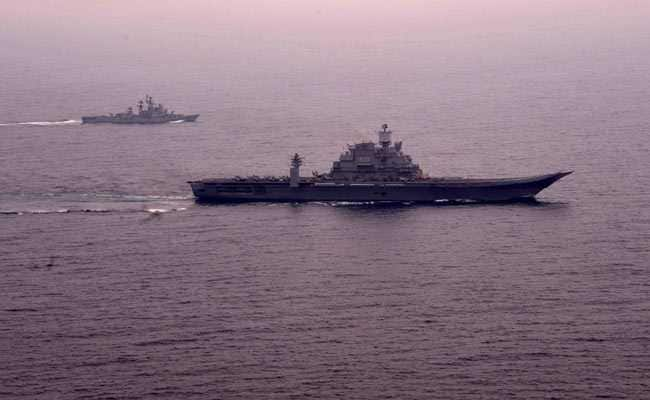
Strategic message to China-US Navy Commander on the five-day Malabar Naval Exercise on-board INS Jalashwa.


The Malabar exercise is taking place amid the ongoing military standoff between armies of India and China in the Sikkim section and Beijing ramping up its naval presence in South China Sea.

95 aircraft, 16 ships and 2 submarines from 3 countries are taking part in Malabar exercise

On-board INS Jalashwa: The three-nation Malabar Naval Exercise involving India, Japan and the United States maritime forces which began today, is setting a great example to the world, a top US official has said.

"I would like to say this is a strategic message to China. It (the message) would also be the same to Canada or to Republic of Korea or to Australia or to any other maritime force," US Navy Commander, Rear Admiral William D Byrne Jr told reporters after the inauguration of the five-day Malabar Naval Exercise on-board INS Jalashwa.

The US, Japanese and Indian maritime forces began the Malabar Naval Exercise-2017 aimed at "achieving deeper military ties between the three nations."

"Operating together and practising together is a good thing. It is because -- we are better together and we learn from each other. We know who we are and what is our capability. That is the strategic message to the entire world. I think, we are setting a great example here in Malabar (exercise) 2017", he said.

The Malabar exercise is taking place amid the ongoing military standoff between armies of India and China in the Sikkim section and Beijing ramping up its naval presence in South China Sea. Responding to a query about it, Flag Officer, Commanding-in-Chief, Eastern Naval Command, HCS Bisht said, "it has nothing to do with Malabar Exercise."

"The Process of Malabar exercise starts a year before (its scheduled beginning) and the initial planning takes place six months in advance. The stand-off you are talking about has got nothing to do with the Malabar exercise. Through this exercise we learn from each other," he said.

Flag Officer Bisht reiterated that the joint Naval exercise would focus on the "mutual learning," "sharing of best practices" and enhancing the "inter-operability" among the three countries.

To a query on the conduct of Malabar exercise vis-a-vis the situation prevailing around North Korea, US Commander Byrne said, "There are certainly global threats. Malabar is not focused on any specified threat. It is directed towards three countries India, Japan and United States. It is not directed towards any specific country or threat."

As many as 95 aircraft, 16 ships and two submarines from the three countries are taking part in the Naval exercise.

Taking part in the trilateral naval exercise in the Bay of Bengal would be US Ship Nimitz (CVN68), guided missile cruise USS Princeton (CG59), guided missile destroyers USS Howard (DDG83), USS Shoup (DDG86) and USS Kidd (DDG100), a Poseidon P-8A aircraft as well as a Los Angeles fast-attack submarine.

Besides, Japan Maritime Self Defence Force ships JS Izumo (DDH 183), JS Sazanami (DD1 13) along with Indian Naval Ship Jalashwa and INS Vikramaditya would participate in the joint Naval exercise, an official press release said.

The 21st edition of the exercise, conducted ashore and at-sea, would include professional exchanges on carrier strike group operations, maritime patrol and reconnaissance operations, surface and anti-submarine warfare.

Medical operations, damage control, explosive ordinance disposal, helicopter operations and anti-submarine warfare would also take place.

The at-sea exercise includes events such as submarine familiarisation, air defence exercises, medical evacuation drills, surface ware fare exercises, communication exercise and search and rescue operations.

Indian, Japanese and the US maritime forces have an understanding and knowledge of shared working environment at the sea.
The joint naval exercise is a demonstration of a commitment of all three nations to address common maritime challenges across the spectrum of operations and will go a long way in enhancing maritime security in the Indo-Pacific region for the benefit of the global maritime community.

This year’s Malabar exercise is notable on several fronts. First, it’s the first naval exercise between the three countries to involve carriers from each navy.

The Indian Navy has dispatched INS Vikramaditya, its modified Russian-made Kiev-class carrier that was commissioned in 2013. The United States has sent the USS Nimitzsupercarrier to the exercises. Meanwhile, the Japanese Maritime Self-Defense Force sent JS Izumo, which left Japan earlier this spring for a multiple-month-long deployment to Southeast Asia before arriving in the Indian Ocean for Malabar 2017.

The Izumo is one of two Japanese warships that are among the largest the country has operated since the end of the Second World War. Japan describes the Izumo-class vessels as “helicopter destroyers” and not aircraft carriers; the warships are not equipped to launch fighter aircraft, but could likely be retrofitted for short-take-off and vertical landing (STOVL) variants of the F-35B. The Izumo is joined at Malabar 2017 by JS Sazanami; both vessels recently joined U.S. Nimitz-class supercarrier USS Ronald Reagan for bilateral exercises in the South China Sea.

Excluding the three carriers from each nation, at least fourteen other warships and submarines from the three nations are participating in this year’s exercise. Additionally, the Indian Navy has sent P-8I maritime surveillance aircraft to this exercise, underlining the anti-submarine warfare focus this year. The United States has also sent a P-8A Poseidon aircraft to the exercise.

Notably, Australia, a former Malabar participant, is not participating in Malabar 2017, despite interest from Canberra earlier this year. India and Australia held a separate bilateral naval exercise in June and the United States and Australia just concluded the latest iteration of their major bilateral exercise, Talisman Saber 2017. Australia had joined India, the United States, Japan, and Singapore for the 2007 iteration of the Malabar exercise, drawing a sharp reaction from China, which perceived the multilateral drill that year as a threatening signal of oncoming containment of its ambitions by like-minded democracies.

Malabar 2017 consists of both ashore and at-sea activities. The activities ashore, which are being held in Chennai, “include subject matter expert and professional exchanges on carrier strike group operations, maritime patrol and reconnaissance operations, surface and anti-submarine warfare, medical operations, damage control, explosive ordnance disposal (EOD), helicopter operations, and visit, board, search and seizure (VBSS) operations,” according to a statement by the U.S. Navy.

The at-sea activities include “liaison officer professional exchanges and embarks; a photo exercise; submarine familiarization; high-value unit defense; air defense exercises; medical evacuation drills; surface warfare exercises; communications exercises; search and rescue exercises; helicopter cross-deck evolutions; underway replenishments; gunnery exercises; VBSS exercises; and anti-submarine warfare.”

The anti-submarine warfare focus of this year’s Malabar also carries subtext given the ever-increasing and regular operation of Chinese People’s Liberation Army-Navy submarines in the Indian Ocean. Since 2015, at least, Chinese Shang-class and Song-class submarines have been deployed in the Indian Ocean, raising concerns for India. China has, in the meantime, also broken ground on its first overseas naval base in Djibouti.


Sunday, 9 July 2017

When Indian Army Defeated Chinese Badly in 1967, The Heroic Story of Nathu La And Cho La

When Indian Army Defeated Chinese Badly in 1967, The Heroic Story of Nathu La And Cho La


Source-http://defencelover.in/india-china-clashes-1967-war-nathu-la/

Time and again, we have heard about the unfortunate 1962 India-China war which India lost but most of us have no clue about the Indo-Sino war in 1967.

China has used deception always to cheat India, they used the Hindi-Chini bhai bhai slogan to hit from the behind and took a lot of our land in 1962. In 1967, true to their deceptive nature, they tried again to forcefully occupy Nathu La and Cho La passes.

After the defeat of India in 1962, the Indian army size doubled by 1967. The international border was not indicated. The Indians are on the South end of Nathu La(14,200 ft) and North end of Nathu La is with the Chinese. In August, 1967, the Chinese tried to intervene in the Indian side of Nathu La by digging trenches. The Indian army was keeping a close check on the Chinese movements and it was conveyed to the Chinese commander that there was a clear indication of China advancing further.It’s chilling at Nathu La but our soldiers fought at this place to secure our land, all we can do is Salute the brave souls.

On the warning of the Indian army, China delayed and went back. Again after a month in September, the Chinese dug trenches and left some loudspeakers. The Indians build a barbed wire at Nathu La which was objected by the Chinese. The Chinese troops guarded at the border armed with weapons. Due to the barbed wire, the Chinese and Indian forces had a scuffle among themselves which led few Chinese soldiers face extreme injuries.

As the things progressed, India on his part never showed any aggression to China but China was reluctant and created war-like conditions.

The Indian jawans were laying the barbed wire to lay the right international border. It led to a fight and the Chinese commander ordered for a firing towards the Indian army. The Indian army was caught off guard as the Jawans were busy laying the barbed wire, and due to the lack of cover, they suffered huge casualties at first. After some time, the Indian and Chinese army were fighting against each other, with machine guns, MMGs, mortars and artillery. The clash and the firing lasted for three days.

When the ceasefire happened after 3 days, a lot had happened. The casualties at Chinese side as estimated by Indian authorities was 400-500 and the Indian casualties were 88. The company commander Capt. PS Dagar laid his life and was honoured with Vir Chakra posthumously.
Vir Chakra, Capt Prithvi Singh Dagar(VC)

The Chinese yet again did some fight and a clash at Cho La Pass just after a month of fight at Nathu La, they were again badly defeated and repulsed in their border by three kilometers. Chinese were taught a lesson that the Indian army was developing at a fast pace and they had gone past the days of 1962. China is again to it’s old way and trying to create a situation of a possible war in the coming future. We hope China has not forgotten 1967 in order to justify another war that they might like to fight against India.Nathu La Memorial, source – https://en.wikipedia.org/wiki/Nathu_La#/media/File:Indian_War_Memorial_at_Nathu_La.jpg

A memorial was instilled at the place where the brave soldiers of 2 Grenadiers fought bravely to protect our motherland. We salute the soldiers who sacrificed their everything so we can live safely today.

This is just not the only fight that Indian army fought against China, the story of brave soldiers of Rezang La will move you to the core. We are indebted to our soldiers and that shall remain forever. A small video dedicated to the exemplary courage 13 Kumaon depicted.

https://www.facebook.com/OfficialDefenceLover/videos/1884307501895477/