Sunday, 4 December 2016

World's Largest Solar Farm Leapfrogs India to Third in Utility-Scale Solar Power Generation

World's Largest Solar Farm Leapfrogs India to Third in Utility-Scale Solar Power Generation.

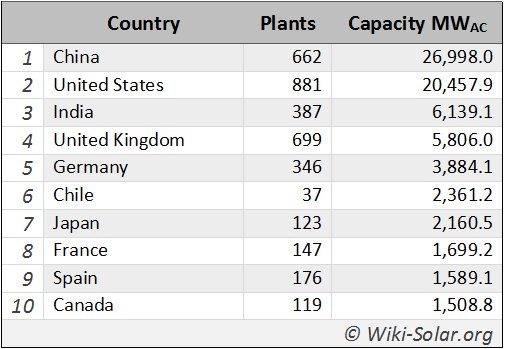
The Kamuthi solar plant in the southern Indian state of Tamil Nadu has vastly expanded the country's solar capacity. Based on Wiki-Solar's calculations, thanks to the new plant, India now claims the number three spot in terms of utility-scale solar, behind China and the U.S.

http://www.ecowatch.com/india-solar-market-2118202661.html

World's largest single location power project was commissioned by Adani Group in the town of Kamuthi in Tamil Nadu. Adani Group

The 648-megawatt Kamuthi plant went online this September and is considered the world's largest solar project in a single location. For comparison, the world's second largest solar plant, the Topaz Solar Farm in California, has a capacity of 550 megawatts.

"India has now leap-frogged the UK, as predicted, to become the world's third nation for the deployment of utility-scale solar," Wiki-Solar founder Philip Wolfe stated. "India still has a huge backlog of awarded tenders, which should enable it to close the gap with the USA and China in coming years."

As Alternative Energies writes, "over the next five years, India plans to build a number of 25 extra large solar power plants with a generation capacity between 500 and 1,000 MW."

"The success of India's solar energy policy stems in part from the [Jawaharlal Nehru National Solar Mission] national program, but also the extent to which many states are supporting this effort," Wolfe continued. "The majority of Indian states have now designated one or more 'solar parks' where priority is given both to allocation of land and to provision of high capacity connections."

This push towards clean power cannot come soon enough. Earlier this month, the air pollution in the nation's capital of New Delhi was literally off the charts, earning it the dubious title of "world's most polluted city." Delhi Chief Minister Arvind Kejriwal declared the intense smog levels an "emergency situation," and ordered the shut down of 5,000 schools and halted construction operations for several days.

With the new plant in Kamuthi, India's total installed solar capacity has now crossed the important 10 gigawatt milestone, according to consultancy firm Bridge to India.

"The pace of sector activity has picked up tremendously in the last two years because of strong government support and increasing price competitiveness of solar power. India is expected to become the world's third biggest solar market from next year onwards after China and the US," Bridge to India stated.
 

In 2014, Indian Prime Minister Narendra Modi announced plans to increase India's solar power capacity to 100 gigawatts by 2022, a target that seems too ambitious for some.

"Many people are going to ask the obvious question—if we have taken more than 5 years to achieve 10 GW, can we reach 100 GW in another 5 years? It is a very steep target in our view," Bridge to India managing director Vinay Rustagi said. "But rather than quibble about the target, the important point is to acknowledge the transformational economic, environmental and social potential of solar technology and to create a conducive environment for its growth."

Aljazeera has published new footage of the Kamuthi facility that's spread across 10 square kilometers—or the equivalent of 60 Taj Mahals. The plant consists of 25,00,000 solar modules and can supply enough energy for 150,000 homes.


The operator, Adani Green Energy Ltd, built the impressive structure in only eight months thanks to the around-the-clock dedication of a 8,500-member team. Roughly 11 megawatts were installed in a day on average.

In September, Adani Group chairman Gautam Adani formally dedicated the solar structure to the nation.

"This is a momentous occasion for the state of Tamil Nadu as well as the entire country," he said. "We are extremely happy to dedicate this plant to the nation; a plant of this magnitude reinstates the country's ambitions of becoming one of the leading green energy producers in the world."

http://www.ecowatch.com/india-solar-market-2118202661.html

Income Disclosure Scheme bags Rs.67,382 cr unaccounted money

Income Disclosure Scheme bags Rs. 67,382 cr unaccounted money
The government on Sunday revised upwards the amount of black money disclosed under Income Declaration Scheme (IDS) to Rs 67,382 crore, even as it did not take into account two high-value disclosures.
By: IANS | New Delhi | Published: December 4, 2016 8:00 PM
http://www.financialexpress.com/economy/income-disclosure-scheme-bags-rs-67382-cr-unaccounted-money/463846/

The Income Tax Department did not take into consideration the Rs 13,860 crore declaration made by Ahemdabad-based Maheshkumar Champaklal Shah, which was reported prominently, as well as another made from Mumbai. (PTI Image)

The government on Sunday revised upwards the amount of black money disclosed under Income Declaration Scheme (IDS) to Rs 67,382 crore, even as it did not take into account two high-value disclosures.

“After final reconciliation, the revised figure of actual declarations received and taken on record was Rs 67,382 crore which had been made by 71,726 declarants,” the Finance Ministry said in a statement here on IDS 2016.

“On Oct 1, 2016, it was announced that declarations totalling Rs 65,250 crore were received from 64,275 declarants, subject to reconciliation,” it said.

The Income Tax Department did not take into consideration the Rs 13,860 crore declaration made by Ahemdabad-based Maheshkumar Champaklal Shah, which was reported prominently, as well as another made from Mumbai.

“Among the declarations received, there were two sets of declarations of high value which were not taken on record in the above figure because they were found to be suspicious in nature being filed by persons of small means,” the statement said.

It said a family of four headed by Abdul Razzaque Mohammed Sayed, resident of Bandra, Mumbai, made a total declaration of Rs 2 lakh crore which was rejected by the Department as three out of the four PAN numbers were originally in Ajmer which were migrated in September 2016 to Mumbai, the place of the declarations.

“After due enquiry it was found that these declarants were persons of suspicious nature and very small means, and the declarations could have been misused,” the ministry said.

“Therefore, after due consideration, the Income Tax Department decided by November 30, to reject these two sets of declarations of Rs 2 lakh crore and Rs 13,860 crore respectively. The Department has commenced enquiries against these declarants to determine the intention behind these false declarations,” it added.

Saturday, 3 December 2016

Rs.152 crore unaccounted income-seized in Karnataka so far, update


http://www.thehindu.com/news/cities/bangalore/Rs.-152-cr.-unearthed-in-3-days-two-Karnataka-officials-suspended/article16754145.ece

Anti-Corruption Bureau will seek details from Income Tax Department on the disproportionate assets found in the possession of the two PWD chief engineers.
A whopping Rs. 152 crore unaccounted income, including a huge stash of new notes, bullion, jewellery, and documents pertaining to property ownership, have been seized on the premises of two chief engineers of the PWD and contractors, by the I-T officials over the last three days.

Home Minister G. Parameshwara announced, on the Floor of the Council, suspension of the two chief engineers S.C. Jayachandra, Chief Project Officer of the State Highway Development Project, and T.N. Chikkarayappa, Managing Director of Cauvery Neeravari Nigam Ltd. 


Prime Minister Narendra Modi called I-T sleuths in Bengaluru and congratulated them for the successful seizure operation.
 

Searches concluded on Friday night. Searches started in Bengaluru, and Erode and Chennai in Tamil Nadu on Wednesday and concluded on Friday night. A total of 18 locations in Bengaluru are under the I-T scanner. “The unaccounted income is expected to go up further. We will get a rough estimate on the extent of income and properties by Monday,” sources said.


ACB to seek details of disproportionate assets

The Anti-Corruption Bureau (ACB) will seek details from Income Tax Department on the disproportionate assets found in the possession of Public Works Department chief engineers S.C. Jayachandra and T.N. Chikkarayappa.

ACB Inspector General of Police M.A. Saleem told The Hindu that they are keen to pursue cases against the two officials on the basis of information about unaccounted income coming from I-Tax department since the money recovered from their premises could be more than their known sources of income.

Incidentally, Mr. Jayachandra had run into trouble when Lokayukta sleuths had searched his premises in 2008 on the charge of disproportionate income. The government is yet to give permission for prosecution.
Gold and cash seizures go up

Meanwhile, the search of premises of the two officials, contractor Ramalingam, Sibi Chakravarthy of Kannan Borewells and banker Umashankar continued for the third day on Friday. The amount of unaccounted cash and gold has gone up. The I-T search, which officials say was in the offing for some time, comes when the State government has finalised tenders for execution of road works worth about Rs. 3,500 crore under the State Highway Development Project (SHDP).

Of the over Rs. 6 crore currency seized, the department said that nearly Rs. 5.7 crore was in new Rs. 2,000 currency. About Rs. 90 lakh is in the demonetised Rs. 500 and Rs. 1,000 currency. Sleuths have seized about seven kilos of bullion, suspected to have been purchased after demonetisation of Rs. 500 and Rs. 1,000 currency, nearly nine kilos of gold jewellery – together worth about Rs. 5 crore, an I-T department note said. Several high-end cars too have been seized.
 

Cash seized
In two separate incidents, new Rs. 2,000 notes, being carried without documents, were seized. Three persons were caught with Rs. 71 lakh in Bailoor village, while three others were caught in Chikkamagaluru with Rs. 46 lakh.
 

New notes seized in Chikkamagaluru
Meanwhile, Chikkamagaluru Police on Friday seized Rs. 46 lakh in currency notes of Rs.2,000 denomination from two people in Jayanagar town. The police have taken the duo Kiran and Kumar into custody.

The duo were transporting the cash in a car. They had no explanation for the cash. The police have seized the car. It is said that the car belongs to a businessman in Hassan - Staff Reporter
 

Mangaluru I-T officials seize Rs. 71 lakh in new currency
Three persons were caught carrying new Rs. 2,000 notes amounting to Rs. 71 lakh at Bailoor village near Karkala on Thursday evening. The police handed them over to Income Tax officials in Mangaluru.

Karkala Circle Inspector Joy Anthony told The Hindu on Friday that the police were checking vehicles at Bailoor on Thursday evening. Around 7 p.m., they stopped a car going from Mangaluru towards Kudremukh. Inside, they found currency of Rs. 2,000 denomination totalling Rs. 71 lakh in a plastic bag. The occupants of the car — Imran Hussain, Asif Umar and Deepak Shetty — failed to give a proper explanation for the huge amount of cash. All three are from Mangaluru and are aged between 35 and 40 years.

The police did the ‘panchanama’ but did not register a case, Mr. Anthony said.Sources in the Income Tax Department said that the youth were part of a money exchange network that has been operating in the coastal towns since November 8. The network operated in two layers, the official explained, adding that while the big operator took a 25 per cent cut from those wishing to convert their demonetised currency to new ones, he would sub-contract the work of getting legal currency to his associates. “The big operators pay Rs. 2,000 for every Rs. 24,000 being withdrawn in legal tender,” the official said.

http://www.thehindu.com/news/cities/bangalore/Rs.-152-cr.-unearthed-in-3-days-two-Karnataka-officials-suspended/article16754145.ece

Corruption will not go on its own and has to be wiped out-PM Modi

Working on plan to jail those who illegally deposited black money in Jan Dhan accounts: Corruption will not go on its own and has to be wiped out-PM Modi Modi said

Prime Minister Narendra Modi said he is working on a formula on how to send the corrupt to jail who deposited their money in Jan Dhan accounts of poor after demonetization and ensure this money goes to the poor households. 


Responding to criticism over long queues outside banks and ATMS since the note ban decision on November 8, he accused his rivals of trying to "spread disinformation and despair" and said "this will be the last queue for the people who have been standing in line for the last 70 years for their daily needs".

"All those who are Jan Dhan account holders, you should not return the money that others have put in your accounts. If you promise to do so, I am working hard on to devise a formula to send all those who deposited their money illegally into your accounts to jail and to ensure the money goes to the poor households," Modi said addressing a public rally here. He said the corrupt rich are not doing any favour, as they have looted this money from the poor in all these years.

"I salute the people of the country for standing for long hours in queues. "I want to ask those politicians who are crying over these long queues. "You kept the entire nation in queues for 70 years after independence, as one had to stand in lines for even sugar, kerosene and wheat in the past. This is the last queue to end all those queues," he said to applause from the crowds.

The PM said only the honest can queue up outside the banks to deposit the money, while the corrupt are standing outside the houses of poor. Modi said he was being hounded by his rivals as "culprit" on the note ban issue and pledged that this fight against the corrupt and corruption shall not stop "come what may".

"I am being hounded as if I have committed some crime by waging a battle against graft. But, what can my opponents do to me? I am a fakir (hermit)...jhola ley kar chaley jayenge (I will exit with my little belongings)," he said.

Modi was addressing BJP's Parivartan Yatra to mobilise public support ahead of the upcoming Assembly elections in Uttar Pradesh.

Tearing into the opposition, he said, "Some call me a culprit.... Is it a crime to fight corruption which is at the root cause of all ills prevailing in the country for the past 70 years?"

Without naming any party, Modi made a subtle reference to Congress when he said that the 1.25 crore people were his leaders and he had no high command.

"You are my leader...I have no high command," he said. His attack against the opposition came in the backdrop of their protests inside and outside Parliament on noteban, where the Winter Session has so far been almost washed out with the uproar eclipsing the proceedings every day. Talking tough, Modi said corruption will not go on its own and has to be wiped out.

Wednesday, 23 November 2016

Nikki Haley-Daughter of Indian Immigrants named by Trump as ambassador to the United Nations

Nikki Haley’s Path: From Daughter of Indian Immigrants to Trump’s Pick for U.N.
By RICHARD FAUSSET and SOMINI SENGUPTANOV. 23, 2016 http://www.nytimes.com/2016/11/23/us/nikki-haley-donald-trump-un-ambassador.html?_r=0

Gov. Nikki R. Haley with journalists at Emanuel African Methodist Episcopal Church in Charleston, S.C., in June 2015, after nine African-Americans were killed at the church. Credit Travis Dove for The New York Times

ATLANTA — Gov. Nikki R. Haley of South Carolina is the daughter of immigrants, favors free markets and global trade, and earned international attention for speaking out against the Confederate battle flag in the aftermath of the 2015 massacre at a black church in Charleston. During Donald J. Trump’s presidential campaign, she sharply criticized his demeanor and warned what it might mean for American diplomacy — even suggesting that his tendency to lash out at critics could cause a world war.

But on Wednesday, Mr. Trump named Ms. Haley as his choice for ambassador to the United Nations, a move that will probably serve to both assuage and confound the president-elect’s critics, raising questions about the tone and direction of his foreign policy. As an Indian-American woman, she would also add ethnic and gender diversity to the appointments, so far predominantly of white men, he has made to other top posts in the administration.

In a statement, Ms. Haley said she had accepted Mr. Trump’s offer because she felt good about South Carolina’s economic standing. She added that this month’s elections had brought “exciting changes to America.”

“When the president believes you have a major contribution to make to the welfare of our nation, and to our nation’s standing in the world, that is a calling that is important to heed,” the statement said. Little is known about how Ms. Haley views America’s role in the world. But an equally important mystery is what her clout might be in the Trump administration. Photo
Ms. Haley signing a bill in July 2015 to remove the Confederate battle flag from the grounds of the South Carolina State House in Columbia. Credit Stephen B. Morton for The New York Times

Has Mr. Trump placed her in a post he considers marginal? Or will Ms. Haley — along with a still-to-be-named secretary of state — be able to temper the more radical views of Mr. Trump’s other aides?

Despite the unknowns, many diplomats, scholars and rights advocates who have been anxiously awaiting Mr. Trump’s choices were relieved at the announcement. They saw in Ms. Haley, a daughter of Indian immigrants, someone unafraid to express her beliefs even if they differ from Mr. Trump’s.

“If confirmed, we hope she will raise that voice on behalf of the world’s most vulnerable people who suffer from hunger, violence and injustice around the world,” the advocacy group Oxfam said in a statement.

Many diplomats said they saw Ms. Haley as something of an enigma, whose views on the world have not yet been publicized.

But her stance is public on a few issues — including the Israeli-Palestinian conflict, refugees, and reproductive rights — and they offer a window into how she may carry out her role.

She signed state legislation to thwart a pro-Palestinian disinvestment campaign against Israel, known as Boycott, Divest, and Sanction, or B.D.S. — which made Israel one of the first to welcome her nomination for the post. Photo
Ms. Haley in January 2015 being sworn into her second term as governor by Chief Justice Jean H. Toal, while her husband, Michael, center, and their son, Naline, watched. Credit Richard Shiro/Associated Press

Ms. Haley has expressed concern about the security checks in place for Syrian refugees resettled in her state, but she is not among those Republican governors who have sued the Obama administration to block resettlement.

She describes herself as “pro-life” and has supported legislation in her state to restrict abortion rights. That position raises questions about whether the United States would reimpose a funding ban on groups that promote family planning overseas, and to what extent the United States would undermine a key United Nations goal to advance sexual and reproductive rights.

The reaction from Republicans in South Carolina’s congressional delegation on Wednesday demonstrated the broad appeal Ms. Haley has earned among conservatives statewide and in Washington. Senator Lindsey Graham, one of Mr. Trump’s harshest critics in the past, praised the nomination, writing on Twitter that Ms. Haley would be a “strong voice for UN reform and stand for American interests throughout the world.”

But others tempered their admiration for Ms. Haley with concern about whether her public service credentials, which are limited to South Carolina government, would translate to the world stage.

“My very practical reaction is that she’d be the least experienced U.N. ambassador in the history of the country,” said Bakari Sellers, a CNN commentator and a Democrat who befriended Ms. Haley when they served together in the State House of Representatives. “You go from Samantha Power” — the current United Nations ambassador — “who was very well versed in foreign policy and our geopolitical relationships, to Nikki Haley, who hasn’t been in that depth ever.”

Ms. Haley’s admirers note that she repeatedly traveled abroad as governor to promote the state as a desirable place for investment. Her highest-profile trip, perhaps, was a 2014 visit to India, the birthplace of her parents. Her husband, Michael, has served in Afghanistan as an officer in the South Carolina National Guard. Photo
Ms. Haley embracing her husband, Capt. Michael Haley, in 2013 after he returned from serving in Afghanistan with the South Carolina National Guard. Credit Rainier Ehrhardt/Associated Press

More generally, Ms. Haley has overcome concerns that she would be a one-dimensional insurgent outsider, similar to worries that dog Mr. Trump. Her 2010 campaign was given a major lift by an endorsement from former Gov. Sarah Palin of Alaska, the polarizing darling of the Tea Party movement. But Ms. Haley has forged a middle path that embraces the conciliatory racial attitudes favored by the left and the business-friendly ethos of the right.

This balancing act faced perhaps its greatest test in June 2015, after nine African-Americans were shot and killed at the historically black Emanuel African Methodist Episcopal Church in Charleston. The white supremacist charged in the massacre, Dylann S. Roof, had posed with the Confederate battle flag in pictures. And for years, blacks and liberals in South Carolina had pleaded with the conservatives who dominate the state government to take the flag down from a prominent spot it occupied in front of the State Capitol.

Ms. Haley, the first ethnic minority and first woman to be elected as the state’s governor, had previously sided with fellow Republicans, who argued that the flag was not a racist symbol.

But the Charleston massacre hit home personally. She had been a friend of State Senator Clementa C. Pinckney, a Democrat and pastor of the church, who was one of the dead. Ms. Haley had a change of heart.

“I couldn’t look my son or daughter in the face and justify that flag flying anymore,” Ms. Haley told The New York Times in June 2015.

At her urging, and after much passionate debate, the State Legislature agreed to remove the flag.

Ms. Haley was born in the small city of Bamberg, S.C., to immigrants from Punjab State in India. She has said the locals in South Carolina were often unsure of her place in what is often a Southern binary of black versus white. When Ms. Haley was about 5, she and her sister entered a Little Miss Bamberg pageant where, traditionally, a black queen and a white queen were crowned. Photo
Mitt Romney, the Republican presidential candidate, with Ms. Haley during a town hall meeting in 2011 in Greenville, S.C. Credit John Adkisson for The New York Times

The judges decided the sisters fit neither category, so they were disqualified.

From a young age, Ms. Haley worked for her family’s clothing business, and she eventually received an accounting degree from Clemson University. She was elected to the State House in 2004.

In 2009, she declared she was running for governor and prevailed despite lingering biases. A Republican state senator at the time called her a “raghead” on a radio show. A Democratic state representative said that voters did not consider her a minority, but more of a “nice conservative with a tan.”

Ms. Haley, a nimble campaigner who is equally at home among C.E.O.s and denim-clad bikers, easily won re-election in 2014, arguing that her maintenance of South Carolina’s anti-union, low-regulation atmosphere had been the key to an economic comeback. Under her leadership, the state continued looking beyond its boundaries, very often abroad, to attract new industries to replace a fading textile industry.

It is a record that might seem at odds with Mr. Trump’s skepticism of global trade deals and his promise to subject imports from Mexico and China to steep tariffs.

But there are other areas of agreement. In 2014, Ms. Haley criticized federal plans that would force power plants to cut carbon emissions.

Also like Mr. Trump, Ms. Haley has weathered accusations of sexual impropriety without suffering at the polls. In her first run for governor, two Republican operatives made separate and unproven accusations that they had sexual encounters with her. She strongly denied the assertions.

A few years later, Ms. Haley was among those rumored as a potential running mate for Mitt Romney, then a Republican presidential candidate.

She said she could not do it because there was too much to be done at home in South Carolina. But she acknowledged that opportunities sometimes arose. “I’ve never been a planner,” she said. “I don’t know what’s next, and I love not thinking about it because the doors open at a certain time.”

Monday, 21 November 2016

India today became an associate member of the European Organisation for Nuclear Research (CERN), the world’s largest nuclear and particle physics labaratory.


India today became an associate member of the European Organisation for Nuclear Research (CERN), the world’s largest nuclear and particle physics labaratory.

The agreement was signed today by Sekhar Basu, Chairman of Atomic Energy Commission and Secretary of Department of Atomic Energy (DAE), and CERN Director General Dr Fabiola Gianotti at the DAE’s office here.

Last year, the Union Cabinet green-lit the proposal for India officially entering the Geneva-based body, following which the CERN Council accepted India as an associate member.

India had ‘observer’ status till September this year, when the CERN Council adopted a resolution upgrading its position.

“There are three major activities going on in our laboratory– accelerators, detectors and computing. Indian scientist fraternity is good at all the three areas; hence we have taken decision to upgrade the status,” Gianotti told reporters here.

Becoming associate member of CERN will enhance participation of young scientists and engineers in various CERN projects. (AGENCIES)